The University has launched a legal challenge to the Trump administration’s ending of the Deferred Action for Childhood Arrivals (DACA) program. The U. filed the joint complaint on Nov. 3 in federal court in Washington, D.C., alongside Maria De La Cruz Perales Sanchez '18 and Microsoft.
Lewinksy has been an outspoken advocate against cyberbullying and she discussed her experiences with it in at the Forbes 30 Under 30 summit in October 2014. Since then, she has delivered a TED talk advocating for a compassionate internet culture and written the introduction to a recent book about cyberbullying.
“Don’t you hate it when you’re reading a book and you get the impression that the writer is sitting there with a keyboard and a thesaurus?” Grisham asked.
During the summer, members of the Class of 2021 filled out orientation surveys designed to place them in one of three programs: Outdoor Action, Community Action, or Dialogue and Difference in Action. Some incoming students answered the survey questions in a way that would allow them to match with the program of their choice, thereby playing the system.
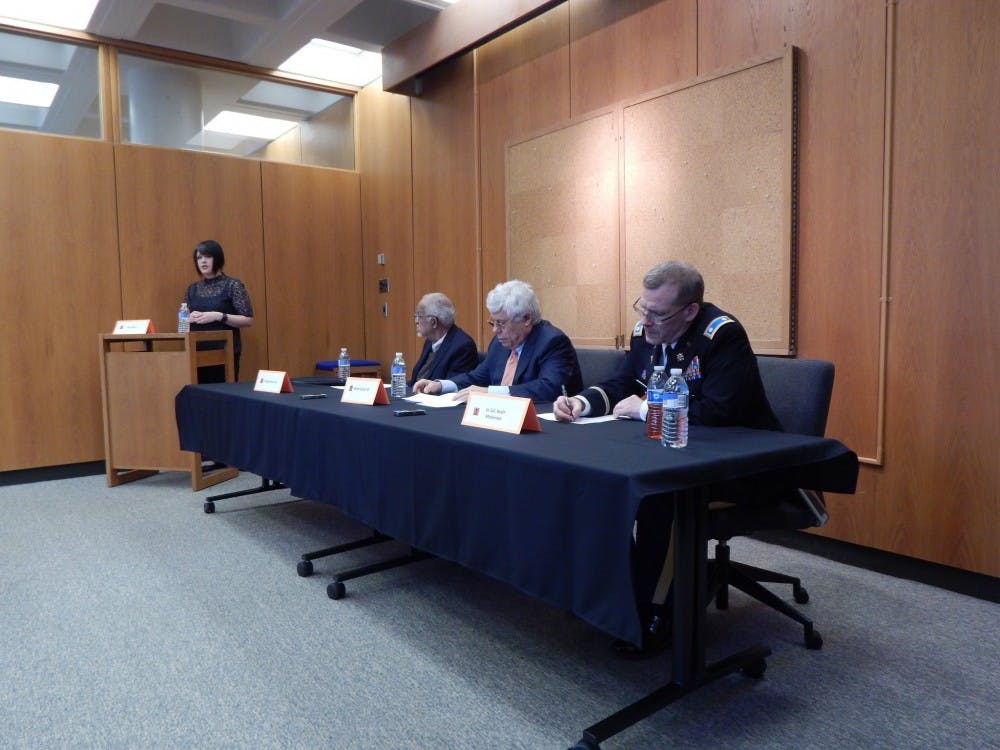
Pulitzer Prize-winning Ferris Professor of Journalism John McPhee ’53 answered questions relating to his extensive career as a writer of creative nonfiction and discussed his most recent book, “Draft No. 4: On the Writing Process.” He was accompanied by Robert Wright ’79 and Joel Achenbach ’82, two accomplished writers in their own rights, at a book discussion on Tuesday evening at Labyrinth Books.
Every campus has the opportunity to bring people together across lines of difference, said Beverly Daniel Tatum in a discussion on the latest edition of her book “‘Why are All the Black Kids Sitting Together in the Cafeteria?’ And Other Conversations About Race.”
Beginning in the 2018–19 academic year, comparative literature professor Sandra Bermann will lead a Sawyer Seminar called Global Migration: The Humanities and Social Sciences in Dialogue. Bermann plans to bring in faculty from multiple disciplines, including history, sociology, comparative literature, and politics.
Rarely can students find a place to share what is weighing on their minds without worrying about the consequences of what they are disclosing. Princeton Peer Nightline, a peer-run, confidential and anonymous call and chat service run by volunteers, offers just that. Open on Tuesday and Friday nights, the network offers an empathetic ear for issues with which students are struggling.
The Undergraduate Student Government discussed upcoming plans for a “restaurant week all year,” diversity on the Honor Committee, and confirmed new members, along with other issues in its weekly meeting Oct. 22.
Francois Héran, an anthropologist, sociologist, and demographer, was unable to obtain his visa in time to visit the United States for a conference at the University last Friday. Héran suspects that the reason is a past visit to Tehran, Iran, for another demographic conference last year.
This year, Campus Dining no longer wants napkins to be thrown in compost bins. Napkins interfere with its efforts to accurately measure food waste in the residential dining halls. Apart from separating the disposal of napkins from organic food matter, nothing else about waste disposal has changed, said Smitha Haneef, assistant vice president of Campus Dining.
After two female graduate students in the tiny German department left abruptly last year — leaving men to outnumber women two to one — student pressure forced administrators to organize a town hall. A third female graduate student was gone by the end of the year. They said the department’s treatment of women had affected their work and research and was a key factor in their departure. The University’s Title IX office opened an investigation into a German professor this summer.