



With the permanent end of Wintersession, Winter Break could be shortened starting in 2028 — and e-bikes could be next to go.
At the last Council of Princeton University (CPUC) meeting of the semester, the University proposed changes to the academic calendar, shortening Winter Break by a week, and weighed banning e-bikes in line with its current Personal Electric Vehicle (PEV) policy.
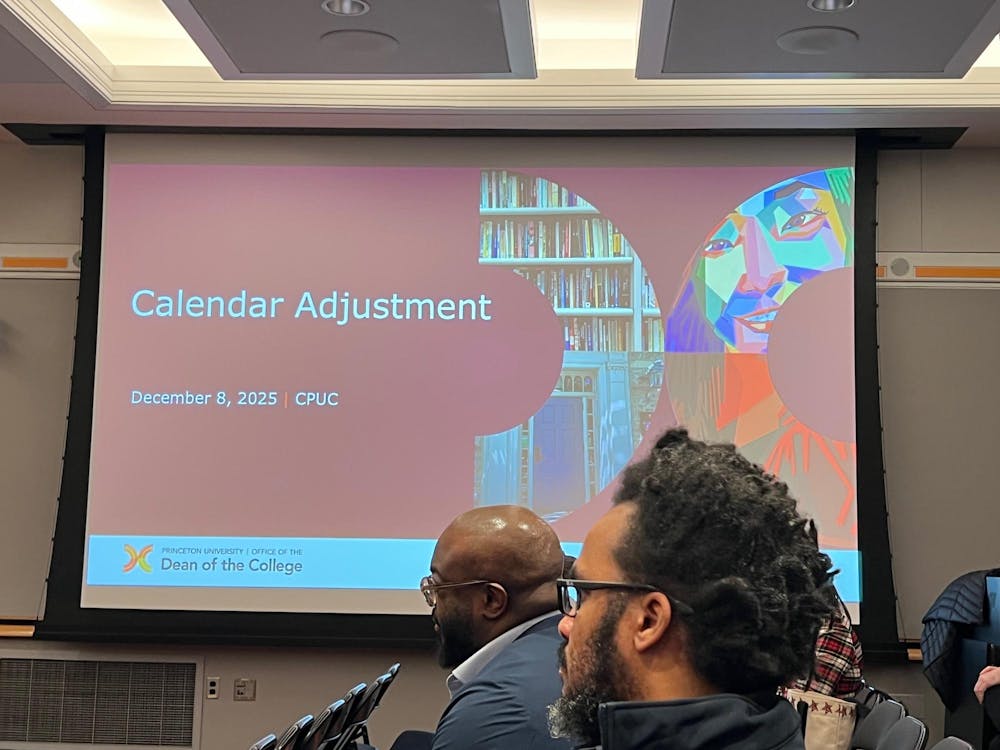
Dean of the College Michael Gordin presented a proposal to the academic calendar that would start the spring semester six days earlier, the day after Martin Luther King Jr. Day (the third Monday of January), effectively shortening Winter Break and ending the semester earlier. These changes would address the five-week gap in learning created by the cancelation of Wintersession, which had been announced in August as a constraint of budget cuts.
“Wintersession is canceled,” Gordin said at the meeting. “It is not going to continue.”
If approved, these changes will first take place in the 2027–2028 academic year, with the 2028 Spring semester proposed to start on Jan. 18, 2028. The Faculty Committee on Classrooms and Schedule, according to Gordin, has found that the current five-week winter break causes “learning loss” and “delayed on-campus research access.” The earlier return to campus will facilitate a healthier mental return to campus, increased engagement with faculty, and a decrease in potential learning loss, it argued.
Looking to the end of the spring semester, Gordin expressed that the new academic calendar would resolve the “persistent conflict” between the spring final exam schedule and the NCAA championships — a conflict which often requires the rescheduling of multiple exams, “which is disruptive to the students, the faculty, and especially the Registrar.”
Additionally, it would allow Princeton students to start their summer internships earlier and would reduce the work that staff and faculty do during Memorial Day weekend, which contains Class Day Hooding and Commencement.
However, faculty raised concerns regarding grading and preparation for spring classes over a shortened winter break.

Barbara Nagel, an associate professor of German, said that she uses the long winter break to prepare for her spring courses — a concern she called “more of a plea than a question.”
“As faculty, I look at this and think, ‘Oh my god, I don’t need another week in the summer, but it’s wonderful to have these weeks … precisely to prepare classes.’ And when I arrived here 11 years ago, it was much easier to prepare for classes,” Nagel said.
Gordin responded by acknowledging that he has received similar complaints and will take these concerns regarding scheduling into consideration. “It’s an issue of six days being moved, which I understand does pinch six days off the schedule. I’ve [also] heard from many other faculty that the six days of added research time in the summer would be most welcome,” Gordin said.
The Committee will remain in discussions to formalize the language for the proposed change through February. The faculty will then vote on the changes in meetings in March and April, “with a proviso of a year delay to work on implementation,” Gordin said.
The meeting also included a proposal to extend the PEV policy to include e-bikes. Personal electric vehicles (PEVs) were initially banned on campus in January 2024. Almost two years later, the Environmental Safety and Risk Management (ESRM) committee has announced that the policy may be updated in the coming year.
The committee has concerns about the increasing number of manual e-bikes that operate primarily using a throttle, Director of Campus Safety and Health Kelly States said.

“They’ve gotten much, much larger, they’ve gotten faster, they are heavier, they are more powerful,” States said.
“Pedestrians being struck by bicycles and killed by bicycles was nearly unheard of from a manual bike perspective versus an e-bike perspective,” she added, noting that ESRM has been tracking e-bike injuries on campus in cooperation with UHS.
“We believe those numbers to be vastly underreported,” she said. “Our numbers don’t capture the near misses.”
“I don’t want to paint this as an administration versus student issue,” States added, noting that informal student polling has indicated that the student body is “split” on the issue. “We’re hearing from students. We’re hearing from staff, faculty, visitors, parents, contractors, with a lot of concerns about how e-bikes are affecting the pedestrian experience on campus.”
The major increases in the use and size of the e-bikes render them out of line with the 2019 campus mobility framework, States said. The framework aims for “Motorized vehicles [to be] mostly behind the scenes to limit their impact on the campus experience.”
“This is not just a Princeton issue,” she said. “This is an issue that municipalities and schools are struggling with across the country.”
Director of Transportation and Parking Services Kevin Creegan highlighted some recent infrastructure changes for manual bikes on campus, including the new cycle lanes on Washington Road and “ad hoc bike storage locations” across campus.
States said that the ESRM committee will be releasing a feedback form to take input through January 2026. The committee is expected to meet again in February.
“If anybody is considering bringing a bike to campus after the break, or is considering a purchase, make sure that you’re making a plan if this decision goes through [so] that you’d be able to get it off campus as well,” States said.
University Architect Ron McCoy GS ’80 concluded the meeting by highlighting the new Environmental Science and School of Engineering and Applied Sciences complex. Briger Hall and Commons opened for classes at the start of this semester, and Commons Library opened in November.
McCoy announced that engineering departments are moving into the complex soon.
“Bio-E is moving into this building this month. [Chemical and Biological Engineering] will be moving in next month,” McCoy said.
The next CPUC meeting will be held after Winter Break on Feb. 9, 2026.
Luke Grippo is an assistant News editor for the ‘Prince.’ He is from South Jersey, and typically covers University and town politics, on a national, regional, and local scale. He can be reached at lg5452[at]princeton.edu.
Leela Hensler is a staff News writer and a staff Sports writer for the ‘Prince.’ She is from Berkeley, Calif. and can be reached at leela[at]princeton.edu.
Please send any corrections to corrections[at]dailyprincetonian.com.
Correction: A previous version of this article suggested that the proposed changes to the academic calendar would end Wintersession. In actuality, the cancelation of Wintersession, as previously stated, is solely due to budget cuts and has led to the proposed calendar. The article has been updated to reflect this. The 'Prince' regrets this error.
Read More

Thieves steal $250,000 in designer bags from Princeton luxury boutique in overnight break-in
Elizabeth HuFour masked people broke into a luxury boutique store in Princeton on Sept. 1, stealing over $250,000 worth of handbags.
Four masked people broke into a luxury boutique store in Princeton on Sept. 1, stealing over $250,000 worth of handbags.

Princeton students ‘Blossom Together’: A student club takes on global humanitarian efforts
Elma CesicThis past winter break, students from Blossom Together travelled to Benin, having raised around $17,000 for food packages, water wells, and cataract surgeries.
This past winter break, students from Blossom Together travelled to Benin, having raised around $17,000 for food packages, water wells, and cataract surgeries.
New Commons Cafe opens following cafe closures in previous years
Hifza KaleemFollowing multiple cafe closures across campus in the last two years, a new cafe opened in the SEAS Complex.
Following multiple cafe closures across campus in the last two years, a new cafe opened in the SEAS Complex.