



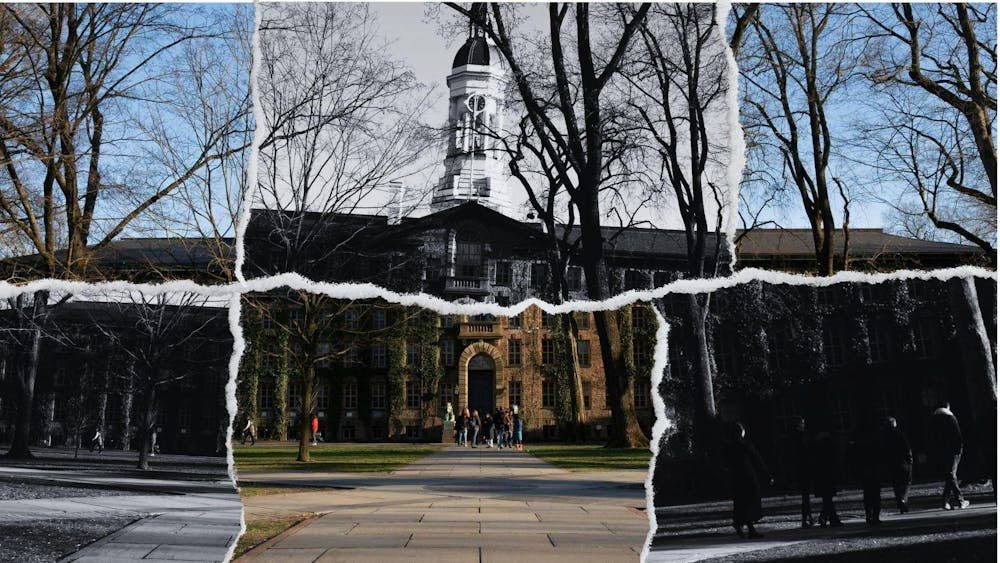
Sitting among 1,264 other undergraduates in Princeton Stadium, Rebecca Berman ’23 did not feel the triumph that usually comes with graduation. Instead, she felt demoralized for most of the ceremony. Over several days of commencement events, Berman recalled that the only students publicly singled out in front of the graduating class were those receiving major prizes.
“You only felt the recognition, or got to feel proud if you got the big awards that you were called out for in front of everyone … the rest of us felt not great about what we’d accomplished,” Berman said, although she generally reflected on her years at Princeton with immense gratitude and fondness.
“That’s the most Princeton thing: graduating is still not enough,” she continued. “Even when we’re graduating, we’re competing for recognition, competing for that validation that all of us want.”
At a university defined by excellence, success is visible and publicly affirmed; failure, by contrast, is rarely part of Princeton’s public vocabulary. Across several dozen interviews with The Daily Princetonian, many past and current students largely defined “failure” at Princeton in similar terms: the inability to optimize one’s time or to extract maximum value from four finite years.
Faced with often overwhelming pressure to “make the most” of vast resources, many students attempt to optimize their lives, strategically selecting classes, internships, and extracurricular commitments. While most students appreciate the opportunities offered by the University, many noted the difficulties of social comparison, seeking help, and engaging in critical self-reflection in such an intense environment.
“Now that I’ve graduated, I really loved so much of the things that I did end up being involved in at Princeton,” Berman said. “But it was hard to breathe sometimes, through all of the possibilities.”
‘A real optimization of childhood’
A restless pursuit for something more has been embedded in American culture since the nation’s inception, said Brigid Schulte, the author of “Over Work,” in an interview with the ‘Prince.’

“It’s this idea for self-improvement, this idea of social mobility: that you can always improve yourself,” Schulte explained.
Beginning in the 1980s, that cultural instinct collided with structural economic change as globalization reshaped the economy and blue-collar manufacturing jobs declined sharply, hollowing out what had once been stable middle-class pathways. During this time, parents dramatically increased their children’s structured activities outside of school. Beneath decisions about test prep, early enrichment programs, and sports leagues, Kimberley Lear, a researcher focusing on the future of work, pointed to “an underlying economic anxiety” that continues to shape childhood and led to a cultural impulse to optimize.
Last year, studies showed that less than a third of 2025 college graduates in the U.S. secured a full-time job in their field. At the same time, recent graduates have expressed anxiety about AI’s impact on the job market.
Anna Nguyen ’29 came to Princeton after graduating from a prep school, where juggling a multitude of commitments felt like a way of life.
“But, I feel like there are some things that I feel nobody really expects at Princeton: how hard the academics are, and how you have to manage time, and [how] people around you are going to do so many different things that you can’t really all get involved in,” she said. “You’re in such a competitive environment [that] what you really care about is the outcome,” Nguyen added, speaking to a culture of competition around grades and internships at Princeton.
“There are a lot of parents who feel like good jobs are getting better and bad jobs are getting worse, and middle jobs are disappearing,” Lear said. Parents, faced with that bifurcation, entered what Lear described as an “arms race — a mad scramble to get their kids on the right side of this economic schism.”

“Childhood is optimized, adolescence is optimized, so then there’s no surprise that college becomes optimized,” Lear said.
‘Am I making the most of the institution?’
Students are fluent in being busy by the time they arrive at Princeton. According to the annual frosh survey conducted by the ‘Prince,’ the percentage of students reporting 10–24 hours of weekly study time in high school has increased slightly since 2020, averaging at nearly 50 percent each year. Roughly seven in 10 members of the Class of 2029 held jobs during high school, a rate more than triple the national average for college students.
At Princeton, this impulse to optimize intersects with an abundance of opportunities: this semester, there are more than 500 student organizations, and a steady stream of guest lectures, performances, and travel opportunities.
What begins as a genuine desire to take full advantage of Princeton’s resources can result in being stretched thin across more commitments than students can comfortably hold.
“If you’re trying to do 100 percent of everything, it might end up being more like 80 or 90 percent,” Samuel Kleiner ’25, who was a varsity rower, said.
“I tried to do many things freshman, sophomore year, and did rather poorly [during] freshman semester,” Kleiner added. After asking for help from teammates and getting accustomed to Princeton’s academic workload, Kleiner ended up receiving a “Most Improved” award from the electrical and computer engineering department.
Undergraduate Student Government (USG) Mental Health Chair Aakansh Yerpude ’27 added, “[Students] want to really immerse themselves in the content of the course, but it’s so hard when they have 10,000 other responsibilities that aren’t just academics.”
Students also pointed to the University’s rigorous academic curriculum as a source of stress. Princeton’s grading system appears less inflationary than some of its peer institutions, though the percentage of A-range grades soared almost 10 percentage points during the pandemic and has generally increased over the past 20 years. 66 percent of graduating seniors in the University’s class of 2025 reported a cumulative GPA of 3.7 or higher, compared to 56.3 percent in the graduating class of 2022.
“This place really does push you. It made me restructure a lot of my habits,” Athena Apaga ’26 said, reflecting on her challenges getting accustomed to Princeton’s workload and the difficulties of finding a balance between schoolwork, social life, and extracurriculars.
And beneath these daily decisions about what to prioritize in a sea of possibilities, students said, lies a more existential concern: whether they are truly making the most of their time.
“I think failure at Princeton mostly boils down to feeling like you haven’t made the most of the major facets of Princeton life,” Jay Crowther ’27 said.
Crowther is a former Sports contributor for the ‘Prince.’
“That gratefulness that I’ve had since freshman fall has never gone away and diminished despite the many difficult times I’ve had here,” Connor Romberg ’27, a former USG Academic Chair, added.
Romberg is a former assistant Prospect editor for the ‘Prince.’
“But every single day, I’m like, ‘Am I making the most of the institution that I fought so desperately to attend?’ And I think that question alone will put this intense weight on anybody.”
‘Average fish in the pond’
This pressure to optimize, students said, does not operate on an individual level. The question is not whether one is working hard, but whether one is working hard enough relative to everyone else.
Mikayla Barton ’28, a Peer Health Advisor, noted that many of the courses she has taken assign grades on a curve, a structure she described as making the experience feel “all about comparison.”
Apaga similarly said that although she would be satisfied with an A-minus or a B-plus, she has seen peers retake classes because they would not get an A.
“In your high school or in your town, you might have been the biggest fish in that pond, but when you get here, it’s going to turn out you’re just kind of an average fish in the pond, right?” politics professor Charles Cameron said.
Cameron recalled teaching POL 329: Policy Making in America last fall, where he added a new final oral quiz to deter artificial intelligence use.
“There was one student who almost threw up,” he said.
This anxiety extends beyond coursework and into the social environment.
“There was so much performative busyness at times,” Berman recalled. “Obviously, everyone was genuinely very busy, but we were helping encourage each other: a lot of times when you have conversations with people, it’s like, ‘Who got less sleep? Who did more studying on a Friday night?’”
According to many students, the dynamic of social comparison is a structural problem due to the selectivity of certain clubs and organizations.
“[Failure] could be sleeping through a class, or not making a performing arts club, or getting hosed from an eating club,” Romburg said. “Princeton has such niche and specific things that students hyperfixate on, and when they don’t find success in those things, it disproportionately affects their mental health and wellbeing as a student.”
Admission into eating clubs, a defining feature of Princeton’s social landscape, has grown more competitive as the University expands class sizes. Similarly, admission into certain student groups can be as low as 1.4 percent.
“It seemed like all of the coolest opportunities were ones that not everyone could be a part of,” Berman said.
‘Anxious about falling behind’
The pressure to optimize in all areas of the Princeton experience may suggest a remedy: pause. But students and professors described an environment in which the drive to maximize one’s time collides with a campus culture that makes stepping back feel costly.
USG President Quentin Colón Roosevelt ’27 noted that while Princeton does offer many avenues of support, the campus culture makes it difficult to ask for help.
“There is an issue where it seems like you have to be performing at the highest level here all the time, and that causes you to not reach out for support and not even discuss with your friends that you might be struggling academically, mentally, socially,” Colón Roosevelt said.
As a result, rest has become perceived as unproductive, and struggle can feel deeply isolating.
“The students who are really failing … are students who become so anxious about the quality of their work; anxious about falling behind; anxious about disappointing people that they stop communicating, stop coming to class, or stop answering emails,” English professor Jeff Dolven said.
Dolven encouraged students to make use of what he described as one of Princeton’s greatest privileges: faculty accessibility. “There are so many open doors on this campus, and it’s almost the only way to fail at Princeton: to not walk through them,” Dolven said.
The doors, faculty say, are open. But beyond a cultural aversion to asking for help, students expressed that Princeton is institutionally ill-equipped to encourage rest.
“I’ve seen someone be super, super sick,” Barton said. “They can’t come to [Thursday] lab, and the alternative proposed to them is coming in on Friday, one day later, for lab.”
Barton emphasized that the issue was less about unwilling professors than about logistics: while faculty encourage communication, missing a precept can require attending another session or completing alternative assignments, sometimes adding work rather than reducing it.
In a July 2025 article, The Daily Princetonian documented the tensions that can arise between mental health needs and institutional expectations. One student who had missed 11 days of school due to mental health issues recalled being asked by University administrators to choose between completing all of her assignments in the two days before Dean’s Date in December 2023, or taking a leave of absence.
Compared to many peer institutions, Princeton’s semester is also shorter: 12 weeks of instruction in addition to an exam period, as opposed to around 13 to 14 weeks of instruction at other Ivy Leagues.
“The materials are so packed that you’re just going through the motions during the actual academic year,” Nguyen said, referencing the University’s 12-week semester.
“I think Princeton, in its commitment to academic rigor, has gotten in the way of having a flexible environment for students where they can go through life with all of the changes that might come with being a college student and be able to still pursue academics rigorously,” Roosevelt said. “And I think those two things do not have to be in conflict.”
‘You can’t optimize everything’
Recently, there have been efforts among some students to interrogate such a culture and strive toward a more purpose-driven experience.
Early in the 2025–26 academic year, Kyler Zhou ’27 launched a student-run chapter of the School for Moral Ambition, inspired by Dutch historian Rutger Bregman’s book “Moral Ambition.” The movement convenes small “Circles” of individuals committed to addressing global problems.
Kyler Zhou is a former News contributor for the ‘Prince.’
Within weeks, more than 120 students had signed up for the email list, according to Zhou — a sign of appetite for change. “We go to the top school in the world,” he said, “and I think for us to use that and advance our own riches, instead of giving back to the world, to our community — that would be a waste.” Over dinners and guest talks, including one featuring Bregman, participants discuss how to orient their studies and careers around purpose instead of optimization without moral consideration.
On another front, student leaders have sought to address the emotional toll of campus life directly. In February, USG’s mental health committee, led by Yerpude, launched a mental health campaign titled “One Too Many,” in collaboration with the Alumni Mental Health Coalition. Students were invited to share their experiences and beliefs, with findings to be compiled in policy proposals presented to the University administration.
But change, others say, can stem simply from a recalibration of mindset.
“I’m one of certainly many who feel that there’s something lost in the absence of open and unscheduled time,” Dolven said. “I think Princeton could become more of an oasis; the structure is there to permit that.”
Natalie Lord ’29 described the process of reconsidering her own reflex toward optimization. “If you approach [life] with the fact that every experience is valuable, then you’re learning something from everything you do,” she said. “You’re human. You can’t optimize everything.”
Natalie Lord is a staff Copy editor for the ‘Prince.’
Brian Chan ’29 noted a similar shift in his attitude towards failure.
“Rather than trying to grasp at everything, I would rather choose to experience what I’m able to, and what would make me happy,” he said. “So I think the end goal is happiness, which is pretty elementary.”
Despite some students seeking to change their mindsets, campus culture remains one of optimization driven largely by anxiety and social comparison. “I feel like you definitely see more people who are working for the grade and internship, more than those who are more purpose-driven,” Nguyen said.
Ultimately, the question facing Princeton, perhaps, is not whether its students are capable, worthy of abundant resources, or utilizing them to the fullest, but whether they can permit themselves, occasionally, to step outside a culture of optimization and ask what exactly they are optimizing for.
“We are on autopilot,” Yerpude added. “We don’t think that [issues like mental health] are problems, or we don’t have enough time to think that they are problems because we have another problem to go after, we have another p-set [problem set] to do.”
“We can’t spend time thinking about things that aren’t ‘productive.’”
Sena Chang is the associate News editor and a contributing Features writer for the ‘Prince’ leading investigations. She is from Japan and South Korea, and she often covers local politics and student life. She can be reached at sc3046[at]princeton.edu.
Please send any corrections to corrections[at]dailyprincetonian.com.
Read More

Princeton University Orchestra and men’s ultimate frisbee team named in University’s latest hazing report
Andrew ArthurTwelve students in the Princeton University Orchestra and Men's Ultimate Frisbee team were found responsible for hazing violations in the University's latest Campus Hazing Transparency Report. Sanctions ranged from Dean's warnings to disciplinary probation.
Twelve students in the Princeton University Orchestra and Men's Ultimate Frisbee team were found responsible for hazing violations in the University's latest Campus Hazing Transparency Report. Sanctions ranged from Dean's warnings to disciplinary probation.

Murray-Dodge Café celebrates 50th Anniversary, drawing over 260 students
Hifza KaleemOn Wednesday, Murray Dodge Cafe celebrated its 50th anniversary, drawing more than 260 students to celebrate with free cookies and merchandise.
On Wednesday, Murray Dodge Cafe celebrated its 50th anniversary, drawing more than 260 students to celebrate with free cookies and merchandise.
Students share mixed reactions as mandated officer and treasurer trainings return to in-person format
David EstradaThe University's student organization officers and treasurers returned to mandatory in-person training this fall after years of online sessions. Student reactions found parts of the training redundant or tedious, though most agreed the sessions were important.
The University's student organization officers and treasurers returned to mandatory in-person training this fall after years of online sessions. Student reactions found parts of the training redundant or tedious, though most agreed the sessions were important.