



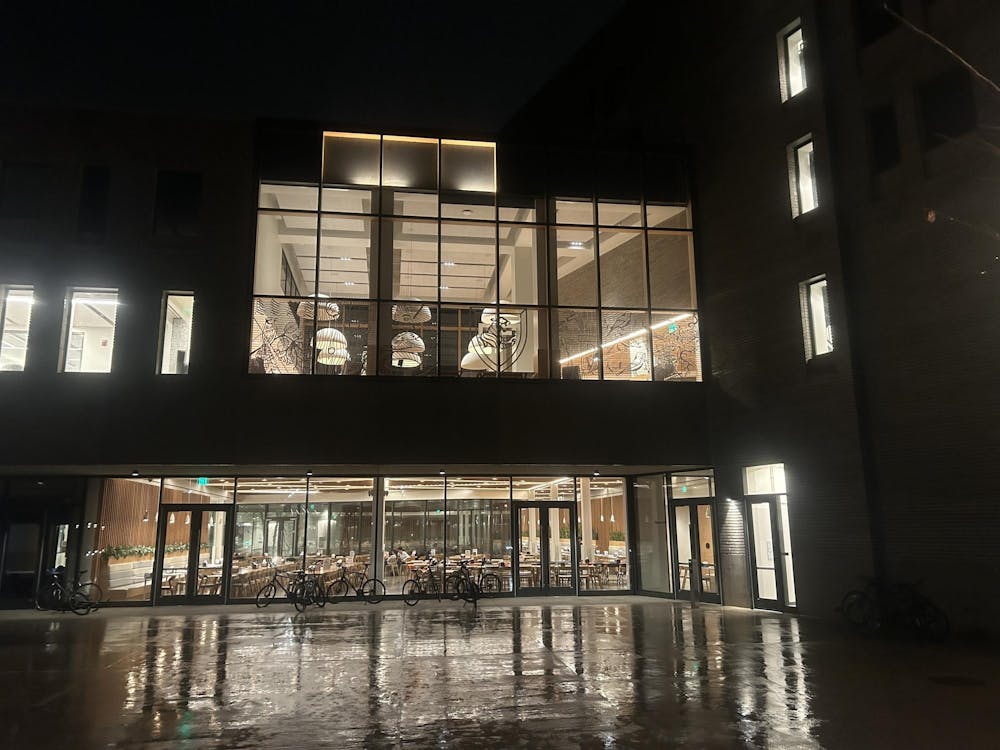
Around this time every year, death comes to campus. If you know where to look — beneath Fine Hall, below Frick Chemistry Laboratory, or outside Choi Dining Hall — you can find carcasses of migratory birds strewn across campus. Since 2022, students, faculty, and staff have advocated for the University to do more to protect the resident and migratory birds that collide with glass buildings on campus every year. In 2024, it seemed like the University had finally started to listen: Bird-safe glass was installed on Prospect House. Yeh College also recently unveiled a new installation to help prevent birds from striking the large glass window in the common room.
While the lower third of the common room window is adorned with a beautifully ornate nature-themed decal, there’s just one problem: it’s not finished. Most of the three-pane window is left completely unchanged. Craig Marshall, assistant director at the Center on Science and Technology and the lead of the project, wrote in an email to me that the more limited installation was chosen because the majority of collisions occur on the first two floors of buildings.
A 2014 study found that 4–11 story buildings were responsible for 56 percent of collisions, while 1–3 story buildings accounted for only 44 percent. It’s therefore reasonable to assume that upper floors bear some responsibility for bird deaths.
If the risk still exists, why not finish the job? It’s hard to imagine adding decals to a few more panes would be prohibitively expensive. This half-finished installation is just one symptom of a broader problem with the way that Princeton seems to pursue the aesthetic of change over genuinely impactful solutions.
But this isn’t just about bird deaths. The University’s pervasive affinity for incomplete, lazy solutions is what I have begun privately calling Princeton’s “half-measures,” in reference to Mike Ehrmantraut’s iconic monologue from “Breaking Bad.” Putting aside the extraordinarily violent specifics of those particular half-measures, the concept provides a useful lens through which we can view the administration’s shortcomings, in particular when it fails to take necessary action in furtherance of its clearly articulated values, whether due to cowardice, lack of vision, or incompetence.
The University’s handling of mental health is just one example of its broader reliance on half-measures. The administration has made it clear that it views suicides as an inevitable part of life on this campus — something that occurs “even when people do all the things that they should be doing,” in the words of University President Christopher Eisgruber ’83. Yet a statement like this suggests a troubling lack of ambition on the part of the administration and that, much like in the initiative to minimize bird collisions, they have capitulated in their efforts to address an issue before delivering the promised — or any — results. In lieu of a comprehensive plan to fight suicide, the administration points to the new Frist Health Center as evidence of its commitment to support mental health. While shiny new buildings are nice, Frist alone can’t solve the mental health crisis: A building is not mental health infrastructure.
Numerous other institutions, including the University of Alabama at Birmingham and the University of Utah, have instituted a “zero suicide” approach that aims to provide a comprehensive approach to addressing mental health crises through “the belief and commitment that suicide can be eliminated.” In contrast to this constructive and radically hopeful vision, University administrators present a view of campus mental health that is deeply unambitious and borderline fatalistic.
The administration’s response to climate change is similarly timorous. Powerful figures on campus and within the administration recognize the pressing threat that climate change poses and acknowledge Princeton’s responsibility to address it. Yet when given the chance to take bold action, the administration hesitates time and time again. The University pledged to divest from fossil fuel companies after years of student activism, only to quickly backpedal. Princeton labs continue to receive funding from fossil fuel companies, and the University refuses to even give up its privately-held oil company. Princeton’s unwillingness to extract itself from oil reflects the same tentativeness and lack of vision that lets it accept a suicide rate far above the national average.

Princeton’s pledge to achieve net zero by 2046 reveals a similar lack of ambition. If the University of Vermont — a school with 4000 more students than Princeton and a fraction of the endowment — can make substantial progress towards their pledge to achieve carbon neutrality by 2030, surely the University can set a more ambitious target than sixteen years later. Of course, the explanation for choosing 2046 as a target year for net zero is obvious to anyone familiar with Princeton history. But is prizing the aesthetically pleasing target of the University’s 300th anniversary really more important than taking aggressive action to minimize its impact on the climate crisis?
Half-measures are never a satisfactory response to any issue, but they are especially dangerous for the University in our present times: Academic freedom is under attack, international students are under threat, and ICE thugs operate in town with impunity. The climate crisis remains as urgent as ever. And students are still dying. Princeton deserves an administration that has the clarity to understand these issues and the conviction to confront them head-on rather than retreating to half-measures, opting to surrender before the battle has even begun. The University must do better to live up to its responsibilities to its students and community.
If nothing else, at least finish the damn window.
Thomas Buckley is a senior Opinion Writer from Colchester, Vt. He has never once taken a half-measure and is offended that you’d even ask. You can contact him at thomas.buckley[at]princeton.edu.
Read More

The real crisis on campus isn’t cheating, it’s thinking
Jack GoodmanFurther, a growing body of research confirms that use of generative AI undermines the cognitive effort that is essential to the development of the human brain. As AI use increases, learning, recalling, and critical thinking skills decline.
Further, a growing body of research confirms that use of generative AI undermines the cognitive effort that is essential to the development of the human brain. As AI use increases, learning, recalling, and critical thinking skills decline.

Trust in academia is at a low. Can Writing Seminar help?
Ian RosenzweigAcademia has a PR problem, and no amount of insular critical inquiry is going to solve it. Writing Seminars should live up to their name and teach us not just to solve thorny research problems but also to effectively communicate our solutions through clear and — perhaps more importantly — stylistically compelling prose.
Academia has a PR problem, and no amount of insular critical inquiry is going to solve it. Writing Seminars should live up to their name and teach us not just to solve thorny research problems but also to effectively communicate our solutions through clear and — perhaps more importantly — stylistically compelling prose.
Why is the recording policy being kept secret?
Isaac BarsoumIn denying new students — and faculty and staff, for that matter — the right to know what regulations they are subject to, Princeton makes violations likely and will end up unfairly investigating or disciplining community members who were unaware of the policy’s existence in the first place.
In denying new students — and faculty and staff, for that matter — the right to know what regulations they are subject to, Princeton makes violations likely and will end up unfairly investigating or disciplining community members who were unaware of the policy’s existence in the first place.