



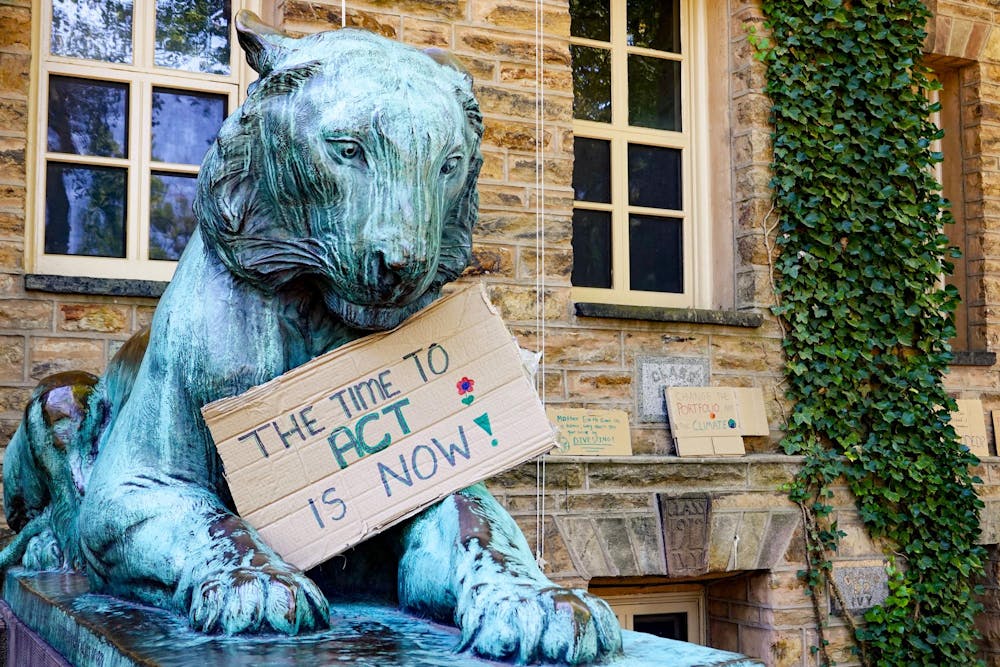
The following is a guest contribution and reflects the author’s views alone. For information on how to submit a piece to the Opinion section, click here.
When I first arrived at Princeton about eight months ago, I was amazed at the plethora of academic and extracurricular opportunities available to students passionate about climate justice. From classes on environmental media and climate migration to Sunrise Princeton’s campaign against PetroTiger to the Princeton Climate Symposium, it quickly became clear to me that many Princeton students see the fight against climate change as part of our mission to act “in the nation’s service and the service of humanity.”
But as a proud New Jersey resident since the age of three used to batting away jokes about my state and explaining the many distinct personalities of its different towns and cities, one thing troubled me. While Princeton students are quick to mobilize around global and national issues, as well as issues limited to the University, most Princeton students are not nearly as eager to stand in solidarity with local communities in our state. Yes, Princeton students act “in the nation’s service” — but doing so must mean acting in service of New Jersey as well.
On May 6, a broad coalition of local and statewide climate justice groups will come to Princeton to rally for the Climate Superfund Act in the penultimate stop on a statewide tour fighting for a bill years in the making. Princeton students’ responsibilities to our communities and the nation do not end at FitzRandolph Gate: we must fight to protect the state that we all call home during our time at Princeton. Supporting the effort on May 6 is one way to join that fight.
The Climate Superfund Act would raise $50 billion to pay for climate resiliency projects across the state, including flood protection infrastructure, upgrades to roads and transit systems, home buyouts, energy efficiency upgrades, and preventive healthcare programs. The act would be funded by finally holding fossil fuel companies that do business in New Jersey — and have produced more than one billion metric tons of greenhouse gas emissions since 1995 — liable for damages to our communities.
It is hard to understate how monumental this bill is. New Jersey would become only the third state to pass this kind of “Polluters Pay” legislation, after Vermont and New York. But similar bills are also making their way through legislatures in ten other states, and a win here would further propel the movement nationwide.
And the bill is particularly necessary here. New Jersey ranks fifth in the nation for per capita spending on climate disasters — in other words, it is one of the states most financially hurt by these disasters. All of New Jersey’s 21 counties have been hit at least five times by disasters in the last decade and a half, costing more than $7.9 billion.
The forecast for the future looks even worse. Flood risk threatens $435.9 billion in property value and $5.9 billion in annual property tax revenue in New Jersey by 2050, and over 1.3 million people will face high flood risk and a third of public facilities will face flood risk. In Mercer County — where Princeton sits — two-thirds of our wastewater treatment facilities and one-third of our hazardous waste sites are currently in flood-prone zones. Inundation at a hazardous waste site in Trenton can send toxins along the Delaware and Raritan Canal to Princeton, and, without adequate flood resilience infrastructure, the next hurricane will likely affect us too.

Though its impacts may not yet feel as tangible as the wildfires in California or the hurricanes in Florida, the climate crisis is already touching our lives all over New Jersey. A classmate here at Princeton, who hails from Cranford, N.J., described to me how his neighbors escaped their inundated homes in kayaks during floods. And communities down the shore contend with coastal erosion and sea level rise. My own hometown, Livingston, experienced a brushfire a year and a half ago that burnt nearly 200 acres, following a particularly dry summer that triggered several more blazes across the state.
It comes as no surprise, then, that 77 percent of New Jersey voters say they are concerned about extreme weather events, and 93 percent say that it is “somewhat” or “very” important that the state invests in damage mitigation projects, like the ones the Climate Superfund Act would fund. These investments pay dividends in the future: according to the U.S. Chamber of Commerce, every dollar invested in disaster resilience saves $13 in future costs.
Within Princeton’s idyllic magnolia-lined Orange Bubble, the ravages of the climate crisis often seem far away, save for students’ complaints about the temperamental temperatures this spring. But the truth is that our campus sits in a climate vulnerable state, and it is high time that our students see themselves as a part of it.
On Wednesday, May 6, climate organizations from across the state will rally at Princeton for the Climate Superfund Act. This is the perfect moment for Princeton students to both stand in solidarity with and take pride in their New Jersey community. We will be meeting at 5:30 p.m. in Firestone Plaza, and the rally is being led by Climate Revolution Action Network, Empower NJ, Food & Water Watch, and more. All students are welcome to simply show up, and signs will be distributed to students who don’t have their own.
If New Jersey won’t fund critical climate resilience projects, it won’t protect Princeton students. Whether or not you consider yourself a climate activist, whether or not you have ever even been to a climate rally, you are a part of the New Jersey community. It is time that Princeton students realize that acting “in the nation’s service and the service of humanity” means protecting our neighbors, our community members, and even our own campus in the great state of New Jersey.
Shayne Cytrynbaum is a first-year from Livingston, N.J., intending to major in SPIA with minors in Environmental Studies and Near Eastern Studies. He has been a climate activist since age 12, and is now a member of Sunrise Princeton. He can be reached at shayne.cytryn[at]princeton.edu.

Please send any corrections to corrections[at]dailyprincetonian.com.
Read More

Start the conversation
Ian RosenzweigIt’s no secret that the United States is, functionally, a gerontocracy. By facilitating the occasional opportunity for national or international leaders to truly listen to young people’s concerns, Princeton will have made a more immediate impact in the service of humanity than most other campus initiatives can claim.
It’s no secret that the United States is, functionally, a gerontocracy. By facilitating the occasional opportunity for national or international leaders to truly listen to young people’s concerns, Princeton will have made a more immediate impact in the service of humanity than most other campus initiatives can claim.

Students need to know where their food comes from
Angela BahnaThe sad reality is that you could be sitting in a restaurant or a dining hall surrounded by rich farmland without any of the food on your plate coming from it.
The sad reality is that you could be sitting in a restaurant or a dining hall surrounded by rich farmland without any of the food on your plate coming from it.

Make the Pre-read a work of fiction
EmmaRose ZillaA story that’s intellectually ambitious and philosophically provocative doesn’t necessarily have to be nonfiction. A fictional text can help us understand political tensions or erosion of autonomy just as much as an explanatory novel can.
A story that’s intellectually ambitious and philosophically provocative doesn’t necessarily have to be nonfiction. A fictional text can help us understand political tensions or erosion of autonomy just as much as an explanatory novel can.