



According to the Senior Survey for the Class of 2025, graduating Princeton seniors’ most-studied language was Spanish, with a full 29.2 percent of students studying it. However, the second-most-studied language, with a representation of 23.7 percent, is no language at all.
Many engineers don’t study a language. While only 10 percent of A.B. students go through Princeton without taking any foreign language classes, the same statistic for Bachelor of Science and Engineering (B.S.E.) students is a whopping 56 percent.
Because studying a foreign language is not a requirement for completing a B.S.E. degree, many engineering students don’t make space for them in their schedules. More importantly, introductory language classes don’t even count towards B.S.E. students’ humanities and social sciences distribution requirements. As a result, B.S.E. students often go through Princeton without the incentive or space in their schedules to learn a new language. To remedy this, Princeton should allow B.S.E. students to count language courses at the 102-level or above as credits toward their humanities requirements.
Studying a language at Princeton is one of the most unique and satisfying academic experiences available on campus. Though language learning is not an opportunity unique to Princeton, the small size of the classes and consequent approachability of instructors is hard to find outside universities like Princeton. Studying Japanese in my first semester changed my academic trajectory in a way I wouldn’t have imagined possible before Princeton: I declared East Asian studies as my major partially thanks to how much I enjoyed Japanese. Cultural immersion, mediated through language learning, has the power to change lives.
However, for a significant number of students, particularly engineers, learning a completely new language doesn’t seem like a viable option. Engineering students need to take seven humanities and social sciences courses during their four years at Princeton, but languages count towards this requirement only for classes at the intermediate level — that is, 107- and 108-level for Romance languages and 105- and 107- level for other languages — and above.
Under this system, without any previous background in a foreign language, if a student wanted to satisfy their requirements using a language class, they would have to take two or three classes to satisfy just one requirement. Why would anyone — save for those most committed to language-learning for its own sake — do this when they could just take one relatively undemanding intro-level humanities course to satisfy the same requirement?
Furthermore, consider how many requirements engineering students need to complete in order to graduate: six engineering prerequisites, seven humanities requirements, and at least nine departmental requirements.
Within such tight constraints, it’s often unfeasible for B.S.E. students to take elective classes that don’t fulfill any requirements. Most of the introductory sequences have either one or two classes before students reach the intermediate level. For example, in French or Spanish, the 101-102-107, 103-107, and 105-108 sequences are considered equivalent. In Japanese, the only way to reach the intermediate level without previous proficiency is 101-102-105. Plus, intro language classes cannot even be taken with the pass/D/fail grading option, something available for many humanities courses engineers could use to fulfill their requirements.

In light of this, there is little reason to completely discount introductory level language classes from counting towards the humanities requirement. There isn’t any fundamental change in the structure or purpose of language classes once they reach an intermediate level, and the School of Engineering and Applied Sciences policy should reflect that.
If classes starting with the 102 level counted for the humanities requirement, engineering students would be able to obtain credit for language courses from their second course in the sequence, or even the first if they have previous background in it. This wouldn’t encourage shallow study: since students would not receive credit for 101 level classes, they are still incentivized to engage deeply with a new language and not stop learning after acquiring the most basic competency level.
With this change, B.S.E. students who truly wish to learn a new language would have a better incentive to do so. Even if bilingual B.S.E. students could theoretically try to take advantage of this requirement by taking introductory-level courses in a language they already know, it would either be a mind-numbing experience to lower their language ability for the class or professors would instruct the student to take a more advanced class.
Engineering students have a host of reasons they might want to learn a new language at Princeton. On the one hand, research has shown that language acquisition and proficient bilingualism improve both divergent thinking abilities, which is used when coming up with creative ideas during brainstorming, and convergent thinking, which is used when needed to focus and push through with one singular idea. Both of these skills are essential to solve problems engineers face daily in their careers, so language learning would be directly beneficial to them.
On the other hand, language learning has value to it as a key component of a liberal arts education. One of the pillars of liberal arts education is cultivating a sense of awareness and appreciation for the diversity of ways human knowledge and expertise can come into being. There is no better way to engage with this diversity than by encountering it in its native language, whatever that might be. In a world where artificial intelligence and similar technologies promise to impact humanity at an unprecedented scale, we need engineers who understand this scale not only as a number, but as a human and intercultural reality.
Engineering students at Princeton would benefit significantly from developing proficiency in foreign languages, and they should have the option to do so without setting them back in their degree progress. Aspiring engineers are expected to master programming languages like Java and Python. It’s past time they got to learn Spanish or Chinese, too.

Andrei Dragomir ’28 is a contributing Opinion writer from Brasov, Romania. He is majoring in East Asian Studies, with prospective minors in computer science and history of science. He can be reached at ad2234[at]princeton.edu.
Read More
Bring back Communiversity
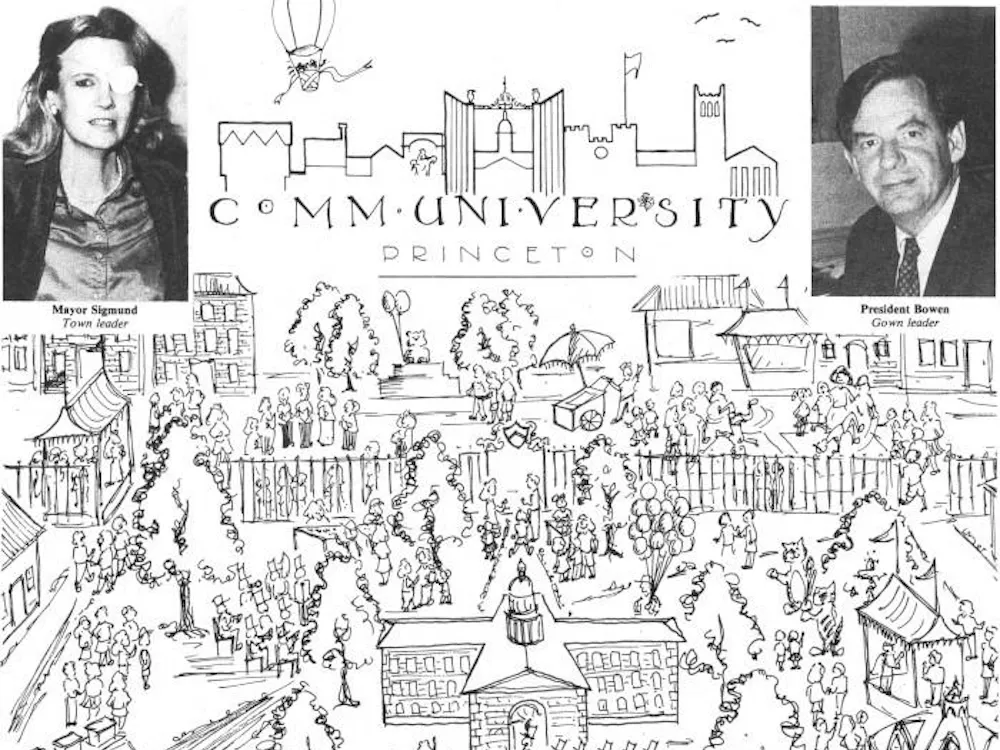
Isaac BarsoumFrom its inception in 1985, when it subsumed the Arts People Party — the Arts Council’s pre-existing festival — Communiversity always aimed to be more than just an arts festival. It was both a physical and symbolic coming-together of the University and the town in a celebration of all that we have in common and all that makes us different.
From its inception in 1985, when it subsumed the Arts People Party — the Arts Council’s pre-existing festival — Communiversity always aimed to be more than just an arts festival. It was both a physical and symbolic coming-together of the University and the town in a celebration of all that we have in common and all that makes us different.

Who rights our rules?
Charlie YaleWith fairness for students in mind, the University must require that all changes to RRR go through the Committee on Rights and Rules.
With fairness for students in mind, the University must require that all changes to RRR go through the Committee on Rights and Rules.

Freedom of speech is a right, not an excuse
Lily Halbert-AlexanderFreedom of speech should function to hold us to a high standard of honesty and transparency, not to excuse abuses of power and influence in the country’s most influential institutions.
Freedom of speech should function to hold us to a high standard of honesty and transparency, not to excuse abuses of power and influence in the country’s most influential institutions.