



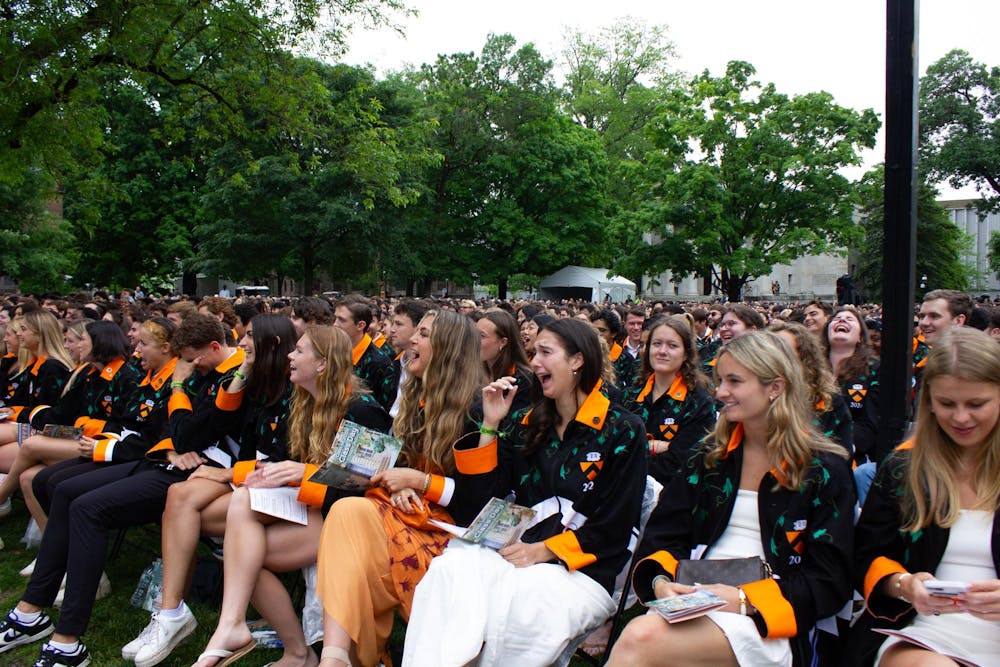
Princeton’s 279th Commencement ceremony last Tuesday marked the culmination of a three-day period of graduation celebrations for the Class of 2026. A two-hour event held in Princeton Stadium, the ceremony honored 1,469 seniors — the largest class in the University’s history — and 668 graduate students.
The Class of 2026 also participated in Baccalaureate in the University Chapel on Sunday, and Class Day on Cannon Green on Monday. The Army Reserve Officers’ Training Corps (ROTC) Commissioning Ceremony, which commissioned nine members of the graduating class; departmental Class Day ceremonies; and residential college receptions were among smaller-scale ceremonies that celebrated seniors and their families.
The three central events each featured selected speakers to address the class, with Craig Robinson ’83 speaking at Baccalaureate and Wendy Kopp ’89 at Class Day. Salutatorian Madeleine Murnick ’26 and valedictorian Daniel Yu ’26 spoke at Commencement, followed by remarks from University President Christopher Eisgruber ’83. The University president is the traditional speaker at Commencement.
All of the speeches mixed humor and reflection, but largely returned to the same somber theme of responsibility: after over a year of turbulence in higher education, clashes in national politics, and global conflict, Kopp, Yu, and Eisgruber particularly emphasized that the Class of 2026 must use their degrees to make the world a better place, returning to the University’s informal motto of “In the nation’s service and the service of humanity.”
Baccalaureate
Attended in-person only by graduating seniors, the Baccalaureate service remains one of Princeton’s oldest traditions, mirroring Opening Exercises in its interfaith component. This year, Sanjana Venkatesh ’26, Yahya Habib ’26, and Amelia Brown ’26 were selected as leaders of their religious communities on campus to read from their respective sacred texts.
After a choral segment, Eisgruber introduced Robinson as executive director of the National Association of Basketball Coaches and a former Princeton University trustee.
“Craig and I are both members of the Great Class of 1983, and while we did not know each other as students, I cheered for him from the stands in Jadwin Gym as he played basketball for the legendary coach Pete Carril,” Eisgruber said.

At the pulpit, Robinson recounted his academic struggles while at Princeton, having entered with the hopes of becoming an aerospace engineer but ultimately majoring in sociology. Post-graduation, he similarly made an unexpected pivot, going from working at Morgan Stanley to becoming a basketball coach.
“Life is rarely a straight line, no matter how carefully you plan it,” Robinson told the class. “My sister — who some of you might know, has a way with words — she calls this ‘The Swerve.’” Robinson’s sister, Michelle Obama ’85, has spoken about “swerving” in her memoir “Becoming” and on other platforms.
“We spend years climbing ladders, only to discover the ladder was leaning against the wrong wall. The paycheck may look good. The title may impress people at reunions,” Robinson continued. “But if you wake up every day disconnected from your purpose, eventually, success starts to feel surprisingly empty.”
He closed aptly with a basketball metaphor, noting, “It’s easy to be the person with the ball; it’s much harder, and much more rewarding, to be the person who creates the space for someone else to score.”
“Whether you end up in the halls of government, a high-tech lab, or a neighborhood nonprofit, remember that your degree isn’t a crown to be worn — it’s a tool to be used in the service of others,” he reminded.
Class Day

The most lighthearted of the classwide graduation events, Class Day included announcements of multiple leadership and service awards, comedic speeches from class heralds Allen Shen ’26 and Tyler Wilson ’26, and inductions of honorary class members, before Kopp gave her address.
“As a B.S.E. student, I am particularly thankful to be up here as a class herald. It is a position with no responsibilities, no power, no salary — giving me a true taste of a Princeton humanities degree,” Shen joked, to laughter from the class and their families.
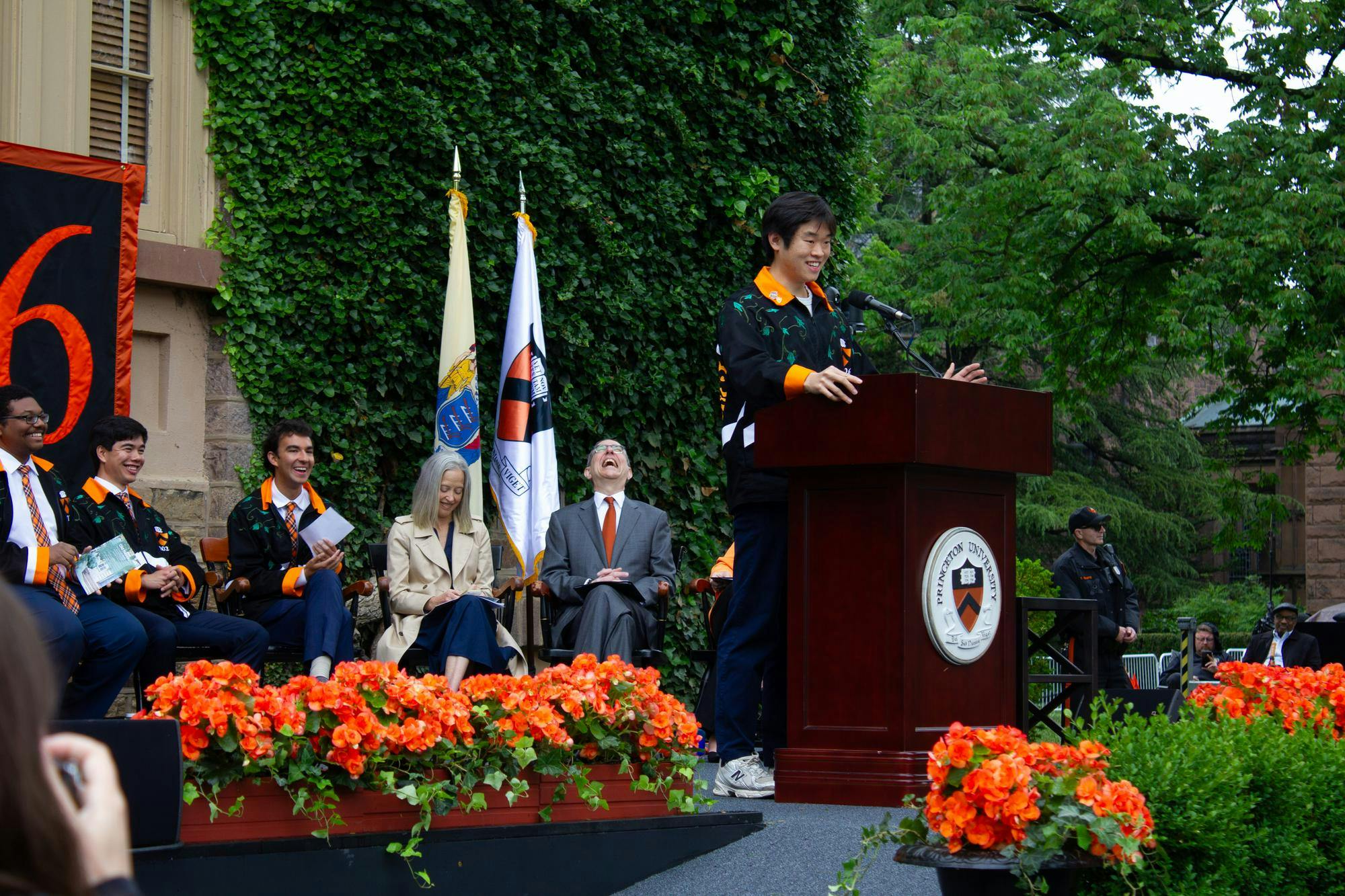
University President Christopher Eisgruber ’83 reacts to a Class Day speech delivered by Class Herald Allen Shen ’26 behind Nassau Hall, Monday, May 25, 2026.
Jerry Zhu / The Daily Princetonian
Wilson sarcastically proclaimed, “I am proud to be joining a long line of idiots: people who are stupid enough to think that they can actually change the world for the better. People who chase down problems in need of solving, glass ceilings in need of smashing, and status quos that demand disruption.”
Yet, these qualities were precisely what Kopp, founder of Teach For America as well as co-founder and CEO of Teach For All, encouraged in her address, speaking with even more force than in her 2022 Baccalaureate speech.
While she had called the Class of 2022 the “activist generation,” she said the Class of 2026 belongs to “the rejected generation, which did everything right, but has the lowest acceptance rate ever into college and employment.”
“Best-selling authors tell us you’re the anxious generation, thanks to phones and social media,” Kopp added. “But on this day, I want you to celebrate your freedom.”
Kopp told the seniors, “When people ask you over these next days what you’re going to do next year, please remember: you don’t have to set off on another track. Today, you are free to decide where to put your time and energy.” Wherever they direct that time and energy, however, should be meaningful, Kopp emphasized.
“As you go forth, I hope you’ll stay present to the impact of your surroundings, your relationships, your day-to-day work on the person you become. Make choices that expand your worldview, rather than limit it,” she asked of the class.
“I don’t need to tell you that our country and our world are not well,” Kopp said.
“We need the most committed, creative, capable leaders in the arena tackling these problems, so your choices do matter. I’m not asking you to sacrifice for the common good. I’m just sharing that you have the opportunity to do something that really matters, that helps put the world on a better trajectory.”
Kopp was inducted into the class as an honorary member immediately before her speech, along with Mariyah Salem, assistant director for international programs at the Davis International Center; Alvan Flanders, detective sergeant in the Department of Public Safety along with his therapy dog Coach; and Henry Shim, a University lecturer in economics.
Inducted but not introduced at Class Day were Whitman-Butler dining hall chef Christeen Griffiths, campus photographer Tori Repp, African American Studies professor Ruha Benjamin, Humanistic Studies program manager Stephanie Lewandowski, and Hellenic Studies administrative coordinator Christine Twiname.
Class president Minna Abdella ’26 synthesized Robinson’s and Kopp’s messages as she addressed her peers on the podium behind Nassau Hall.
“The education we’ve received … these four years, it comes with a responsibility — not just to do well and to excel, but to do good in the world,” Abdella said. “We are more connected to each other and to this world than we may think. What happens in one part of the world is not separated from you. It is not separated from me, it is not separated from us.”
“This may be fitting coming from a politics major, but I urge you all to be political. Be people who care about the world you live in. What you do in your careers will be felt somewhere by someone. Use what Princeton gave you and help create a better world for everyone,” she implored.
Commencement
Undergraduates, master’s students, and Ph.D. candidates filed into seats on the field of Princeton Stadium to celebrate their degrees. They did not receive their diplomas during the ceremony, but were applauded when asked to stand by department.
Typically, students receive their diplomas at their residential college receptions following Commencement; however, the Class of 2026 will be the first class to have their diplomas mailed to their homes, as part of budget reduction measures.
Murnick performed a lively salutatio in Latin, remarking, “We have witnessed a time of change and we are the stronger for it. Now, as we face this transition, I think the poet Ovid’s words are fitting: ‘All changes, nothing dies.’”
Yu, an African American Studies major and a 2026 Marshall Scholar, spoke to current turmoil around higher education. “This past year, as the attacks on higher education, on civil liberties, on our lives, and the lives of the people we love have intensified, these moments have become harder to ignore and to bear,” he began.
“Each of these instances forced us to consider the state of our choices at Princeton, to confirm why we were here and what we stood for, to question what it means to be in the nation’s service and the service of humanity,” Yu said, invoking the University’s informal motto. “To live in the service of humanity is not an old, forgotten motto, and it is not something we save for our careers; it is something we have practiced here together every day.”
Drawing upon recent developments that have destabilized academia — and especially the humanities — in systematic and financial ways, Yu emphasized the importance of humanistic, ethical thought.
“‘So what?’ ‘What are the stakes of our actions and our inactions?’ These are the questions that the humanities and social sciences raise — and they are the answer our world right now requires,” he stated. “Attacks on such disciplines reaffirm these fields’ very purpose: the power of ideas and unsettling the status quo.”
Advising his peers not to “withdraw or be silent,” he stressed that “the world acts on Princeton, and Princeton acts on the world. We cannot opt out of that exchange.”
Following Yu’s remarks, the recipients of the President’s Award for Distinguished Teaching were honored on stage. The four University faculty awarded were operations research and financial engineering professor Amir Ali Ahmadi, English professor Jeff Dolven, chemical and biological engineering professor Jerelle Joseph, and senior lecturer in the Princeton Writing Program Emma Ljung.
The University also honored the five recipients of the Princeton Prize for Distinguished Secondary School Teaching — awarded to secondary school teachers in New Jersey — and presented six honorary degrees across the doctors of laws, science, humane letters, and music.
Eisgruber closed the ceremony with a call for the graduating class to continue the University’s tradition of “unpopular dissent” as they leave campus.
Recognizing the same political issues raised by Kopp and Yu, Eisgruber said, “We are, of course, not the first Princetonians to confront such challenges. As I seek perspective on today’s problems, I often find it useful to consult the wisdom of our predecessors from the 1960s, another period when America and its college campuses experienced social upheaval.”
“Princeton’s leader during that decade was Robert F. Goheen [’40],” he noted, going on to quote from the past University president’s book “The Human Nature of a University”: “‘Perhaps the highest and most difficult function of the university, its most irreplaceable form of service in a free society, is to be willing to stand up as a judge of society’s tastes and actions.’”
Redefining “courage” as rejection of the “popular,” Goheen’s words aligned with Eisgruber’s longstanding commitment to free speech.
“‘The critic and the judge are not always popular,’” Eisgruber further quoted from Goheen, “‘but the greatest teachers in all ages have preferred hard truth to comfortable fiction and self-respect to popular esteem.’”
“If we are to live up to the ideals of citizenship and scholarship, we must sometimes speak anyway,” he declared to the class. “We must be faithful to the standards of truth-seeking inquiry and civic responsibility, even when they lead us down difficult paths.”
Haeon Lee is the associate News editor for the ‘Prince’ leading research coverage. She is from Brooklyn, N.Y. and often covers campus research and academic departments. She can be reached at hl1389[at]princeton.edu.
Please send any corrections to corrections[at]dailyprincetonian.com.
Read More

USG senate adopts statements on Cornell case, data center construction in South Brunswick
Nico David-Fox and Nika SchindlerAt its Sunday meeting, USG unanimously adopted statements calling for Title IX reforms in response to the Cornell case and opposing a South Brunswick data center over health and pollution concerns.
At its Sunday meeting, USG unanimously adopted statements calling for Title IX reforms in response to the Cornell case and opposing a South Brunswick data center over health and pollution concerns.

How ‘Jane Eyre’ helped me find my voice at Princeton
Katharine VenninkContributing Writer for The Prospect Katharine Vennink reflects on a novel that has shaped her voice and identity.
Contributing Writer for The Prospect Katharine Vennink reflects on a novel that has shaped her voice and identity.
Two new fast food restaurants open on Nassau Street
Walker VivianTwo new fast food restaurants, Hotbirds and 7th Street Burger have opened in Princeton over the summer. This comes after three other new fast food spots, BurgerRunn, Food Street, and Best Grill and Fries opened last winter.
Two new fast food restaurants, Hotbirds and 7th Street Burger have opened in Princeton over the summer. This comes after three other new fast food spots, BurgerRunn, Food Street, and Best Grill and Fries opened last winter.