



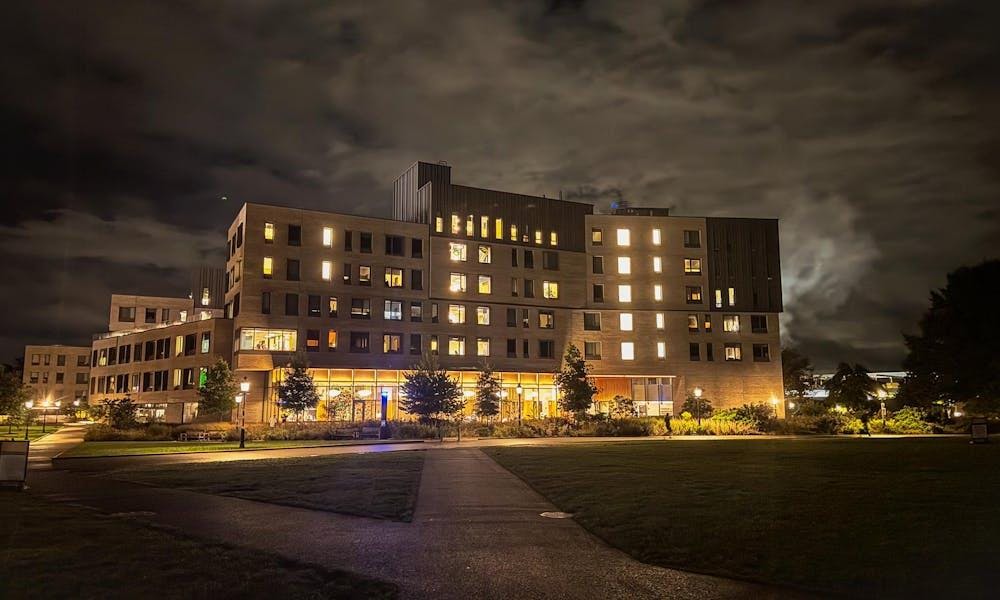
Buying naming rights remains trendy at Princeton: This year, New College West was named Huo College after Yan Huo GS ’94, while construction nears completion on Hobson College, named after Mellody Hobson ’91. While neither donor has disclosed the amount of their contributions, placing your name on a residential college does not come cheap. In 2002, Meg Whitman ’77 was the primary funder for the eponymous college with a $30 million donation. In 2018, Ronald and Debra Perelman ’96 promised $65 million (a gift that was later revoked) to name what later became Huo College.
While celebrating the semiquincentennial anniversary of our nation, we practice an archaic system of selling naming rights more reminiscent of the European feudal system. While our founding fathers were morally incorrect when it came to a wide array of issues, their opposition to hereditary privilege was groundbreaking. By allowing wealthy individuals to name buildings after themselves or their immediate living family, Princeton reifies the value of wealth and inherited power and breaks with national tradition. Moving forward, Princeton should not offer donors the right to name buildings after themselves or their family.
As it stands, the physical landscape of our campus serves to carry forward a legacy of inherited wealth: Future generations of donors’ family members inherit power and privilege, buildings lose their neutrality, and we spend our days in in a community embedded with the ethos and stigmas of figures who paid their way into being memorialized. Buildings named after donors monumentalize those wealthy enough to afford a building and serve as a daily physical reminder of how traditions favoring privilege and legacy live on at our university.
When ugly truths are revealed about a benefactor with their name on a building, it reflects badly on the University. We have seen this across the nation. For instance, our friends in Cambridge, Mass., face nationwide backlash because Leslie Wexner, billionaire and affiliate of Jeffrey Epstein, has his name plastered on a Harvard Kennedy School building. The Sackler family — a major art donor to the previous Princeton University Art Museum— similarly, had its name removed from multiple buildings at Tufts because of controversy around its role in the opioid crisis. The names of our buildings today at Princeton could become the problems of tomorrow: After all, Michael Bloomberg — a donor of Bloomberg Hall — is infamous for his “stop and frisk” policy.
But the problem with naming isn’t simply relying on a better vetting process. Many of Princeton’s recent donors have an egalitarian mission. For instance, Hobson explained her donation as a way to "remind future generations of students — especially those who are Black and brown and the ‘firsts’ in their families — that they too belong.”
Negotiating donor laudability on a case-by-case basis doesn’t solve the larger issue: With this naming practice, Princeton monumentalizes wealth and allows the wealthy to buy a place in its history. There is no need to be apologetic for legacy or economic success, but when buildings carry donor names, the campus becomes a museum of wealthy alumni.
In 2026, the existing naming policy is anachronistic. The Class of 2029 had 69 percent of students qualify for financial aid and the largest number ever qualifying for Pell grants. We are simultaneously diversifying our university while protecting archaic naming traditions.
I hate to say it, but Yale beats us out: It doesn’t name its residential colleges after donors, no matter how large the donation. As a former senior fellow of the Yale Corporation explained, Yale “donors … haven’t been driven by plastering their name all over the place. They have been driven by trying to make Yale fantastic.” Instead, Yale’s colleges are named after historical figures. The truth is, Yale has not gone bankrupt and continues to receive large donations.

Granted, ending the naming of any buildings after donors would be a step beyond Yale’s residential college-specific policy and may lead to a financial hit. It would take time for alumni to appreciate a new trajectory for Princeton, but a forward-thinking financial ethos would ultimately be beneficial to our campus culture. Some potential donors may be hesitant, but the University can and has declined gifts from donors who tie strings to their philanthropy. There’s no denying the likelihood of a reduction in donations, but such a sacrifice is worth it to amend our present relationship with inherited wealth. We must ultimately trust our donors to do what’s right for our University.
I suggest that we learn from our University’s name — which came from a geographical location — that there are other ways to name a building. There is nothing wrong with New College West or Prospect House. The eating clubs are an example of this naming philosophy: Terrace Club is named after its physical terrace, Ivy Club after its first location in Ivy Hall, and Tower Club for the tower on the original building.
It’s undeniable that the act of naming is an assertion of power. President Donald Trump is actively attempting to rename the Kennedy Center, the United States Institute of Peace, and the Palm Beach International Airport after himself, even though only 9 percent of Americans believe that a sitting president should be able to do so. The names which define our campus speak to our values, and that statement will carry into the future: It is time for Princeton to create a legacy not based on wealth but on principles and a love for our University.
Contributing Opinion writer Sasha Johnson is a junior in the politics department from Southern California. She can be reached at sj5266[at]princeton.edu. She would prefer it if you fail to reach her!
Read More

We know what has changed. How will future classes?
Thomas BuckleyI am by no means the first student to complain about replacing the charm of meandering into Labyrinth on the first day of classes with navigating an e-commerce website, but I might be among the last. When the Class of 2027 graduates, so will the last class of students who remember Princeton before eCampus.
I am by no means the first student to complain about replacing the charm of meandering into Labyrinth on the first day of classes with navigating an e-commerce website, but I might be among the last. When the Class of 2027 graduates, so will the last class of students who remember Princeton before eCampus.

It’s time to end the alumni interview
Cate YoungThough it’s tough to diverge from tradition, the interview process presents far more possible risks than it does positive returns. Interviews’ ultimate and admirable goal is to get to know Princeton applicants better—and to let them get to know the University—but there are better and more equitable ways to achieve this.

Reducing student debt is more important than a No. 1 ranking
Raf BasasIn terms of mean debt for all students, including those with zero debt, Princeton outperforms its peer universities.
In terms of mean debt for all students, including those with zero debt, Princeton outperforms its peer universities.