



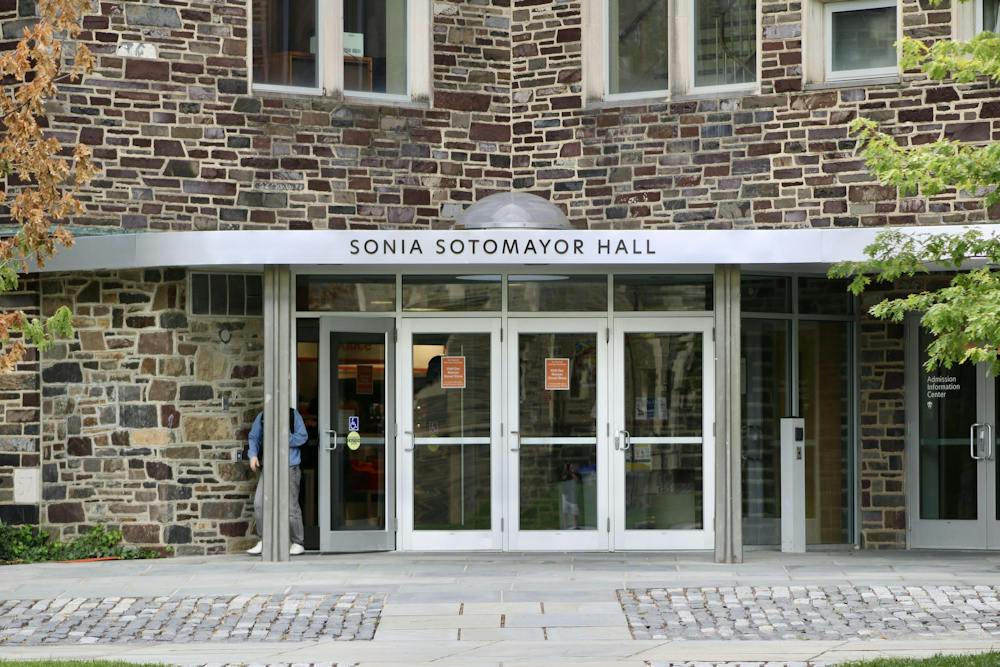
My Princeton admission interview last fall was like a car wreck you couldn’t look away from. Actually, no need for the simile: it was a literal car wreck. My interviewer was in an accident directly outside of the coffee shop where we’d planned to meet, and spent the time handling his own “interviews” with police, AAA, and the other driver as I sprinted to the nearest CVS for bandaids. I couldn’t fix his car, but I could help with the bloody gash he sustained. Head trauma and a high-stakes interview go great together, right?
I assumed nothing could make the interview worse — until I found myself met with questions like “Which eating club would you bicker?” and “You want to be an English major? What’s the difference between iambic and trochaic pentameter?”
After what may go down as the second-worst Princeton admissions interview in Princeton history — see: Tom Cruise, “Risky Business” — I left feeling gutted, assuming that such a negative experience had tanked my chances for admission to my dream school. Years of work, undone in mere hours. The anxiety and disappointment were consuming.
Though well-intended — vaguely advertised as a chance to “discuss the things that are important to you and also ask questions” — the potential benefit of alumni interviews is vastly outweighed by the risks of putting high school students into contact with an unvetted pool of alumni. The disastrous specifics of situations like mine are hopefully rare, but alumni interviewers still function as representatives of the University — the only representatives many will ever interact with personally. My experience was unusual, but the fact that it could have happened shows that the current interview model is damaging to both applicants and the University itself.
A 2024 article in the Princeton Alumni Weekly described the alumni interview as “the first point of contact in a lifelong relationship with the University.” In the piece, Dean of Admission and Financial Aid Karen Richardson ’93 shared the sentiment: “Our hope is that every student — whether they are admitted or not, and whether they’re admitted and decide not to come to Princeton, that they can walk away saying, ‘Wow, that was a really nice conversation that I had with this person, and I learned about this place.’” Richardson’s idealistic representation of the admissions interview sounds reasonable in the context of the 1940s and ’50s, when Princeton received under 5,000 applicants, but Princeton received over 46,000 applicants for the Class of 2030.
The University admits that they don’t have the resources to offer every student an interview. But it’s clear that they still value the interview greatly as an opportunity to show itself off to high schoolers across the country. It should greatly concern the administration to so significantly outsource the responsibility for these pivotal first impressions, and thus risk damaging experiences that directly harm Princeton’s reputation.
Interviewers aren’t admissions officers, practiced in engaging with high school-age applicants. They’re simply people who — although admirably interested in supporting their alma mater — hold degrees from a university whose admissions landscape is unrecognizable from half a century ago.
The problem of bad first impressions isn’t unique to Princeton — more often than not, I left my admissions interviews feeling discouraged, insufficient, and upset. My rejection letter from Stanford wasn’t too shocking after my interviewer — an AI developer — spent the duration of our time trying to understand why I’d want to pursue creative writing when I could instead write legislation, code, or things that “actually impact the world.” Ouch.

There’s a problematic imbalance when the anxiety of Princeton applicants meets the relatively random and even informal process by which their interviewer is selected. If Princeton wants to preserve any positive interactions that do occur from alumni interviews, they need to begin thoroughly vetting and training the alumni they enlist. And if they can’t vet all of the currently-involved alumni, they should become more selective in those they allow to represent the University. Fewer interviewers may mean that fewer students get these one-on-ones or interactions with high schoolers occur in group settings, like low-stakes informational sessions or Q&As. But prioritizing quality interaction and the opportunity for students to learn and come away with a good first impression is more important than reaching every applicant individually.
Many peer schools have already modified their approaches to such individual interactions after evaluating their own outreach capacities. Columbia eliminated interviews entirely in 2023, and Yale focuses on interviewing candidates who they’re on the fence about, meaning guaranteed “yes” students and guaranteed “no” students don’t receive interviews. The latter would most definitely qualify as a pressure cooker, but at least students know exactly what they’re getting into.
Other schools have found another way to allow students to advocate for themselves without the negative impacts of the traditional interview. Brown, Duke, and Vanderbilt have transitioned to Glimpse, a video platform that allows applicants to showcase personality from a more controlled setting. These programs, too, have their drawbacks — it’s impossible to guarantee authenticity when students have the opportunity to curate a snippet of themselves on video. But we also can’t pretend that Princeton’s current interview model always successfully fosters meaningful conversation and allows an applicant — and Princeton itself — to share who they really are.
For a leading school, Princeton’s interview process is behind the rest of the pack. Princeton shouldn’t allow any student’s first point of contact with the University to potentially be a slap in the face. Though it’s tough to diverge from tradition, the interview process presents far more possible risks than it does positive returns. The ultimate goal of admissions interviews is to give the admissions office a chance to get to know Princeton applicants better, and to let them get to know the University — an admirable goal, but there are better and more equitable ways to achieve this.
At the very least, maybe the University could start ordering the alumni interviewers Ubers.
Cate Young is a freshman contributing Opinion writer from Dallas, who now knows what trochaic pentameter is. You can reach her at cey[at]dailyprincetonian.com.
Read More

Reducing student debt is more important than a No. 1 ranking
Raf BasasIn terms of mean debt for all students, including those with zero debt, Princeton outperforms its peer universities.
In terms of mean debt for all students, including those with zero debt, Princeton outperforms its peer universities.
My class has an AI student
Emily Y. ZhangThe goal of education should not solely be to make students better at doing everything AI can already do — reading, summarizing, iterating, designing. It should be to give students experiences that make them better thinkers in ways that cannot be reduced to producing the correct answer.
The goal of education should not solely be to make students better at doing everything AI can already do — reading, summarizing, iterating, designing. It should be to give students experiences that make them better thinkers in ways that cannot be reduced to producing the correct answer.

Stop sending us emails about your new AI thing
Josh StiefelThe potential extinction of the human race is grounds for expressing some concern. But, in Princeton email inboxes, recent public discussions of AI are altogether too frequent.
The potential extinction of the human race is grounds for expressing some concern. But, in Princeton email inboxes, recent public discussions of AI are altogether too frequent.