



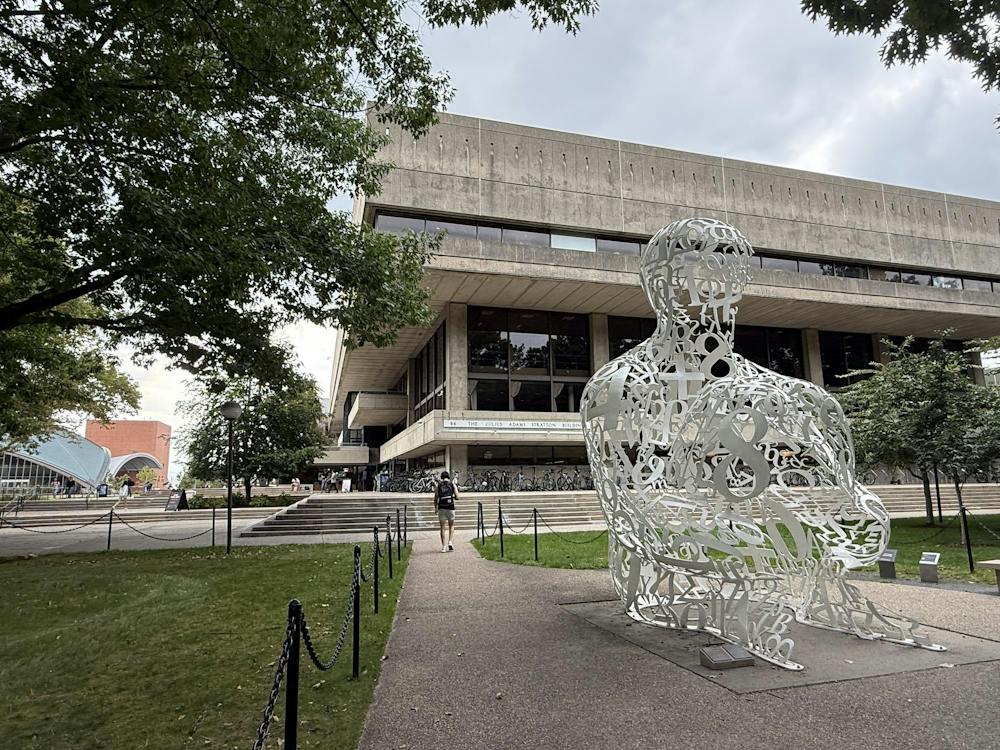
For 15 consecutive years, U.S. News has ranked Princeton No. 1 on its Best Colleges list of national universities. But this Monday, the University was dethroned: The Massachusetts Institute of Technology has taken the No. 1 spot.
Of course, these rankings are not truly reflective of the academic quality of a school, and often shift in response to major methodological changes. One change that possibly influenced Princeton’s fall is that U.S. News replaced its metric on post-graduation student debt with earnings by major for federal aid recipients. While U.S. News explains this decision as a result of being unable to obtain data on student debt, such data could have been obtained through section H5 of the Common Data Set and school surveys.
Rather, it seems that U.S. News is shifting its priorities, valuing return on investment over affordability. This sparks a broader question: As U.S. News changes its priorities, must the University follow suit in its own considerations?
U.S. News’s previous calculation of student debt was poorly implemented, as Vanderbilt chancellor Daniel Diermeier has argued in the past. But this does not make reducing student debt an unworthy cause. Now that the ranking-based incentive for reducing debt has been removed, the University has the chance to advance its mission not because of external validation, but in spite of it. By doing so, the University would help ensure that students are free to choose their careers for passion and fulfillment, not mere consideration of their future salaries.
Many of the students who take out loans belong to two groups: wealthier students who do not qualify for sufficient financial aid and international students who receive nearly full or full financial aid. These international students are subject to a scholarship tax from the International Revenue Service, and their money from personal expense aid and employment is often inadequate to pay this tax: as a result, they take out loans. Therefore, to tackle debt, Princeton must expand financial aid in two ways: increasing the range of households covered by financial aid, and ensuring that the scholarship tax for international students is paid off.
If, like me, you receive full financial aid, you might have rolled your eyes at the idea of expanding aid. After all, Princeton’s financial aid is already very generous. If you’re in the bottom 70 percent of American households, all your costs to attend Princeton are going to be covered. And if you’re in the bottom 90 percent, Princeton will likely pay for your entire tuition. It may seem like a low priority to address the financial concerns of domestic students with debt, since they are often privileged.
But privilege isn’t really the point here. It is in the University’s best interest for students to as easily as possible be able to work “in the service of humanity,” in line with the University’s unofficial motto, after graduation if they so desire. And a 2011 study revealed that indebted graduates tend to choose higher-salary jobs, passing up on jobs that are more oriented towards public service. You don’t need to feel bad for these students to recognize that not having debt makes students feel more comfortable deprioritizing salary in career deliberations.
Then, for low-income international students, the burden of debt is even greater. The scholarship tax is 14 percent of aid money awarded beyond tuition, often adding up to thousands of dollars. Thus, international students are even more constrained by their debt and therefore may also feel limited in the career choices that they can make.

Despite these issues, Princeton is still one of the most affordable universities. Only 11 percent of students in the Class of 2025 took out loans. In terms of mean debt for all students, including those with zero debt, Princeton outperforms its peer universities. Based on the Common Data Set for the Class of 2025, we can find that the average debt at Princeton was 2,338 dollars, compared to 3,668 at Harvard, 5,385 at Penn, and 5,369 at MIT.
A commitment to reducing debt is one of Princeton’s most unique features, and something of which we should truly feel proud. The University does not need to score first place in the U.S. News rankings, when it knows that it has been a trailblazer in affordability and encouraging public service. But to keep that identity, we’ve got to commit to it, which means making Princeton affordable for a wider range of students.
Raf Basas (he/him) is an assistant Opinion editor from Elk Grove, Calif. He is a junior in the Politics department. You can reach him at raf.basas[at]dailyprincetonian.com or @raf.basas on Instagram.
Read More
My class has an AI student
Emily Y. ZhangThe goal of education should not solely be to make students better at doing everything AI can already do — reading, summarizing, iterating, designing. It should be to give students experiences that make them better thinkers in ways that cannot be reduced to producing the correct answer.
The goal of education should not solely be to make students better at doing everything AI can already do — reading, summarizing, iterating, designing. It should be to give students experiences that make them better thinkers in ways that cannot be reduced to producing the correct answer.

Stop sending us emails about your new AI thing
Josh StiefelThe potential extinction of the human race is grounds for expressing some concern. But, in Princeton email inboxes, recent public discussions of AI are altogether too frequent.
The potential extinction of the human race is grounds for expressing some concern. But, in Princeton email inboxes, recent public discussions of AI are altogether too frequent.

Why is Princeton so afraid of chalk?
Isaac BarsoumChalking upends the political order and tidiness of Princeton by forcing everyone — powerful players, ordinary students, and campus visitors alike — to notice what they see written on the ground. It claims a piece of campus, if only temporarily, for the drawer.