



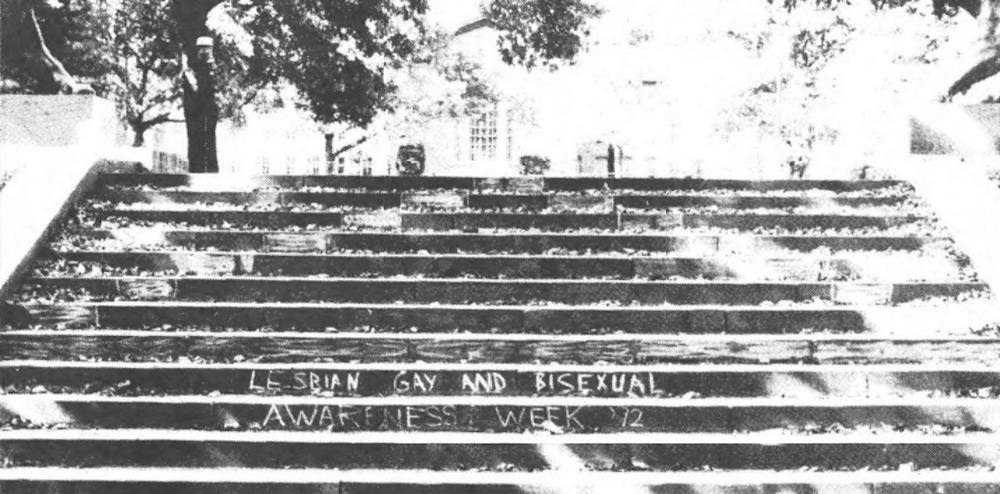
In April 1995, University maintenance crews spent two days cleaning “walkways, benches, plazas and walls on campus,” working to remove not dirt or debris, but simple sidewalk chalk. The chalk drawings, according to a report from The Daily Princetonian, consisted of “pro-gay messages” written by hand during Pride Week. After the removal, advocates were rightly in uproar — while the Pride Week chalkings had been scrubbed, other chalk drawings advertising events and student government candidates were left alone.
Following the incident, the University, claiming that the discrepancy had transpired because of “cross-office confusion,” clarified its chalking policy — it was henceforth banned, in all cases. Today, that policy consists of fourteen simple words: “The use of chalk and tape applied to University grounds and walkways is prohibited.”
Three decades on, chalk at Princeton has found itself relegated to dusty trays in classrooms and lecture halls. Hardly anyone — students, activists, artists, campus organizations, candidates, schoolchildren — chalks University grounds anymore. Simply put, the University’s ban has worked. But the question remains: Why is Princeton so afraid of chalk?
Chalk, which leaves a semi-permanent, anonymous mark on the physical University, is a unique medium for political discourse that shakes the institution in a way that is distinguishable from, and in some cases more powerful than, other forms of activism or speech. And its power is drawn from a long history of scrawled resistance.
Sidewalk chalk was first mentioned in the ‘Prince’ in 1955, when an unsigned satirical column bemoaning campus’s lack of women mentioned spotting a writing “in chalk by the libe [library].” The author mused: “There’s always someone who’ll write something like that.”
Over the next forty years, it turned out, someone was always drawing on the ground with chalk.
By the early 1990s, Undergraduate Student Government candidates would advertise their campaigns by chalking walkways around campus: In October 1991, candidate for Class of 1995 president Michael Signer ’95 said in an interview that “some of his chalk messages have been rubbed out and another candidate’s name substituted.” Chalk evolved into an expected part of campaigns and campus life. “The chalk on the sidewalk,” predicted the ‘Prince’ in late November 1994, “should begin any day now for next week’s USG elections.”
But in the early part of that decade, chalk was also proliferating on campus for reasons entirely unrelated to student government elections. In May 1991, for instance, the ‘Prince’ published a photo of Jason Lee ’94, “obviously influenced by Andy Warhol,” drawing in chalk on the steps of Robertson Hall. “Chalk one up for art,” the photo was captioned.
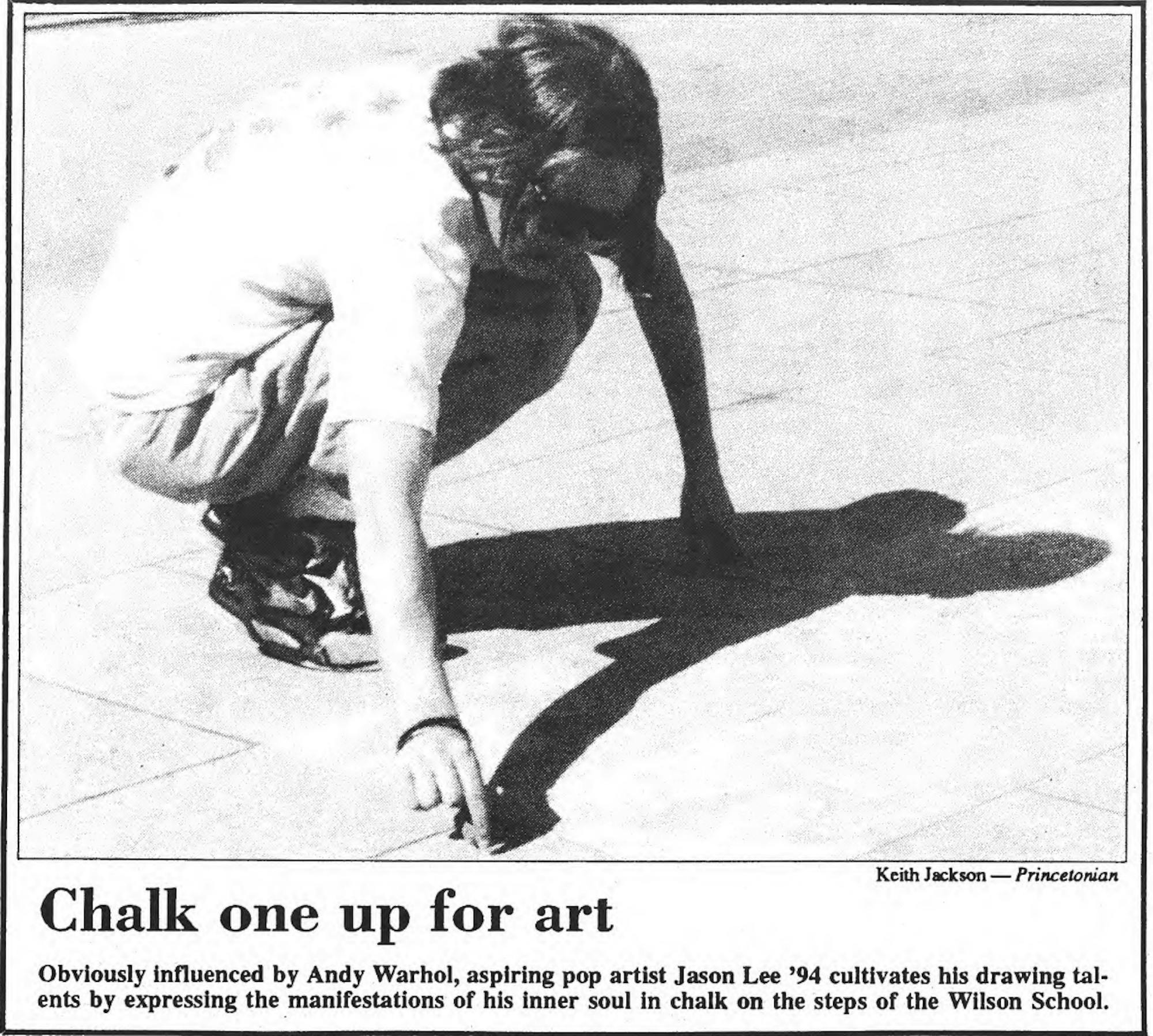
Jason Lee ’94 expressed “the manifestations of his inner soul” in chalk at Robertson Hall in 1991.
Keith Jackson / The Daily Princetonian
Chalk had become an important tool of visibility for the LGBTQ+ community on campus, a community that “was pretty small and insular” in the 1990s, according to a 2017 interview with former Lesbian Gay Bisexual Alliance Coordinator Jennifer Handler. The LGBA, Princeton’s most prominent LGBTQ+ advocacy group at the time, organized events like Pride Week and Gay Jeans Day throughout the academic year. Students would promote these events — and assert their very existence, despite incessant attempts to deny it — with chalk messages drawn on walkways across campus.
During this time, as Marina Ferraro ’98 wrote, students used chalk to “[remind] Princeton of our presence on this campus. We are here, and, as has been noted countless times, we are not leaving.”
In an interview with me, Handler commented on the politics of chalk on campus, and how LGBTQ+ students used it, in the 1990s.

“I think they felt like it was an expression of pride on a campus [on which] I don’t think they felt very represented or seen,” she said. “I think it was an important way of trying to increase visibility.”
But Princeton remained a rather conservative, homophobic place through the 1990s. Handler said in her 2017 interview that “there was a lot of homophobia under the surface, and that’s part of why it didn’t feel like such a welcoming climate.”
And, sometimes, this homophobia reared its head above the surface. In a 1992 comment to the ‘Prince,’ one student called the chalkings by LGBTQ+ advocates “a belligerent effort to assault people.” Another wrote that “I do not enjoy reading rude and militant chalk writing on my way to class or in front of my club.” In the same column, the author describes the chalkers as having made “Princeton a hostile place for those who are not gay by resorting to the harassment of a large number of students through their chalk markings and blatant vandalism of school property.”
Jennifer Kates GS ’95, the LGBA coordinator before Handler, pointed out that chalking was not out of the ordinary for contemporary Princeton. “This ‘tarnishing’ of the beauty of the campus,” she wrote in a 1992 column, “was done in the true Princeton tradition of chalking, which is used by a variety of individuals on campus to announce candidates, parties, and deliver awareness messages.”
But when chalk became a tool of visibility and resistance for marginalized people in the 1990s, Princeton leveraged its power to stop it. For years, the implicit cultural agreement at Princeton had been: Our homophobia will stay “under the surface,” and you will too, hidden out of view in the closet or Terrace Club. But the chalk marked out gay students’ presence at Princeton in a way that upended this sheltering equilibrium. It insisted, for the first time, that Princeton and its people come face-to-face with reality.
In April 1995, the “true Princeton tradition” of chalking came to an abrupt end. With the aggressive removal of “pro-gay” chalk drawings on both University property and at Terrace, Princeton revealed its fear of chalk and willingness to erase it. By the end of the academic year, an inconsistent Princeton had clarified its chalking policy: It was always prohibited, on all surfaces, for any purpose. And all future chalking would “be taken off,” said then-Associate Dean of Student Life Joyce Clark.
“[Chalk] was an important way of expressing themselves that became unavailable to them,” Handler told me, describing the ban’s effect on LGBTQ+ students. “I think the campus overall, the feeling, the culture [was] a little bit restrained. And so this was a very healthy way of people expressing who they are.”
Since the 1995 ban, chalking has been moribund at Princeton. Though students and community members continued using chalk to create art in the off-campus Communiversity festival and on the walls of Murray-Dodge Café, sidewalk chalk has otherwise faded from the campus zeitgeist, replaced by even more flyers, HoagieMail, and the occasional bike-a-thon in the campus rhetorical ecology.
But chalk did not disappear completely from Princeton.
In an email to me, Dean Vineet Chander, Princeton’s Hindu chaplain, wrote that chalk has been used by students to create rangoli, a form of traditional floor art, for Diwali during his time at Princeton, which began in 2008. It is unclear what the University’s response to those chalkings was.
Asked if the University would act differently if chalk is used for religious purposes such as creating rangoli, University spokesperson Michael Hotchkiss wrote that “as set forth in University policy, ‘The use of chalk and tape applied to University grounds and walkways is prohibited.’ If the University is made aware of a violation of this policy, they will take appropriate action.” No exceptions.
In 2009, a cappella groups promoted their open houses with “elaborate sidewalk chalk,” according to The Nassau Weekly. That act was met with powerwashing to remove the chalk and a campus-wide email that declared that “the use of sidewalk chalk on campus walkways amounted to vandalism of university property.”
In 2014, when a Missouri grand jury refused to indict Officer Darren Wilson for the murder of unarmed, Black, 18-year-old Michael Brown, The Nassau Weekly reported that Princeton students repeatedly used chalk as a tool of resistance in the build-up to a March on Prospect with more than 300 students, which the ‘Prince’ described as “probably the largest public protest at the University in recent years.”
But their chalk, too, was shamefully erased.
And at the “Gaza Solidarity Encampment” in April 2024, students drew Palestinian flags and wrote “Hands off Gaza” and other messages of solidarity with Palestine in chalk. These drawings were removed by powerwashing by Princeton University Facilities, almost certainly at the directive of the administrators who felt that their position and stature — and the campus’s image — was threatened by students declaring that Princeton must have no hand in the genocide of the Palestinian people. Though they could not do away with the students’ encampment, they could do away with their chalk — and they did.
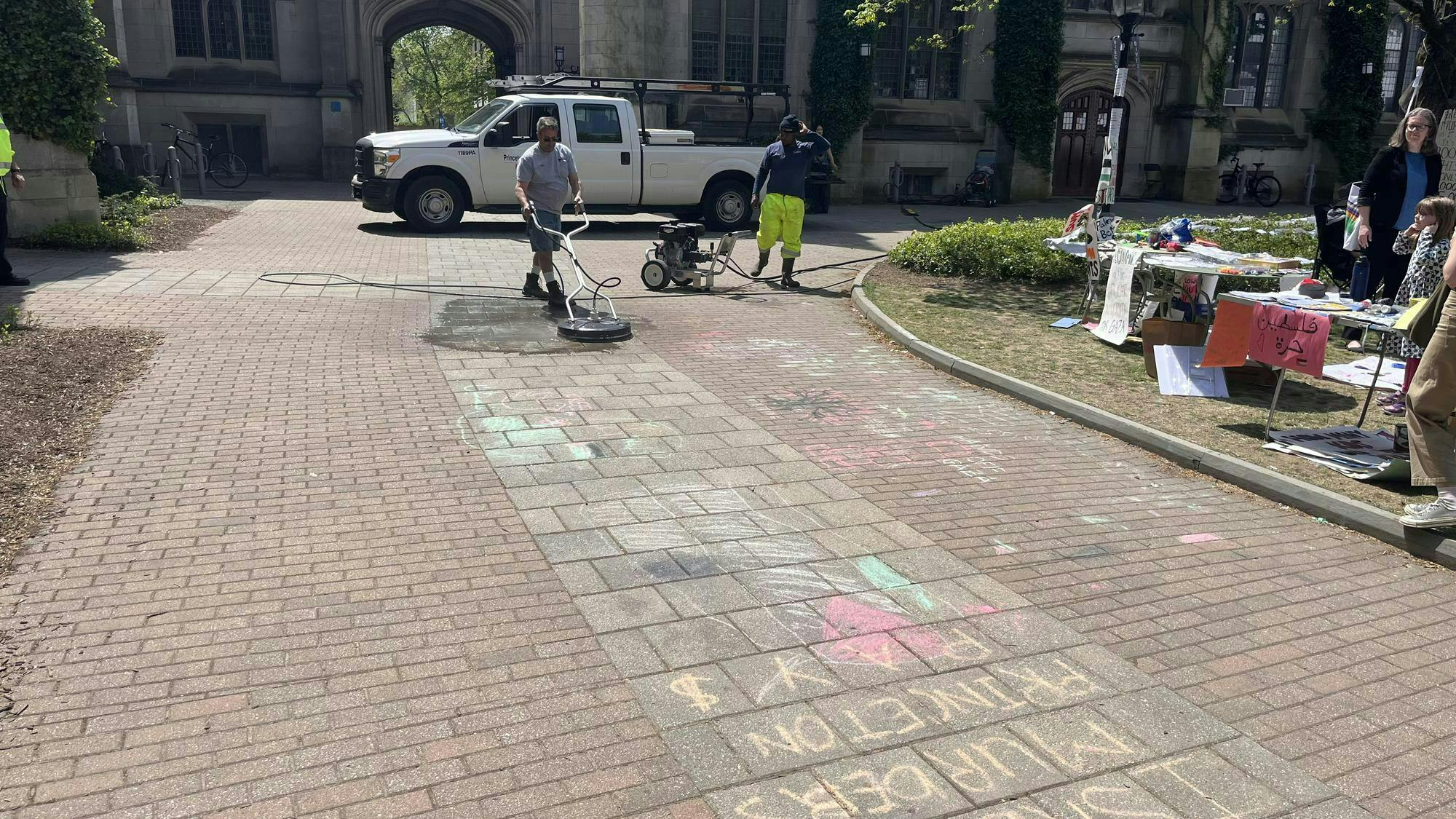
Facilities removed chalking on sidewalks near the “Gaza Solidarity Encampment” in 2024.
Ryan Konarska / The Daily Princetonian
At other universities, chalk remains a powerful tool for activism and visibility today.
“On college campuses across the country, the weapon of choice in the duel of clashing political viewpoints is — chalk,” wrote law professor Frank LoMonte and legal researcher Paola Fiku in a 2023 article reviewing the First Amendment implications of anti-chalking laws. “Sidewalk chalking has become a popular medium for expression, particularly by young people, for obvious reasons: It’s cheap, it’s immediate, it reaches a geographically targeted audience, and it’s fun and artistic.”
All that to say, chalk still matters, for individual and political expression. A student at the University of California, Santa Barbara wrote in the campus newspaper that “due to its impermanent nature, affordability, and ability to engage with the public,” chalk is useful “for both self-expression and acts of resistance without permanent damage to the environment.”
Many of Princeton’s peer institutions retain more liberal chalking policies, even after their campuses were rocked by pro-Palestine protests in 2024 — drawing blowback from university administrators and national politicians alike — many of which used chalking as a tactic.
Yale, for instance, permits chalking “on outdoor walkways that are open to the sky and the weather,” subject to content restrictions to prevent chalk that is “harassing, threatening, or that violates law or Yale policy.” (That regulation, though, is not always evenly enforced.) Brown, with similar restrictions, explains that “chalking is a permissible way to promote programs and events, make announcements, share messages, and express ideas.” Cornell, Dartmouth, Stanford, the University of Pennsylvania, the University of Chicago, and the Massachusetts Institute of Technology all retain similarly liberal, though limited, chalking rules.
Beyond universities, chalk functions similarly as an important, and contested, medium of political expression. In 2020, for example, Black Lives Matter protesters in a small town in Washington state had their chalk drawings powerwashed away and were threatened with jail time and fines by city officials who said they were protecting the town from “mayhem and evil.”
“Chalk art has long been a tableau for social activism, a form of instant commentary that takes political expression quite literally onto the streets,” Mike Baker, the New York Times journalist reporting on the story, wrote. “Cities have at times targeted it, such as in San Diego, where a man was charged with 13 counts of vandalism in 2013 for writing anti-bank messages on a public sidewalk.”
Chalk’s ability to frighten powerful actors is not solely contained within the United States, either. In late 2025, students in Slovakia used chalk to express opposition to their government becoming more pro-Russia, more corrupt, and more authoritarian. After the chalkings, the prime minister abruptly canceled a planned visit to their school. That “was funny because, damn, I would not want to be someone who is afraid of a chalk message,” the first student to draw in chalk said. Anti-government chalkings soon proliferated across Slovakia, coming to be known as the “Chalk Revolution.”
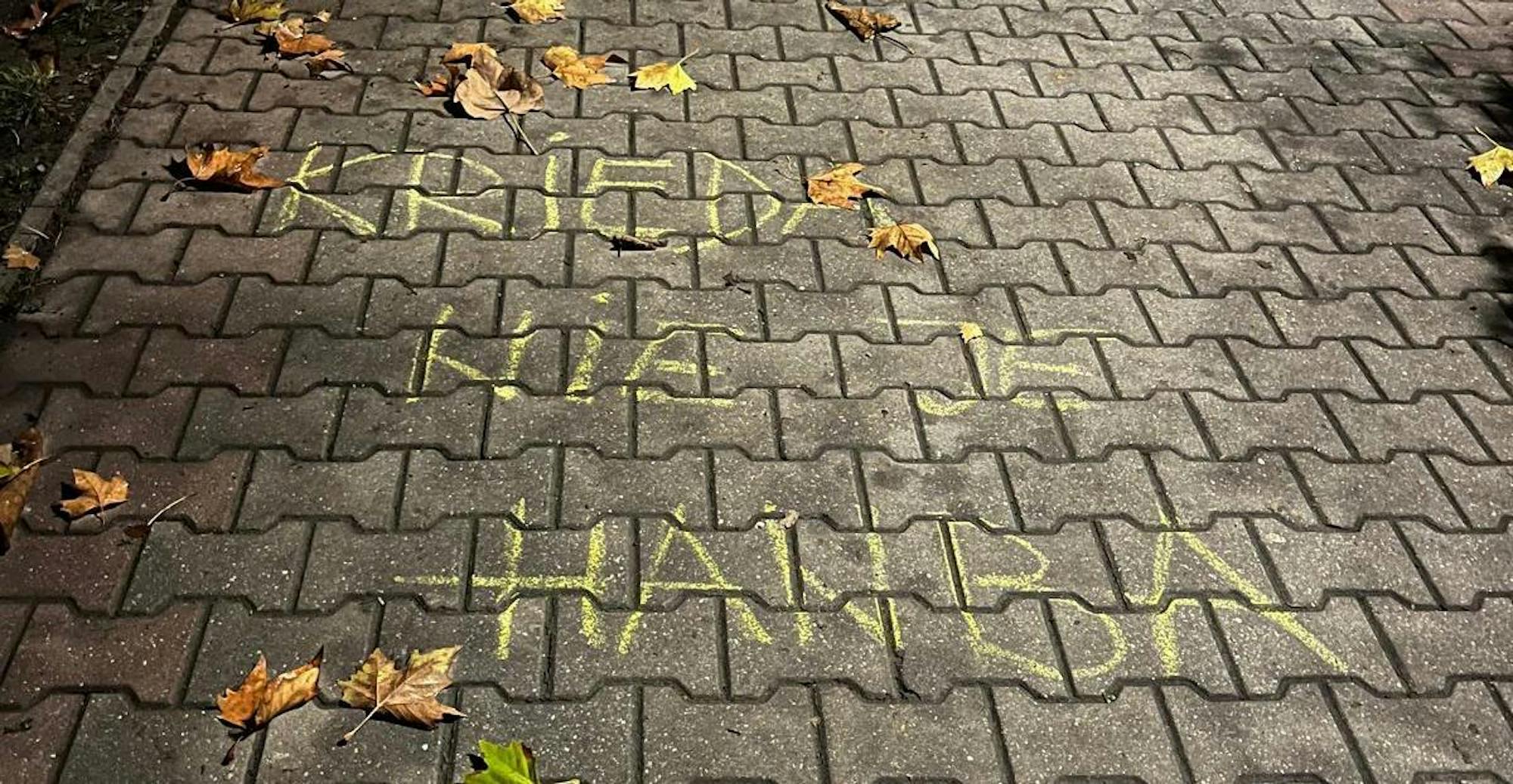
A chalk drawing on a Slovakian sidewalk declares, “chalk is not a shame.”
“Protestní křídové nápisy v Bratislavě” by Glomerata / CC BY-SA 4.0
Attempts at chalking policy reform at Princeton have come close to succeeding in recent years but have ultimately fallen short. In a September 2023 proposal obtained by the ‘Prince,’ then-U-Councilor Daniel Shaw ’25 offered a slate of reforms to University regulations, including a rewrite of the chalking policy based on existing rules at the University of Chicago.
“Chalking by members of the University community is allowed only on campus sidewalks or walkways that can be easily washed away by rain and that will not cause lasting or permanent damage,” Shaw’s proposal read. “Chalking on buildings, building entryways, non-sidewalk, or non-walkway surfaces is prohibited. Water-soluble chalk must be used. Use of spray chalk, spray paint, markers, or any materials other than water-soluble chalk are prohibited. Preservation or protection of specific chalking is not possible.”
Shaw attempted to push his reforms through the Committee on Rights and Rules of the Council of the Princeton University Community. But the committee did not give him the chance to meet to discuss his proposal. When they finally responded — in March 2025, just two months before Shaw’s graduation — they appeared open to the idea of chalking reform.
In a March 6, 2025 email obtained by the ‘Prince,’ philosophy professor and chair of the Committee on Rights and Rules Jacob Nebel told Shaw that Princeton would move forward with chalking reform.
“ODUS is discussing a potential revised chalking policy with campus partners,” Nebel wrote, “and will proceed with revisions in accordance with our regular processes.”
But Shaw graduated in 2025 and the conversation at CPUC has since moved on. Despite Nebel’s promise that ODUS “will proceed with revisions,” the chalking policy remains unchanged today, those fourteen simple words still prohibiting it everywhere on campus, without exceptions.
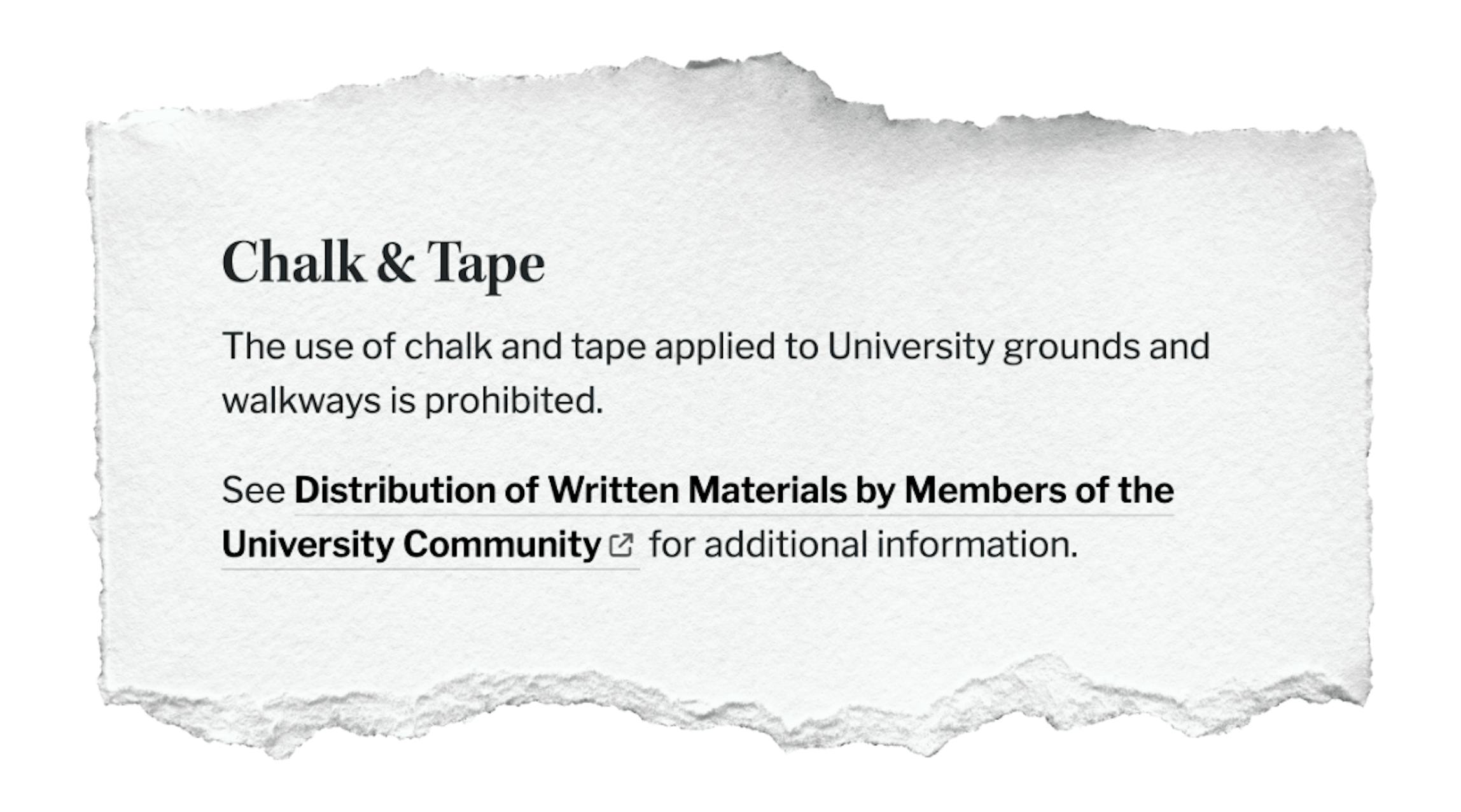
The Princeton chalk policy remains the same.
Isaac Barsoum / The Daily Princetonian
So what is Princeton — which has not backed down from its thirty-year-old declaration that all chalk “will be taken off” — so afraid of?
For one, chalk threatens the power of individuals and institutions by providing activists with a semi-permanent and anonymous way to distribute their messages.
Traditional protests are, by their nature, fleeting, at Princeton usually lasting no longer than an hour. While chalk doesn’t give organizers the chance to flex their muscles through scale — a bigger chalk drawing doesn’t necessarily indicate that a political movement has more support, whereas a bigger protest might — it trades that off for the ability to stick around for a little longer and reach many more people. How many students, staff, and visitors pass through Firestone Plaza in an hour? How many do so in a day?
But while chalk is semi-permanent, it does not cause property damage, as many who seek to ban it like to suggest. Princeton’s Rights, Rules, Responsibilities includes chalking in its section about “Willful or reckless damage, vandalism, or destruction of the property of others, or of the University.” But chalk, especially when drawn on a horizontal, exposed surface, washes away with the rain. It’s hard to justify including it with other acts of “deliberate defacement” or “destruction” of campus property for disciplinary purposes.
Chalk also threatens power by anonymizing — and thus generalizing — political messages. Before the ban, LGBTQ+ students at Princeton were able to express their individual identities through chalk without having to face the sort of social ramifications they probably would have if they had worn clothing with the same messages. And pro-Palestine students could write messages like “Israel murders, Princeton pays” without facing the kind of disciplinary action they so often do for their political speech. The anonymous dissemination of political messages, some of which are critical of the University, threatens a Princeton that seeks to police that speech at every turn.
Princeton’s administrators are afraid of chalk for the same reason you have to keep your protest within the correct “time, place, and manner” and the same reason they don’t want journalists and activists and observers recording at CPUC or in faculty meetings: They are afraid that, one day, their constituents — the students, faculty, staff, and alumni who make Princeton — will look down at the ground and encounter some dissidence they agree with.
But they are equally afraid that, one day, visitors to campus — the prospective students and parents whose experience at Princeton will be carefully weighed against the tour at Harvard and the information session at Yale — will look down at the ground and encounter something, some small fact, some imperfection about Princeton they’d prefer wasn’t there. This is the second way chalk threatens the institution: by potentially damaging its image.
“I think many students probably viewed chalking as something that was contrary to the orderly, conventional character of the campus,” wrote Jason Victor ’98, a former ‘Prince’ reporter who covered the chalking ban, in an email to me. “There was an implicit understanding that Princeton had certain standards for how the campus should look and behave, and most students were comfortable with that.”
Chalking upends the political order and tidiness of Princeton by forcing everyone — powerful players, ordinary students, and campus visitors alike — to notice what they see written on the ground. It claims a piece of campus, if only temporarily, for the drawer.
As Sophie Abromowitz ’13 once wrote in The Nassau Weekly, “Every act of physical deformation of Princeton’s campus personalizes the university while chipping away at the desirable timelessness of the institution.” That is, she continues, “an individually-inflicted blemish,” like chalk, “on the university’s physical landscape says to the tour group that sees it, ‘This is my university,’ rather than, ‘This is a university which will one day be yours.’”
“This is a university which will one day be yours.” That simple sentiment becomes the core message — and the core lie — of the University’s marketing. So long as Princeton continues to wash away markings of ideas and identity before the rain comes to take them away of its own accord, Princeton can never be yours, and it can never be mine. We are a transitory people on this campus, meant to linger on Firestone Plaza no longer than the time it takes us to walk across it, and certainly not meant to mark it for the world to see.
But Princeton should be ours, if only for a while: It should be mine, and yours, a place for us to change and transform while we mold and reimagine the University. The mark of students — their ideas and identities and initiatives, sometimes scribbled in chalk — are what allow the University to renew itself, year after year, to march into the future both retaining its ivy allure and becoming a place for modern learning and knowledge production and self-creation.
So why is Princeton so afraid of chalk? Perhaps it’s afraid of us; perhaps it’s afraid of the future; perhaps both. But whatever the case, it’s time for Princeton to face its fears and end the antiquated chalking ban, once and for all.
Isaac Barsoum can’t draw, but he should be allowed to. He is a junior Politics major and associate Opinion editor from Charlotte, N.C. You can reach him at isaac[at]dailyprincetonian.com, or leave him a message on the sidewalk.