



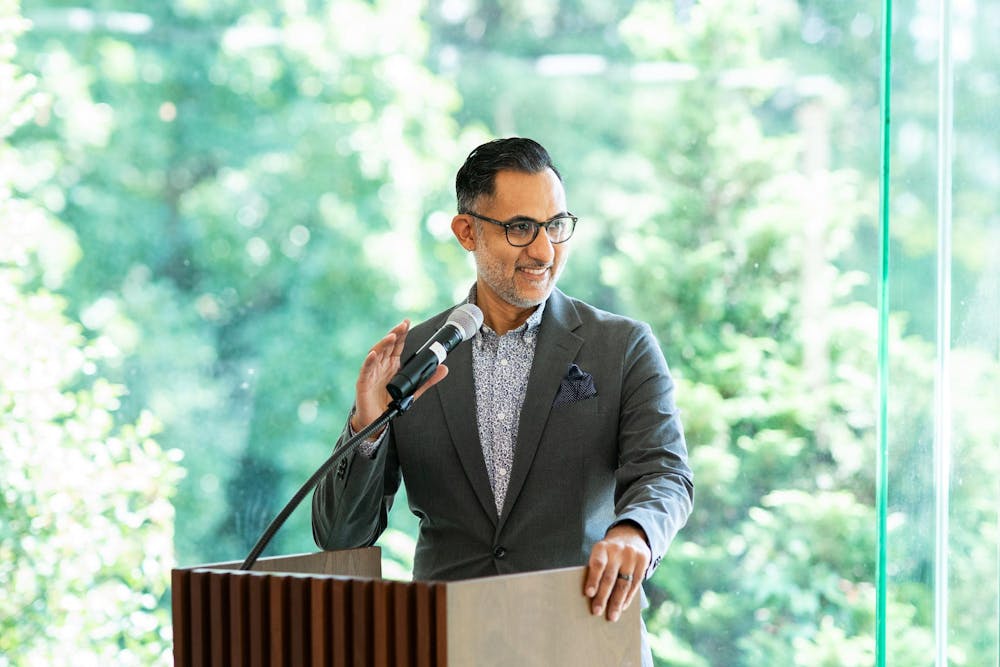
Legs crossed and a shawl wrapped around his shoulders, Dean Vineet Chander begins to chant an “om,” followed by the few dozen people seated in the circle in a quiet, dark room in Murray-Dodge. A shaky start and a few unsure breaths and coughs later, our voices all blend. The next ten minutes fly by, measured by unlikely shifting chords that emerge through the chanting of friends and strangers.
When Chander signals the end of the session with a tap on the metallic bowl beside him, the silent air in the room seems to vibrate. Some of us laugh in awe as we get up from the plush cushions beneath us.
Chander is the Assistant Dean for Princeton’s Office of Religious Life and Princeton’s Hindu Chaplain. Because chaplaincy originates from a Christian tradition, there have not historically been Hindu chaplains on college campuses. Chander became the first in American higher education to translate the role to a Hindu context.
As Princeton’s Hindu community grew, the need for a formal Hindu Life professional in the Office of Religious Life became clear. Hired in 2008, Chander has led Princeton’s Hindu Life Program (HLP) to become the vibrant program it is today.
Chander’s story of spiritual practice and faith forged an unlikely path to Princeton, and informs his approach to the chaplaincy today.
Coming of age in New York City in the 80s and 90s, Chander characterizes his childhood as “an experience of liminality,” even when surrounded by the diversity of New York. He belonged to two worlds, not one.
Although according to Chander, the concept of “a practicing Hindu” is an arbitrary classification given the personal nature of Hindu tradition, Chander said he didn’t grow up in what he would term a “particularly religious” family.
“I grew up with an awareness of being Hindu, but more as a cultural reality than anything else,” said Chander.

However, in middle and high school, Chander began exploring faith and spirituality both in Hinduism and within other traditions. He didn’t feel limited to the religion he was born into. After heavy exploration, Chander found himself led back to Hindu practice, specifically a particular tradition of bhakti yoga, or “the path of devotion."
Chander found an affinity for spirituality and philosophy in those years. “If I was a little bit more honest with myself and with my parents,” reflected Chander. “I probably would have studied religion or philosophy [in my undergraduate].”
“Except brown kids didn’t do that when I was growing up,” he noted, referencing the constraints many South Asian students felt at the time.
Chander recalls being wary of going “a little too out of the box.” Knowing that STEM (science, technology, engineering and math) wasn’t for him, Chander decided to pursue something within the humanities, and settled on law.
A shy high schooler, Chander challenged himself to step into the world of speech and debate, where he found that his passions of philosophy, truth, and rhetoric had “a lot of resonance.”
After Chander’s undergraduate studies, he took a year off before starting his law school experience to live in an ashram and spend his time studying sacred Hindu texts.

Afterwards, when Chander arrived at George Washington University law school fresh off his gap year, he found himself eager to continue his practice and apply what he had learned. “My mind and my heart were buzzing with all this sacred wisdom that I just studied,” said Chander.
Chander recalls his first year of law school, walking across the GW campus and stumbling onto the undergraduate activities fair.
“[I] almost literally bumped into this table that was the Hindu student group,” said Chander. The students expressed that they had been hoping to create a study circle on the Bhagavad Gita, a fundamental Hindu text, but lacked the right person to guide them.
“I just took it as a complete answer to my prayers,” said Chander. After that turn of fate, Chander ended up holding Bhagavad Gita classes with the undergraduates, his involvement with the student group becoming the most meaningful part of his law school experience.
It also ended up being the first time Chander encountered the word ‘chaplain,’ an unfamiliar concept in the Hindu tradition. Although “spiritual caregiving” is an integrated part of Hinduism, “chaplaincy” was never the word used.
The concept of a chaplaincy originated from Christian practices of appointing chaplains for guarding relics and providing Christian and secular services. Today, most chaplains provide spiritual guidance. Chander would ultimately take the position as GW’s volunteer Hindu chaplain.
Despite its Christian origins, Chander intentionally uses the term because he is interested in how the term can be “reappropriated” respectfully. “Chaplaincy has grown beyond its Christian origins, and that it is something that serves a purpose in faith communities, beyond Christian communities,” he explained.
Using the term ‘chaplain’ has also opened doors for Chander. “I’m a big believer of availing oneself of opportunities and resources that may not have been necessarily created with minoritized folks in mind,” said Chander. By identifying himself as a chaplain, Chander has been able to connect to other chaplains and attend conferences.
“It’s not always easy, but one of the things that I feel really excited about is also being part of helping to bring a Hindu voice, a Hindu perspective, to spaces that may not have had those perspectives before,” said Chander.
After graduating law school, Chander took the bar for New York and New Jersey and eventually got his dream job as an Assistant District Attorney for New York City’s District Attorney’s office.
However, he soon began to feel disconnected from his spiritual practices, and moreover, himself. “On paper, I had every reason to just feel happy,” said Chander, but in reality, he felt not just tired but drained.
“I felt like maybe what I did feel called to do had to do much more directly with spirituality, with my own spiritual practices, but also with helping and inspiring others,” said Chander. He found that he was happiest working with young adults and in his position as Chaplain.
So he resigned from the DA’s office and became a volunteer chaplain again, with Rutgers University. In 2007, a friend forwarded him the announcement for the Hindu Life Program at Princeton.
In addition to seeking a Coordinator for Hindu Life, the formal title for the chaplaincy, the Office of Religious Life was also seeking a Coordinator for Muslim Life. In 2008, the then-president of PHS, the Princeton Hindu Satsangam (PHS), a Hindu student group, wrote in a comment to The Daily Princetonian that he was “very happy that the ORL has recognized that the practice of Hinduism is now an important part of religious life on campus which deserves formal administrative representation.”
After several rounds of interviews, Chander was offered the position and began his pilot year in 2008. At that point, not a single other college or University had a full Hindu Life Program. “There was no real blueprint,” Chander said.
When he came to Princeton, Siddhant Porwal ’27, a Hindu student from Seattle and one of three social chairs for PHS, was surprised to learn about Chander’s role, given how Hinduism has not traditionally been associated with a chaplain role.
“As a concept, what’s a Hindu chaplain?” At the time, he had no idea.
The Hindu Chaplaincy introduced a new member of Hindu students’ social networks on campus, given that Chander’s role in the HLP is both pastoral — providing spiritual and emotional care — and programmatic.
However, since Hindu students were so unfamiliar with the concept of a Hindu chaplain, Chander faced early challenges engaging hesitant students to connect with him. Unlike their Jewish, Muslim, or Christian classmates, Hindu college students in the U.S. largely lack the kind of spiritual role that would be filled by a pastor or minister, Rabbi, or mentor or Imam.
Although Hindu students might have gone to the temple growing up, the ritual priest at a Hindu temple doesn’t traditionally fill the role of a relational mentor that students might approach for spiritual counseling, from advice on life to venting after a break-up.
Thus, a lot of Hindu students in the early days of the HLP didn’t have a conceptual framework for the role of a chaplain, leading to hesitancy on students’ parts to reach out. Chander started grabbing coffee with students to try and connect with them more, as the other campus chaplains do with their religious communities.
In the process, he noticed shifts in students’ demeanor from the simple act of walking across Nassau Street to grab coffee together. “I could see a certain weight lifted off the shoulders,” he recalled.
Chander works with students across the spectrum, from those that approach Hinduism from the perspective of deepening their connections to family, to students of mixed ethnicity, to students that are not of South Asian origin but have resonated with Hinduism.
“He’s really played this role as a pillar to our group [PHS], making sure all the events run well, and being there for us and everything,” said Chinmaya Saran ’28, one of PHS’ social chairs, of Chander.
Chander finds that his childhood experience of existing in multiple worlds, although difficult at the time, is helpful in his current role. “I now feel grateful for it in that I feel like it’s engendered a certain kind of openness,” said Chander. “It’s helped me very much to see beyond binaries, which I think is really useful in terms of spiritual counsel and care.”
In PHS’ practices, owning their dual identities shines through. “We’re constantly talking about and experimenting with honoring tradition, but also reimagining [tradition],” said Chander. He added that he aims to create a “both/and, rather than an either/or.”
For Saran, conversations are the root of reimagining tradition. In students’ home communities, they might be told to follow certain rituals or procedures in the temple and at home, sometimes without understanding them. In contrast, Princeton’s HLP starts the conversation.
“We don’t blindly ever follow any ritual,” said Saran. “So everything has a significance to it.”
Chander’s weekly Bhagavad Gita study draws a wide range of students, from those completely new to a text to those who might have grown up memorizing whole chapters of the Gita and can recite Sanskrit fluently.
With so many different touchpoints to Hinduism in the room, students are still on equal ground in the study circle’s shared discussion space.
No session is the same and Chander never tires of the conversations that emerge.
“I know it sounds a little corny, but magic is happening on those Wednesday nights,” said Chander.
In creating these spaces for Hindu students, Chander has found that authenticity is key.
“To the extent that I can just be comfortable being who I am and be authentic as that, I think the magic happens, or at least that’s part of the equation,” he said.
Overall, Chander believes his hyphenated identity has enriched his chaplaincy.
“The messiness of it, the uncertainty of it, the insecurity of it, the imposter syndrome of it … I think that all plays a role, even if we can’t see it in the moment.”
Mira Eashwaran is an associate Features editor for the ‘Prince.’
Please send any corrections to corrections[at]dailyprincetonian.com.
Read More

University restricts internship approvals for international students following new Trump administration guidance
Jonah Vimont and Meiya XiongFollowing new guidance from the U.S. Immigration and Customs Enforcement, the University indicated that Curricular Practical Training, a temporary work authorization that allows international students on F-1 visas to pursue off-campus internships, will likely be restricted for all undergraduate and most graduate students.
Following new guidance from the U.S. Immigration and Customs Enforcement, the University indicated that Curricular Practical Training, a temporary work authorization that allows international students on F-1 visas to pursue off-campus internships, will likely be restricted for all undergraduate and most graduate students.

N.J. Lt. Gov. Dale Caldwell ’82 reportedly being investigated for inappropriate behavior
Oliver Wu and Giselle MorenoNew Jersey Governor Mikie Sherrill has opened an internal investigation into Dale Caldwell ’82, New Jersey’s lieutenant governor and secretary of state, for alleged inappropriate behavior with women and possible ethics violations, the New Jersey Globe reported on Friday.
New Jersey Governor Mikie Sherrill has opened an internal investigation into Dale Caldwell ’82, New Jersey’s lieutenant governor and secretary of state, for alleged inappropriate behavior with women and possible ethics violations, the New Jersey Globe reported on Friday.
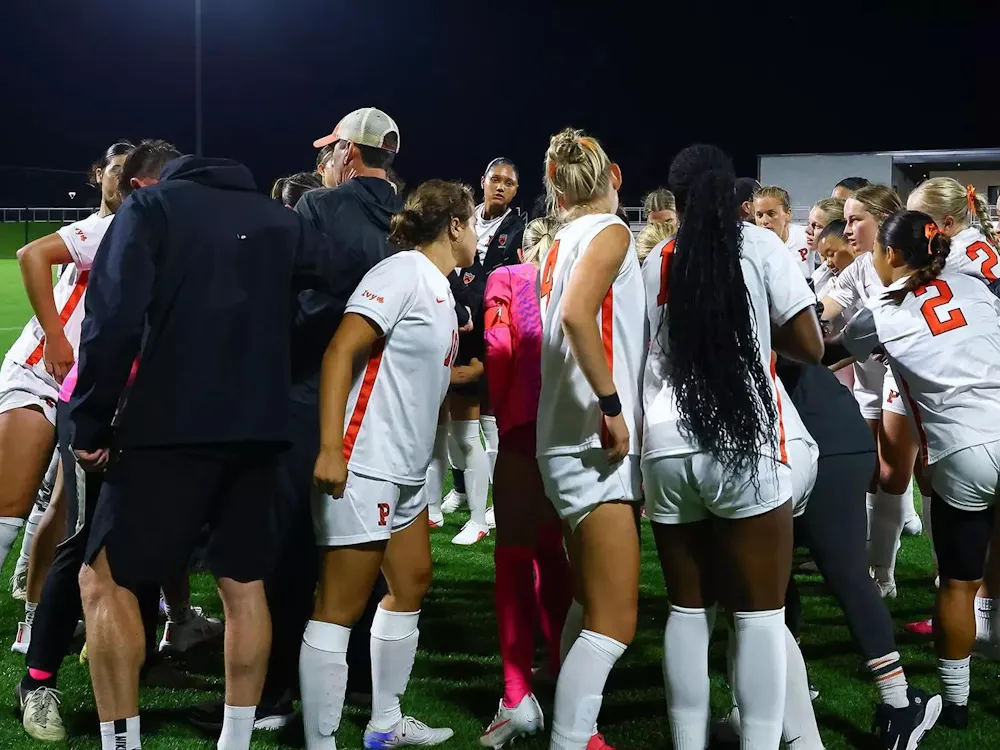
A B1G match-up: Women’s soccer falls to Ohio State
Siena SydenhamNo. 8 Ohio State proved to be a worthy opponent for the Tigers. Two goals in the first 10 minutes gave the Buckeyes momentum, and a second half surge in Princeton’s performance came too late and was not enough to combat the wide OSU lead.
No. 8 Ohio State proved to be a worthy opponent for the Tigers. Two goals in the first 10 minutes gave the Buckeyes momentum, and a second half surge in Princeton’s performance came too late and was not enough to combat the wide OSU lead.