



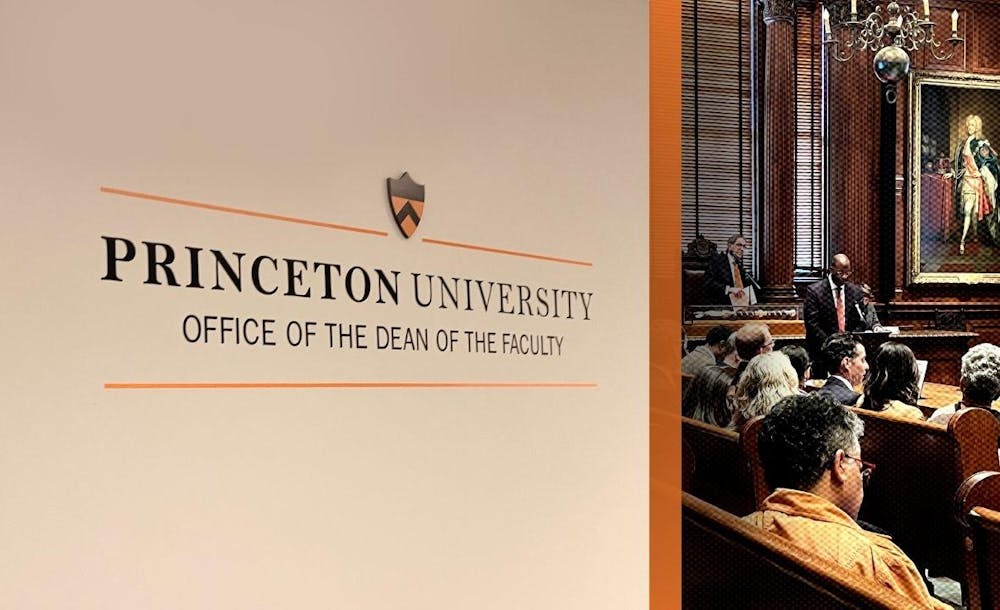
The University has implemented rules prohibiting reporters from recording, photographing, or filming faculty meetings. The new rules went into effect from the May 11 faculty meeting, marking a departure from past practices in which reporters were able to record meetings for transcription and take photographs of the Faculty Room inside Nassau Hall.
The new rules also limit the number of reporters to two per campus publication and stipulate that reporters notify the Office of Communications of their attendance at least 24 hours in advance of meetings. Campus press must also obtain media credentials before each faculty meeting. Campus radio remains permitted to broadcast faculty meetings, though no campus radio station currently broadcasts the meetings.
This follows a broad prohibition of recordings “in an educational, residential, research or workplace setting, including off-campus University sponsored activities” passed by the Council of the Princeton University Community (CPUC) in November 2025. Under the policy, recordings can also be prohibited at public gatherings “when it has been explicitly stated that recording is not permitted.”
Faculty meetings, which are typically held on the first Monday of every month during the academic year, serve as a deliberative forum for faculty members to vote on proposals from faculty and faculty committees. These meetings often include votes on major policies, curriculum changes, and other matters affecting the University.
Major policy decisions are often approved at faculty meetings. Over the past two months, proposals to introduce in-person exam proctoring and shorten winter break beginning in the 2027–28 academic year were voted on and passed at faculty meetings. The Daily Princetonian and Princeton Alumni Weekly (PAW) typically send reporters to cover faculty meetings.
“Our recent guidance clarifying the protocol for observers is designed to ensure faculty can speak openly and candidly at their meetings, consistent with the Rules,” Dean of the Faculty Gene Jarrett ’97 wrote in a statement to the ‘Prince.’
Jarrett clarified that existing provisions in the Faculty’s Rules and Procedures that allow non-faculty observers — including members of the campus press — to attend faculty meetings would “remain in place and will be honored.”
Four faculty that the ‘Prince’ contacted appeared unaware of the new rules, and said that they did not partake in decisionmaking around them.

Campus media leaders raised concerns about the new rules and its implications for reporting accurately on University faculty.
“While we appreciate the University’s desire to make faculty meetings a space where faculty and administrators can speak candidly, those concerns need to be balanced against the need for transparency and reasonable media access,” Editor of PAW Peter Barzilai wrote in a statement to the ‘Prince.’
“The recent decision by the Office of the Dean of the Faculty to restrict press freedoms at Faculty meetings is highly regrettable and creates new obstacles to The Daily Princetonian’s mission of informing the campus community,” Jerry Zhu ’27, editor-in-chief of The Daily Princetonian, wrote in a statement.
“We urge the University and the Office of the Dean of the Faculty to reconsider these restrictions and ensure that the campus press is not unnecessarily encumbered when engaged in legitimate newsgathering,” Zhu continued.
The recording policies for faculty meetings at other universities vary. At Brown University, campus reporters need permission of the secretary of the faculty to attend meetings, and are limited to the “written word,” with cameras, tape recorders, and electronic devices prohibited.
Some peer institutions, including Stanford and Columbia, prohibit photography and audio or video recording during faculty meetings, with their rules predating Princeton’s new procedures.

“We’re not allowed to record or photograph or audio record [faculty senate meetings] in any way,” Sofia Williams, a news managing editor at The Stanford Daily, told the ‘Prince.’ Williams said that reporters must check in with someone prior to entering the meeting room, and that handwritten or typed notes are taken by The Stanford Daily.
“That’s pretty much been the standard for as long as I can remember,” Sterling Davies, a news managing editor at The Stanford Daily, added.
When covering meetings of the Faculty of Arts and Sciences, The Harvard Crimson typically sends two reporters and are not permitted to record photo, audio, or video at meetings. Dartmouth similarly restricts observers from recording general faculty meetings or taking photographs.
Rules governing the Columbia Daily Spectator’s attendance at Arts and Sciences faculty meetings appear more restrictive than its peers. Reporters are prohibited from recording meetings and may use information discussed only “on background,” meaning they can report contextual information but cannot attribute it to the meeting or any speaker.
Slides and numbers presented during the meeting also cannot be quoted without approval from the executive vice president of arts and sciences.
Across the Ivy League, recordings and transcripts from internal meetings have been leaked to members of the national media in recent years. In August 2025, National Review obtained recordings and documents from two Princeton Residential College Adviser sessions on diversity, equity, and inclusion.
Earlier in March 2025, The Free Press obtained a transcript of a private Zoom call with Columbia faculty in which then-interim University President Katrina Armstrong said that Columbia did not plan to meet the Trump administration’s demands to get back $400 million in federal funding.
“In general, people are more hesitant to be recorded in the last couple of months, but I think that’s more like a reflection of the political climate and people being afraid to go on the record, especially if they are international students, for example,” Williams said. “It’s been increasingly more of a complicated conversation about recording people and recording interviews lately.”
Sena Chang is the associate News editor for the ‘Prince’ leading investigations. She is from Japan and South Korea, and she often covers local politics and student life. She can be reached at sena[at]dailyprincetonian.com.
Please send any corrections to corrections[at]dailyprincetonian.com.
A correction was made June 3, 2026: A previous version of this article incorrectly stated that faculty meetings addressed faculty appointments. In fact, faculty appointments are only reviewed by committees of the Faculty and are not discussed during general faculty meetings. The ‘Prince’ regrets this error.
A correction was made June 3, 2026: A previous version of the credit on the photo illustration accompanying this article misstated the author of the illustration. The ‘Prince’ regrets this error.
A correction was made June 4, 2026: A previous version of this article incorrectly stated the rules that govern Brown’s faculty meetings. The article has been updated to reflect the rules listed in Brown’s Faculty Rules and Regulations.
Read More

USG senate adopts statements on Cornell case, data center construction in South Brunswick
Nico David-Fox and Nika SchindlerAt its Sunday meeting, USG unanimously adopted statements calling for Title IX reforms in response to the Cornell case and opposing a South Brunswick data center over health and pollution concerns.
At its Sunday meeting, USG unanimously adopted statements calling for Title IX reforms in response to the Cornell case and opposing a South Brunswick data center over health and pollution concerns.

How ‘Jane Eyre’ helped me find my voice at Princeton
Katharine VenninkContributing Writer for The Prospect Katharine Vennink reflects on a novel that has shaped her voice and identity.
Contributing Writer for The Prospect Katharine Vennink reflects on a novel that has shaped her voice and identity.
Two new fast food restaurants open on Nassau Street
Walker VivianTwo new fast food restaurants, Hotbirds and 7th Street Burger have opened in Princeton over the summer. This comes after three other new fast food spots, BurgerRunn, Food Street, and Best Grill and Fries opened last winter.
Two new fast food restaurants, Hotbirds and 7th Street Burger have opened in Princeton over the summer. This comes after three other new fast food spots, BurgerRunn, Food Street, and Best Grill and Fries opened last winter.