



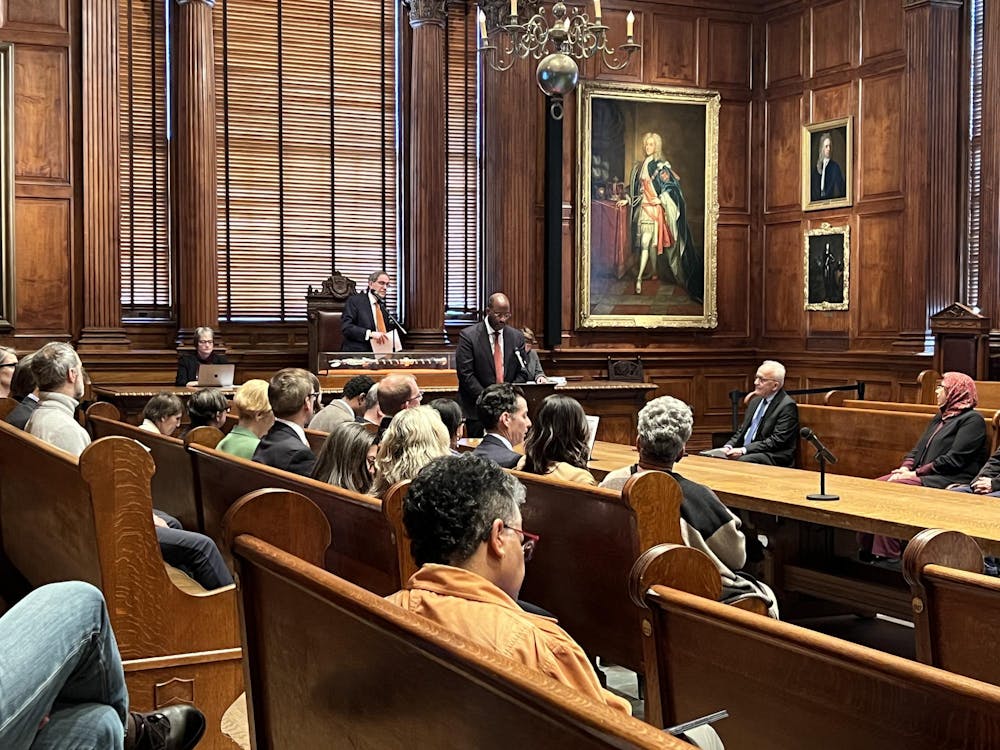
Starting in the 2027–28 school year, winter break will be shortened by six days, with spring term beginning on the first Tuesday after Jan. 16. The proposal, written by the Committee on Classrooms and Schedule and unanimously approved by the Faculty Advisory Committee on Policy in February, was passed with one dissenting vote at the April 6 faculty meeting.
“There were many issues considered by the Committee on Classrooms and Schedule,” Dean of the College Michael Gordin told The Daily Princetonian in an interview following the meeting. Gordin pointed to the gap between the end of fall term exams and the beginning of spring term being longer than peer institutions as well as reducing conflicts between the National Collegiate Athletic Association (NCAA) playoffs and the final assessment period as some of the reasons behind the proposal.
“Five weeks is a very long time for students to be away from campus — especially first-years, who are away from … peer groups that they’ve just made,” Gordin added. He also said that the longer break “produces issues with learning retention, especially in math and languages.”
Starting in the 2027–2028 school year, Commencement Day will fall on the Tuesday between May 16 and May 22. In previous years, Class Day and Commencement have fallen on Memorial Day weekend, requiring staff to work over a holiday.
Prior to the vote at the faculty meeting, Gordin fielded questions from the faculty in the audience. Lecturer in the Princeton Writing Program Echo Thompson raised a question about the impact that a shorter winter break may have on the timeline for independent work.
“There is a trade-off where some students would have six fewer days to do work in January, and other students would have six more days to do work in January, because they will be back on campus,” Gordin responded. He said that while this was a trade-off that the various committees acknowledged, this was a “balanced” approach for the entire student body.
Gabriel A. Vecchi, a geosciences professor and a Princeton Athletics Fellow for the women's hockey team, asked about the impact that the new schedule could have on athletic tournaments. Gordin responded that the changes would “beneficially impact those groups,” citing less conflict with the NCAA playoffs during final assessments, which have often required the rescheduling of exams for student athletes.
Vivian Brennan ’29, a member of the Women’s Swim and Dive team, expressed doubt over general claims that these changes would benefit athletes.

“I don’t know if I would say that it necessarily benefits us, or at least for my sport,” Brennan said. “We try to fit in a lot of meets and that kind of thing during winter break so that we don’t miss class. So it might make us miss one or two more days of class than we would otherwise.”
Other students offered mixed reactions to the policy change. Some expressed disappointment, while others welcomed the change, noting that the current break does not align with the schedules of many peer schools.
For students who do not return home for shorter breaks like Thanksgiving, abbreviating winter break takes away from the little time they had to spend with their families.
“Having such a long winter break has been so helpful for so many students, because for a lot of us, it’s the first time we get to go back home,” Iman Bedru ’28 said.
“[Winter break] is the biggest block of time I get to spend with my family where I don’t have the pressure of needing to be doing something else,” said international student Shaimaa Colaiacovo Abdelhalim ’27.
Allyson Walsh ’27 said that the longer break helped students recover from academic burnout, especially given that Princeton’s semesters are shorter than those at peer institutions.

“I would really like the extra week to go home and just relax,” Walsh said. “It’s sad to see that they are cutting back on it.”
On the other hand, several students described the shorter break as a positive change, saying that the current break does not align with the schedules of many other schools.
“It seemed very long in comparison to everyone else,” Clara Sun ’29 said.
“When I’m home for winter break, most of my friends are already going back to college earlier anyways,” Mark Lancaster ’27 said. “It’s kind of inconvenient ending so late, especially if you’re planning to do a summer internship or travel over the summer, you end up having to start work right after your finals.”
Students also perceived the policy change as reinforcing that Wintersession, which was permanently discontinued in August 2025 due to budget cuts, will not be returning.
“I’m a little sad about [the end of Wintersession] because that was something that I was excited about. I wrote about it in one of my Princeton essays,” Brennan said.
Sun also expressed disappointment, sharing that Wintersession “seems like a really cool experience … it's a shame that we don’t have [it] any more.”
Karen Villanueva ’27 noted concerns over a shortened timeline for junior papers and senior theses.
“If the deadlines don’t move in the semester, it would still be decreasing the amount of time that students would have, typically by a week,” she pointed out.
“As long as the information is communicated clearly and students are given the support they need to make that adjustment between this academic year and next academic year, then it should be a smooth transition,” Villanueva added.
At the faculty meeting, chemical and biological engineering (CBE) professor emeritus Ilhan A. Aksay also read a memorial resolution on the death of chemical and biological engineering professor emeritus Morton Kostin, who passed away at age 89 on May 23, 2025.
Aksay highlighted Kostin’s contributions to quantum mechanics and chemical engineering, noting that Kostin “holds the distinction of longest service by a regular faculty member in the CBE department.”
Aksay concluded his remarks by reading comments from Kostin’s former students, who described him as “a very good teacher” and as “one of the very first or very few chemical engineers at the time working in quantum mechanics to understand molecular dynamics.”
The next faculty meeting will be held on April 20 at 4:30 p.m. in the Faculty Room of Nassau Hall.
Toby Chang is a staff News writer from Prescott, Ariz. He can be reached at toby.chang[at]princeton.edu.
Sena Chang is the associate News editor for the ‘Prince’ leading investigations. She is from Japan and South Korea, and she often covers local politics and student life. She can be reached at sena[at]dailyprincetonian.com.
Please send any corrections to corrections[at]dailyprincetonian.com.
Read More

Princeton’s Baked Bear: a new standout or just bearable?
Alexis ChoiContributing writer for The Prospect Alexis Choi reviews the new Baked Bear location in downtown Princeton.
Contributing writer for The Prospect Alexis Choi reviews the new Baked Bear location in downtown Princeton.

Building community one porch at a time at Princeton Porchfest 2026
Kellen FisherContributing writer for the Prospect Kellen Fisher shares his experience at Princeton Porchfest 2026.
Contributing writer for the Prospect Kellen Fisher shares his experience at Princeton Porchfest 2026.

Princeton Council restricts ICE actions on municipal-owned grounds
Reem TelhaouiCouncil members voted unanimously to bar federal immigration officers from non-public, municipally owned land without a judicial warrant. Residents also urged the Council to reverse its 2024 ban on skating at Lake Carnegie, a decision the municipality is now reconsidering.
Council members voted unanimously to bar federal immigration officers from non-public, municipally owned land without a judicial warrant. Residents also urged the Council to reverse its 2024 ban on skating at Lake Carnegie, a decision the municipality is now reconsidering.