



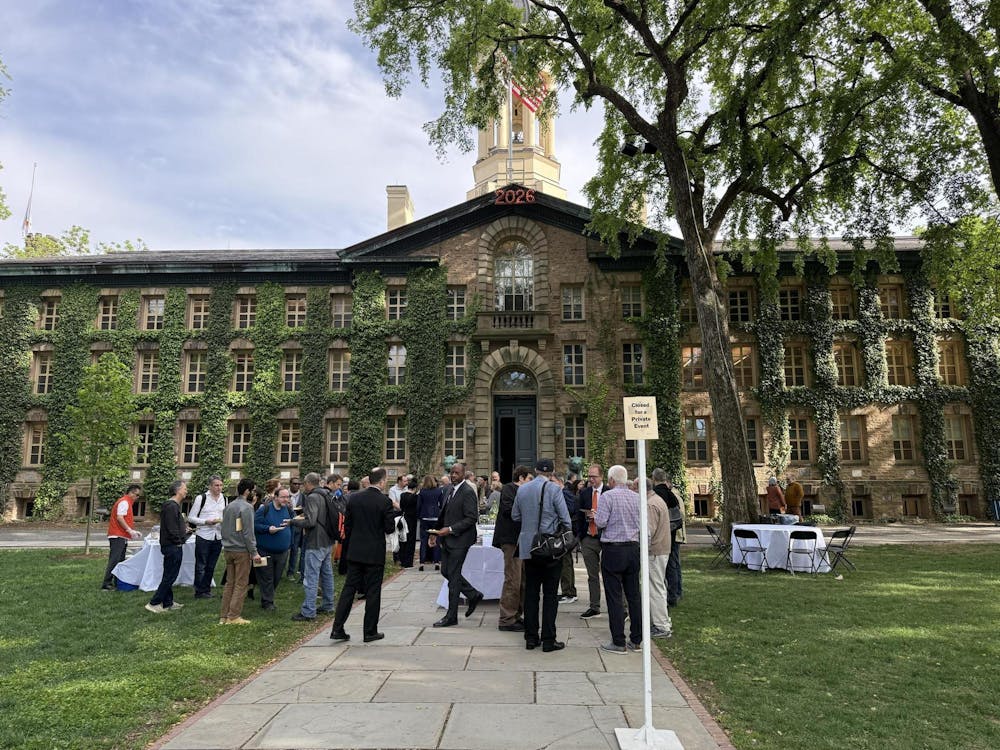
All in-person examinations at Princeton will be proctored starting July 1, representing the most significant change to the honor system since it was established in 1893. The faculty passed a proposal requiring instructor supervision at Monday’s faculty meeting, with one opposing vote.
The historic vote was the culmination of months of deliberation within the administration and student governing bodies about how to address increasing concerns over academic integrity violations, including the proliferation of AI usage. The proposal cleared a full faculty vote as the final of three required rounds of approval, having already been passed unanimously by the Committee on Examinations and Standing and the Faculty Advisory Committee on Policy.
According to the policy proposal, previously sent by Dean of the College Michael Gordin to the Faculty Advisory Committee and included in Monday’s meeting notes, instructors will remain present in exam rooms “as a witness to what happens,” but are instructed not to interfere with students. If a suspected Honor Code violation occurs, proctors will document their observations and submit a report to the student-run Honor Committee, where they may later testify under the same standards used for other witnesses.
The proposal notes that additional details, including proctor-to-student ratios and guidelines regarding monitoring practices, will be finalized in consultation with faculty and student representatives before the policy takes effect.
Princeton’s honor system dates back to 1893, when the faculty first instituted the Honor Code following a student petition to eliminate proctoring during examinations. Since then, the honor system has relied on individual accountability, with students pledging both to refrain from academic dishonesty and to report those they witness in violation.
Following the Honor Code’s original implementation, proctoring was explicitly banned in the Rules and Procedures of the Faculty and the Rights, Rules, Responsibilities of the University, which remained in effect for 133 years up until Monday’s vote.
The policy proposal cites AI and personal electronic devices as major catalysts behind the policy shift. “The ease of access of these [AI] tools on a small personal device have also changed the external appearance of misconduct during an examination,” it reads, making cheating “much harder for other students to observe (and hence to report).”
The proposal also points to a growing reluctance among students to report peers directly. The proposal claims that anonymous reporting of allegations has increased in recent years, fueled by fears of “doxxing or shaming among their peer groups” online.

In The Daily Princetonian’s 2025 Senior Survey of over 500 seniors, 29.9 percent of respondents reported that they had cheated on an assignment or exam during their time at Princeton. 44.6 percent of senior respondents reported knowledge of Honor Code violations that they chose not to report. Only 0.4 percent of seniors responded saying that they had reported a peer for an Honor Code violation.
An Undergraduate Student Government survey of students cited in the proposal reportedly found that “a majority would favor proctoring or are indifferent to any change,” though a “sizeable minority opposes it on the grounds that students should behave honorably, and that faculty and students should trust each other given the 1893 Honor Code compact.”
Similarly, students and faculty previously interviewed by the ‘Prince’ expressed divided views on the policy’s implementation. Some cited the inadequacy of the current student reporting model, while others said the introduction of proctors could erode the trust that defines Princeton’s academic culture.
The historic change comes in the wake of a November policy change mandating proctoring for all individual and small-group exams, including make-up exams, exams taken by student-athletes while traveling, and exams taken with disability accommodations.
In a March guest Opinion column in the ‘Prince,’ Honor Committee Chair Emerita Nadia Makuc ’26 wrote that the Honor Committee, which adjudicates suspected violations of the Honor Code during in-person examinations, had long discussed introducing proctors as an additional witness and reporter in exam rooms, and that the time had come to take that step.
“The Honor Committee has experienced new strains, including an uptick in cases in the last year and challenges such as generative AI, and student sentiment has recognized that its procedures need to better reflect the current challenges to academic integrity,” Makuc wrote.

Honor Committee hearings are confidential, student-led proceedings addressing potential violations of the Honor Code. Accused students can present defenses, call witnesses, and be assisted by a Peer Representative. If students are found responsible for Honor Code violations, the maximum penalty that can be assigned is expulsion.
William Aepli ’26, former co-chair of the Peer Representatives, which advises students accused of academic integrity violations, previously told the ‘Prince’ that his organization would likely see changes in the type of evidence presented in hearings in Honor Committee hearings.
The Honor Committee Constitution and the Honor Code itself will not need to be changed following the institution of proctoring. Gordin previously confirmed to the ‘Prince’ that just the Rules and Procedures of the Faculty and Rights, Rules, and Responsibilities will need to be updated.
The section of the Rules and Procedures of the Faculty that previously banned proctoring will replace those lines with language mandating instructor supervision during in-person examinations, according to the proposal. A one-sentence revision to Rights, Rules, and Responsibilities will be made before the start of the new academic year.
The proposal states that Gordin met with and received endorsements on the policy from “current and former student chairs of the Honor Committee; colleagues from the Office of the Dean of Undergraduate Students and the McGraw Center for Teaching and Learning; the Faculty-Student Committee on Discipline; and the Academics Chair of the Undergraduate Student Government.”
“Undergraduates and faculty are realistic in understanding that having an instructor supervising examinations will not eradicate cheating,” the proposal notes. “However, they believe that there will be a significant deterrent effect, and that having an additional witness in the room will reduce pressure on students to notice and report concerns while they are themselves completing exams.”
Multiple faculty members declined to comment on the new policy following the meeting. Professor of English and Theater Jill Dolan, who served as dean of the college from 2015 to 2024, briefly discussed the change in an interview with the ‘Prince.’
“I think it’s a shame, but it’s necessary,” Dolan said. “But I also do understand why it passed. I think we need some different practices in this day and age, but it does mark a moment.”
Devon Williams is a News contributor for the ‘Prince’ from Menlo Park, Calif. She can be reached at dw9268[at]princeton.edu.
Luke Grippo contributed reporting.
Please send any corrections to corrections[at]dailyprincetonian.com.
Read More
USG provides input on VP for Campus Life selection process, continues election reform debate
Claire DingAt its Sunday meeting, USG weighed in on the search for Princeton’s next vice president for campus life, backed an effort to permit campus chalking, and continued debating election reforms.
At its Sunday meeting, USG weighed in on the search for Princeton’s next vice president for campus life, backed an effort to permit campus chalking, and continued debating election reforms.

Amid budget cuts, Princeton Annual Giving campaign raises second-highest amount in history
Benedict HooperPrinceton’s Annual Giving campaign raised $79.6 million in 2025–26, its second-highest total ever, even as alumni participation continued to decline amid broader University budget uncertainty.
Princeton’s Annual Giving campaign raised $79.6 million in 2025–26, its second-highest total ever, even as alumni participation continued to decline amid broader University budget uncertainty.

‘Now Princeton has gone and done it’: The Critical Languages Program and its former students
Lucia ZschocheThe Critical Languages Program, which ran between 1963–1972, gave students — both men and women — from partnering universities the opportunity to attend Princeton. Its students look back on their experiences and the program’s legacy.
The Critical Languages Program, which ran between 1963–1972, gave students — both men and women — from partnering universities the opportunity to attend Princeton. Its students look back on their experiences and the program’s legacy.