



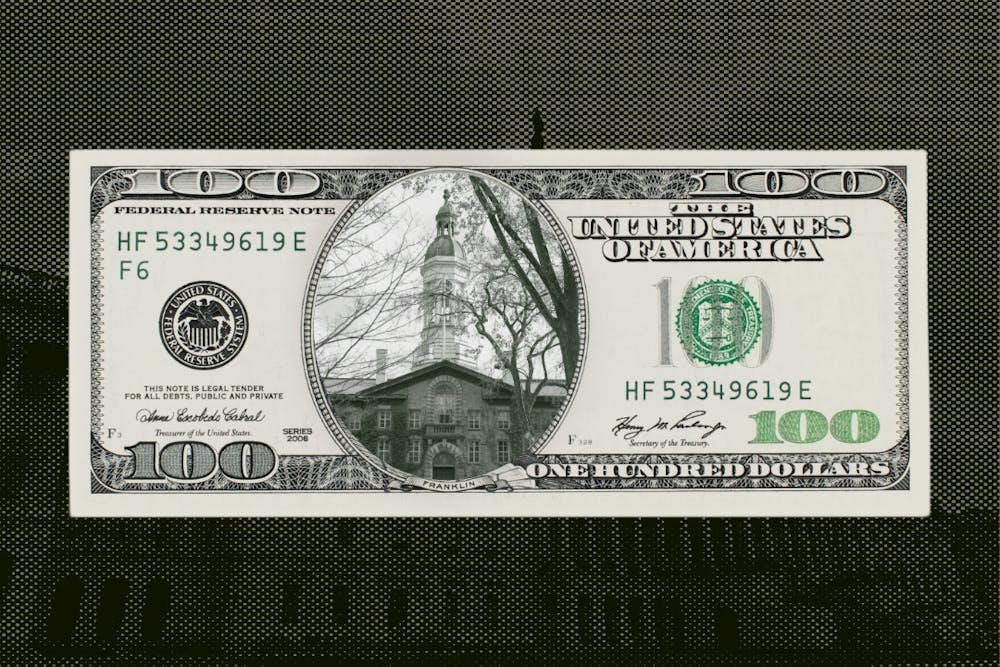
Princeton will not have to pay any net investment income tax on returns from its $36.4 billion endowment, a University investment official said at a private event in January, after a recent expansion of its undergraduate financial aid program left the University below a 3,000 tuition-paying student threshold to qualify for taxation. Experts had projected that the new tax on wealthy university endowments — enacted under H.R. 1, the omnibus tax and spending bill passed by congressional Republicans in July 2025 — would have cost Princeton roughly $180 million annually.
The 8 percent endowment tax was predicted to impose one of the country’s highest university tax burdens on Princeton, which currently enrolls 9,100 undergraduate and graduate students. According to University President Christopher Eisgruber ’83, recent widespread budget cuts have been driven by decreased long-term endowment projections — growth estimates that likely would have been further eroded if the University were required to pay the tax.
The University currently pays out about 5.35 percent every year of its $36.4 billion endowment — the fourth-largest in the country — which accounts for 64 percent of annual revenue and supports key University priorities such as financial aid. The revised tax modified a provision enacted in 2017 that imposed a 1.4 percent excise tax on investment income at wealthy private colleges with over 500 students, which the University has since paid annually.
In interviews with The Daily Princetonian, several attendees of the Princeton Class Leadership Conference in January confirmed that Princeton University Investment Company Managing Director Susan Ciniglio ’09 said the University’s endowment was exempt from the tax, set to kick in for the fiscal year starting on July 1, 2026.
According to the attendees, who were granted anonymity to speak about the closed-door event, Ciniglio stated that the number of tuition-paying students at the University was under the 3,000 threshold to qualify for the tax, in response to an audience question. This comes after a $44 million expansion of the financial aid program for the 2025–2026 academic year, which eliminated tuition for most families making less than $250,000 and followed previous aid increases.
The University has previously declined to share the number of tuition-paying students it enrolls.
In a statement to the ‘Prince,’ University spokesperson Michael Hotchkiss wrote that “Princeton University fully complies with all its tax obligations. Our payments under the revised tax will be calculated and disclosed in 2028, as required by the government.”
PRINCO and Ciniglio did not respond to requests for comment.

In July, amid several Trump administration attacks on higher education, Congress set the 8 percent tax rate for universities with over $2 million in endowment funds per student and over 3,000 tuition-paying students. At around $3.9 million in endowment funds per student, Princeton was expected to be subject to the tax, and many of its peer institutions are still likely to pay hundreds of millions annually.
“The endowment tax is a serious threat to Princeton and other top research universities which it targets,” Hotchkiss wrote. “It reduces the higher education sector’s ability to provide student financial aid and to make investments in research and teaching that support U.S. prosperity, innovation, and security. We continue to advocate against it.”
Republicans argued the new tax increase was intended to ensure elite universities with massive endowments contributed more federal revenue, arguing that the schools had benefited from favorable tax treatment. House Ways and Means Committee Chairman Jason Smith wrote after the tax was enacted that the measure would “hold woke, elite universities that operate more like major corporations accountable.”
The new endowment tax emerged in 2025 as one of Princeton’s federal lobbying priorities. In the first quarter of 2026, it spent its second-highest quarterly total ever on lobbying, $240,000, part of which was focused on the endowment tax.
In a September 2025 interview with the ‘Prince,’ Eisgruber briefly discussed a lobbying group he organized, which included about two-dozen peer institutions and discouraged the implementation of an increased endowment tax. One of the group’s proposals was reportedly to implement a mechanism to spare universities that increased spending on financial aid.
Emeritus Professor of Economics Burton Malkiel GS ’64, who has publicly written about how universities benefit from the illiquid assets of endowments, called the University’s endowment tax strategy a “brilliant response to a punitive and discriminatory tax.”

The expansion of financial aid “increases our income and produces much-needed student support,” he wrote to the ‘Prince.’
However, not all experts on the matter shared Malkiel’s view.
Economics and public affairs professor Owen Zidar took fault with what he saw as a lack of transparency in the University’s financial operations.
“It’s remarkable how little input faculty have had in this process despite the material implications for research and teaching,” Zidar wrote.
Professor Edward Zelinsky of Cardozo Law School, a legal scholar and expert in tax policy, believes that some funds from all endowments — including those of universities, private and community foundations, and donor-advised funds — should be directed to the federal government.
“I really think that the appropriate law, which is far from where we are today, is a flat tax, where every such institution pays the same amount to help the federal government,” Zelinsky said in an interview with the ‘Prince.’ “So from that vantage, I would say it’s not a good thing that Princeton is able to avoid the tax.”
However, he affirmed the legality of Princeton’s expansion of financial aid as a mechanism to avoid the tax.
“Assuming that Princeton has been able to adopt policies so that it is below the 3,000 student threshold, then that strikes me as a legally appropriate position for Princeton to take,” Zelinsky said.
He argued that the endowment tax should not function as a regulatory tool to influence university behavior. He noted that some supporters of the law — including Senator Chuck Grassley, an early advocate of the original endowment tax — viewed wealthy university endowments as underutilized and wanted institutions to direct more resources toward students.
University administrators have consistently pushed back on this notion, pointing to the nationally recognized financial aid program and robust academic opportunities made possible by the previously tax-free status of the endowment.
“For better or worse, we have the social overhead of the federal government, and an income tax ideally should be a tax that is economically neutral … that tries to impose its obligations similarly on similar institutions,” Zelinsky added.
Princeton’s total enrollment falls well below that of peer institutions such as Harvard, Stanford, and Yale, which remain likely to pay hundreds of millions due to the 8 percent tax.
These institutions have responded to the expanded endowment tax with austerity measures. In June 2025, Stanford University announced plans to reduce its operating budget by $140 million, citing “federal policy changes” including increased taxes on university endowments, while also extending a staff hiring freeze and delaying some capital spending.
Harvard extended a university-wide hiring freeze as administrators warned that federal actions, including the higher endowment tax, could place as much as $1 billion in annual revenue at risk. Yale, meanwhile, announced spending cuts and hiring slowdowns while emphasizing that most of its endowment consists of donor-restricted funds dedicated to financial aid, research, and academic programs.
A July Opinion column by Isaac Barsoum in the ‘Prince’ argued that Princeton could potentially avoid the expanded federal endowment tax by increasing financial aid enough to reduce the number of tuition-paying students counted under the law.
Barsoum noted that the University was uniquely positioned to avoid the tax because, unlike many peer institutions, it lacked large tuition-paying law and medical schools and had a comparatively small student body already receiving strong financial support.
After aid expansions in August, subsequent reporting by the ‘Prince’ estimated that the share of students paying tuition had declined to around 3,000 as more undergraduates qualified for substantial aid.
Gray Collins is the assistant News editor for the ‘Prince’ leading University administration coverage. He is from outside of Philadelphia and can be reached at graycollins[at]princeton.edu.
Nico David-Fox is a head News editor for the ‘Prince.’ He is from Washington, D.C. and often covers breaking news. He can be reached at ndf[at]dailyprincetonian.com.
Please send any corrections to corrections[at]dailyprincetonian.com.
Read More

USG provides input on VP for Campus Life selection process, continues election reform debate
Claire DingAt its Sunday meeting, USG weighed in on the search for Princeton’s next vice president for campus life, backed an effort to permit campus chalking, and continued debating election reforms.
At its Sunday meeting, USG weighed in on the search for Princeton’s next vice president for campus life, backed an effort to permit campus chalking, and continued debating election reforms.

Amid budget cuts, Princeton Annual Giving campaign raises second-highest amount in history
Benedict HooperPrinceton’s Annual Giving campaign raised $79.6 million in 2025–26, its second-highest total ever, even as alumni participation continued to decline amid broader University budget uncertainty.
Princeton’s Annual Giving campaign raised $79.6 million in 2025–26, its second-highest total ever, even as alumni participation continued to decline amid broader University budget uncertainty.

‘Now Princeton has gone and done it’: The Critical Languages Program and its former students
Lucia ZschocheThe Critical Languages Program, which ran between 1963–1972, gave students — both men and women — from partnering universities the opportunity to attend Princeton. Its students look back on their experiences and the program’s legacy.
The Critical Languages Program, which ran between 1963–1972, gave students — both men and women — from partnering universities the opportunity to attend Princeton. Its students look back on their experiences and the program’s legacy.