



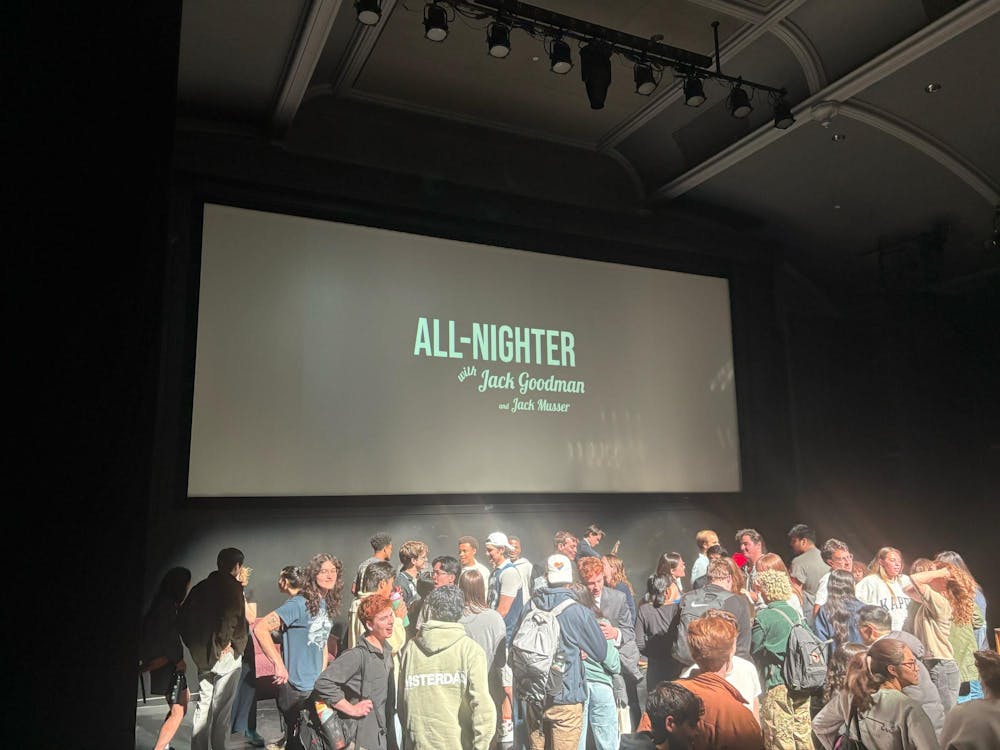
If you know where to look, the wealth of opportunities to watch and create comedy on Princeton’s campus is staggering. With the wide range of satire and improv institutions on campus, it’s difficult for any one option — however hilarious — to stand out from the crowd.
For All-Nighter, however, Princeton’s sole “late-night” comedy show that features a mix of SNL-esque sketches, “The Tonight Show”-style interviews, and campus group performances, standing out has never been a problem. The group consistently runs out of tickets within mere hours of their initial sale. The hosts change every year, and are always seniors chosen by the previous year’s hosts. The Daily Princetonian sat down with current All-Nighter host and co-host Tyler Wilson ’26 and Sophia Shepherd ’26, as well as one of the show’s head writers, Luke Miller ’26, and executive producer Georgia Martin ’27, to discuss the work that goes into crafting each episode and what makes All-Nighter so special.
The Daily Princetonian: Tyler and Sophia, what is it like for you guys working as a comedic duo? How well did you know each other before you started? What has your dynamic kind of been like throughout the show?
Sophia Shepherd, co-host: I—
Tyler Wilson, host: Umm … you go first. Well, that happens.
SS: I would say, before starting as host and co-host, we were friends, but not…
TW: Lovers.
SS: …close friends, and not lovers, as we are now, just kidding. We were actually just thinking about this yesterday because there’s one random photo from freshman year of us that was taken by the Princeton photographer, but then no photos until we became…

SS & TW: Host and co-host.
DP: Is there anything you guys as hosts do to prepare yourselves to go on stage, or do you just wing it?
TW: We have a ritual for sure.
SS: We have a ritual.
TW: The day of a show, my ritual begins a little earlier, at 10 a.m. with Luke and Jack [Goodman ’27, co-head writer], either on Zoom or not, and maybe one of my roommates, and we’re in my room, we write the monologue for the episode, like the day of, because it’s fun to keep it fresh, and for there to be a little pressure on it, I think, and for me to not overly rehearse it, and also, obviously, topical, if something happens the night before…Also, it’s kind of better trying to write that kind of stuff with the perspective of, this is the day that it’s happening. So what feels most relevant this day. But we do that, and then Sophia and I go to McCosh Hall 10 at some point in the afternoon, and we run all of our lines from the top of the show to the end multiple times together. And that’s usually when…we show up, and she’s memorized and fine, and I’m halfway there, but during that process is when I get memorized, and we figure out our blocking, and it’s great.
I don’t know what you do in between that time and the show. That’s a mystery to me. I always exercise beforehand. I do this for Fuzzy Dice, too, but I go to the gym. I do 30 minutes of cardio. Ideally, I listen to a mixture of at first pop and hip hop, and then I listen to show tunes. And then I go to the shower, and I take a deep scrub shower, and then I get my suit on, and I’m ready to go!

SS: He doesn’t just do cardio. I would say he runs up the StairMaster as fast as you could for 30 minutes.
TW: I’m going to do it tonight.
DP: Luke, can you talk us through a typical process for writing an episode of All-Nighter?
Luke Miller, co-head writer: Usually, the cycle is about two or three weeks before the show, we have a pitch meeting; it’s like a one-hour portion where the writers and everyone here, in a pressure-free environment, can say whatever idea they have. I remember the first pitch I gave was frat bros discovering what the term sodomy means. So there’s a really low bar for pitch.
And so that’s the first meeting. And then typically, we’ll have writers’ read one week after that, where the writers present sketches they’ve written, usually in pairs or by themselves. And then, typically one week later, we have actors’ read, where we read all the sketches with the actors that will be in the show. And then after that, the exec team chooses which sketches to put in the show, typically around four or five.
While this is happening, we are writing the show, doing the transitions, typically around a week and a half before … me, Jack Goodman, and these two [Wilson and Shepherd] will meet probably four or five times to write the respective transitions. We do it in one-hour blocks, but it’s a great time. We kind of just bounce ideas, and we decide the frame of the show.
DP: How do you envision all-nighters’ comedic voice, and what kind of comedy have you been trying to cultivate during your time as head writer?
LM: I think Jack and I work really well together; [we] have more distinct senses of comedy. I think we can kind of be absurdist at times, we kind of play into the fact that it’s like … of course, you can kind of compare it to SNL, but I think we can be a little bit more…
Georgia Martin, executive producer: We’re better.
LM: I think we’re better primarily, but we can be a little bit more off the rails, a bit more untraditional, and so I think it’s …Well, I don’t know. I’m curious what you guys would say about what’s our sense of comedy, generally? I’m trying to define it. It cannot be defined. I do think it changes a lot, episode to episode. I think there’s always some graphic jokes in there. They’re kind of funny. Some clever wordplay, maybe.
SS: Some clever wordplay, but also some stupid wordplay.
LM: Some stupid wordplay, yeah. I think we’re not afraid to play into really stupid jokes or physical comedy.
DP: Georgia, what’s one big challenge that you faced? Has something fallen through on the last day that you then had to … I mean, I’m sure that’s happened.
GM: Yeah, one time we were gonna interview Dora from the U-Store, she couldn’t do it. We got my dear friend, Quentin Colón-Roosevelt, that was great. Tech stuff happens all the time. In the third episode, there was gonna be a video transition. The video didn’t work. So that was a really stressful moment. All of prod was on headsets, just like, bro, I can’t do this right now, I can’t do this right now. It was a mess. But we figured it out. We got the video to play. It was good. We’ve had a bunch of stuff like that.
Last year at the Reunions episode, someone threw a can of beer from the balcony … it got on Frist Theater’s lights, and we were like, please don’t be an issue, please don’t be an issue. It wasn’t an issue. But yeah, I remember everything. And it looked like something had sparked because of the beer and the lights. Something’s always going wrong. It’s all about putting out little fires.
DP: How do you all see All-Nighter’s role on Princeton’s campus, in the performing arts scene specifically?
TW: I think in terms of our role within the performing arts sphere, All-Nighter ends up being a junction for lots of groups and people and interests, because we have dance groups that we bring on the show, we have a capella groups … student bands … et cetera, et cetera. That’s really fun, and there really aren’t a ton of opportunities, or at least regular opportunities, to do that, where you could have Body Hype performing right after Princeton Taekwondo, right after Shere Khan, in a series of shows.
Also the way that our writing and acting function … and even our band, like our house band, the people who are on every single show, not just guests, those people are also coming from all over the place, people who maybe just play an instrument because they’re a really talented musician, but they’re not in a band or something, but they’re in our band. Or you have people who are really dedicated actors, who are doing [Theatre] Intime stuff or whatever, who do act in our episodes, or you have people who’ve never acted their entire life, who just are funny and have a talent for the thing, and can deliver lines well. And so then they act in our episodes. And I’ve had people this year who I’ve encouraged, reached out to be like, you’re really funny, you should act in All-Nighter. And they’re now repeats… it makes me super happy that there are people who feel like they can get a platform or a stage through us, because something I’ve learned in my four years here is it’s a real privilege to have that stage. It’s not really an easy thing here to be able to get up on stage and say something.
The last show of All-Nighter Season 14 will take place during Reunions.
Lily Hutcheson is a member of the Class of 2028 and a senior writer for The Prospect and a contributing constructor for the Puzzles Section.
Please send any corrections to corrections[at]dailyprincetonian.com.
Read More
Trump picks Will Scharf ’08 as new White House counsel
Sena Chang and Oliver WuScharf will enter the new position on Sept. 1, Trump announced in a social media post. While at Princeton, Scharf was the Charter Club and Interclub Council president, ran unsuccessfully for Undergraduate Student Government president, and was active in Jewish groups and conservative organizations.
Scharf will enter the new position on Sept. 1, Trump announced in a social media post. While at Princeton, Scharf was the Charter Club and Interclub Council president, ran unsuccessfully for Undergraduate Student Government president, and was active in Jewish groups and conservative organizations.
Suspended male Princeton student’s Title IX lawsuit against U. can proceed, appeals court rules
Sena ChangA federal appeals court ruled on July 21 that a Title IX lawsuit brought by a male undergraduate student can move forward.
A federal appeals court ruled on July 21 that a Title IX lawsuit brought by a male undergraduate student can move forward.
Princeton professors awarded NEH grants months after lawsuit
Luke GrippoMonths after a federal judge ruled that the sweeping cancellation of National Endowment for the Humanities (NEH) grants in 2025 was unconstitutional, two Princeton University professors — Eve Krakowski and Marina Rustow — were awarded new NEH grants.
Months after a federal judge ruled that the sweeping cancellation of National Endowment for the Humanities (NEH) grants in 2025 was unconstitutional, two Princeton University professors — Eve Krakowski and Marina Rustow — were awarded new NEH grants.