



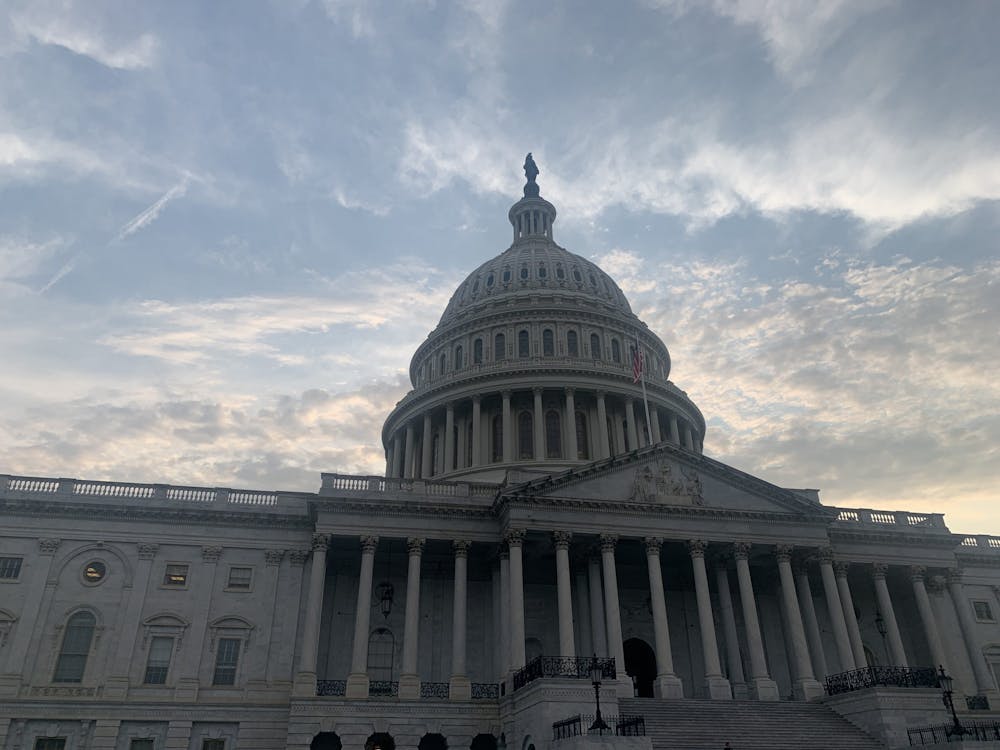
Princeton spent $240,000 on congressional lobbying in the first three months of the year, the second-highest spending total of any quarter in recorded history. The University’s Lobbying Disclosure Act filing shows lobbying efforts spanning issues including scientific research, financial aid, immigration issues, and the recently increased endowment tax.
The increased spending comes after the Trump administration cut hundreds of millions of dollars in federal grants to the University, investigated Ivy League institutions over allegations of antisemitism, and ended a program sponsoring active-duty service members in graduate studies.
In a statement to The Daily Princetonian, University spokesperson Jennifer Morrill wrote, “The University advocates with lawmakers and their staff on issues of importance to higher education, with the goal of enabling the University to continue pursuing its research and teaching mission.”
Quarterly lobbying expenditures at many universities across the country have increased over recent quarters, in line with Princeton’s near doubling of its usual low-to-mid $100,000 allocations over the past decade. Princeton spent the third-most on lobbying efforts in the Ivy League, trailing Yale and the University of Pennsylvania.
In response to a question about why this quarter’s lobbying spending was higher than normal, Morrill said the filing “included funding to support the Association of American Universities (AAU) related to their lobbying activities on behalf of research universities.” The AAU reported over $125,000 in lobbying spending in its own disclosure, aimed largely at laws affecting research funding.
Assistant Vice President for Government Affairs Julie Groeninger and Director of Government Affairs David Bagby carried out the lobbying work in Washington, D.C. on behalf of the University. Both have extensive histories working on Capitol Hill as aides to Democratic senators and representatives. Groeninger and Bagby did not respond to requests for comment in time for publication.

Morrill said the University advocates for “sensible legislation around higher education, tax, science, and immigration policy, which includes efforts to make higher education more affordable and accessible, particularly for low- and middle-income students.”
The University also conducted lobbying efforts on the net investment income tax on university endowments, which was raised to eight percent for certain elite schools. Brown, Dartmouth, Harvard, Stanford, and Cornell University also lobbied on issues related to the endowment tax, according to their most recent disclosures.
According to Princeton’s disclosure, Groeninger lobbied on “issues related to international students, faculty, scholars, & staff, including the Deferred Action for Childhood Arrivals Program [DACA], Optional Practical Training, Temporary Protected Status, visa processing delays, visa revocations, travel restrictions, duration of status, & H-1B Fees.”
Princeton admits undocumented immigrants, and University President Christopher Eisgruber ’83 previously urged Congress to give long-term protection to people enrolled in the Deferred Action for Childhood Arrivals (DACA) program. Some faculty are on H-1B visas, for which Trump imposed a $100,000 additional fee to obtain last September. The Davis International Center advised international students to carry key forms after U.S. Immigration and Customs Enforcement actions on college campuses last year.
According to the disclosure, representatives from the Office of Government Affairs specifically discussed fusion energy, quantum computing, neuroscience initiatives, the National Endowments for the Humanities and Arts, and Department of Defense research, among other areas, in relation to appropriation bills for the 2026 and 2027 fiscal years.
Groeninger and Bagby talked with senators and representatives about the Princeton Plasma Physics Lab, a multi-billion-dollar joint venture between the University and the Department of Energy. According to the filing, they discussed “issues related to funding pauses and grant cancellations at DOE,” as well as the importance and possible commercial viability of nuclear fusion research.

“Princeton’s policy priorities in Washington, D.C. include funding for the federal research agencies, support for fusion energy research and the DOE national laboratories,” Morrill wrote to the ‘Prince.’
Federal funding pauses and cancellations were mentioned multiple times throughout the document, in relation to government military and space programs.
The University also lobbied to enact the Financial Accountability in Research (FAIR) model in the 2027 appropriations bill. Supported by the AAU and universities including Yale, FAIR is an updated structure that aims “to increase transparency, accountability, and clarity in federal research funding.”
The Defending Education Transparency and Ending Rogue Regimes Engaging in Nefarious Transactions (DETERRENT) Act, which seeks to increase regulations relating to reporting foreign gifts in higher education, was another focus of the advocacy efforts.
During Eisgruber’s tenure as chair of the AAU, the organization released a letter condemning the act, saying it would hamper international exchange programs and fail to protect scientific research.
Princeton, as well as Yale, Stanford, and other institutions, lobbied on the Student Compensation Through Rights and Endorsements (SCORE) Act, a piece of legislation that aims to reform the college sports environment, which has been upended since student-athletes have been able to receive compensation for use of their name, image, and likeness.
The lobbyists also covered “efforts to limit military programs at certain institutions.” In February, Secretary of Defense Pete Hegseth ’03 announced that the Department of Defense would end a program which sponsors active-duty military personnel in Princeton graduate programs.
The lobbying disclosure for the second fiscal quarter of 2026, which covers the period from April to June, will be released in July.
Gray Collins is the assistant News editor for the ‘Prince’ leading University administration coverage. He is from outside of Philadelphia and can be reached at graycollins[at]princeton.edu.
Please send any corrections to corrections[at]dailyprincetonian.com.
Read More
USG provides input on VP for Campus Life selection process, continues election reform debate
Claire DingAt its Sunday meeting, USG weighed in on the search for Princeton’s next vice president for campus life, backed an effort to permit campus chalking, and continued debating election reforms.
At its Sunday meeting, USG weighed in on the search for Princeton’s next vice president for campus life, backed an effort to permit campus chalking, and continued debating election reforms.

Amid budget cuts, Princeton Annual Giving campaign raises second-highest amount in history
Benedict HooperPrinceton’s Annual Giving campaign raised $79.6 million in 2025–26, its second-highest total ever, even as alumni participation continued to decline amid broader University budget uncertainty.
Princeton’s Annual Giving campaign raised $79.6 million in 2025–26, its second-highest total ever, even as alumni participation continued to decline amid broader University budget uncertainty.

‘Now Princeton has gone and done it’: The Critical Languages Program and its former students
Lucia ZschocheThe Critical Languages Program, which ran between 1963–1972, gave students — both men and women — from partnering universities the opportunity to attend Princeton. Its students look back on their experiences and the program’s legacy.
The Critical Languages Program, which ran between 1963–1972, gave students — both men and women — from partnering universities the opportunity to attend Princeton. Its students look back on their experiences and the program’s legacy.