



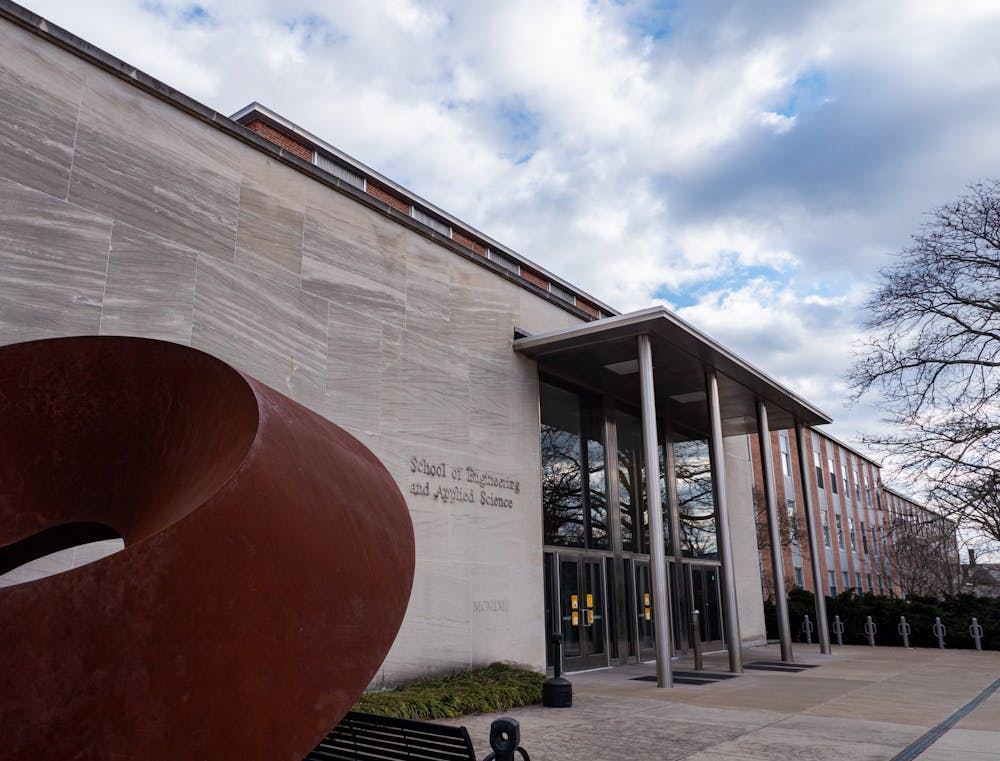
The School of Engineering and Applied Science (SEAS) will allow engineering undergraduates to choose their departments at the end of sophomore fall instead of in the spring of freshman year, starting with the incoming Class of 2030.
The new policy, which will delay the B.S.E. declaration timeline by a semester, marks a significant shift in the undergraduate engineering program and will provide students with additional time to solidify academic plans.
“Since assuming deanship of SEAS, I have worked with my engineering colleagues to implement this timeline change, which will be supported through modifications of our advising structure,” wrote SEAS dean Andrew Houck ’00 in a statement to The Daily Princetonian.
Houck took over as dean last August from Andrea Goldsmith, who left Princeton to become president of Stony Brook University.
“Our new declaration timeline will mean that all B.S.E. students can take departmental courses prior to declaring a major,” Houck added.
The current timeline for engineers requires all students to take prerequisite courses in mathematics, physics, chemistry, and computing in their freshman year and department-specific requirements in their sophomore fall.
B.S.E. students declare their majors typically after just two semesters on campus, whereas A.B. students do not declare their concentrations until the spring of sophomore year.
“While we cannot align with A.B. sophomore spring declaration — our students must launch sooner into the work of their departments — we are confident that a sophomore fall declaration gives students the longer runway they’ve been seeking to explore the curriculum and evaluate their goals,” Houck continued.

The change gives engineering students additional time to explore disciplines before committing to a major and addresses concerns raised by some students about declaring with limited exposure to departmental coursework. These concerns align with the feedback that Houck has received since entering his role earlier in the academic year.
“We have also heard from students that the summer after the first year is a crucial period for reflection, often prompting reconsideration of academic and preprofessional pathways,” Houck wrote. “The later declaration timeline will encourage students to act on their evolving interests.”
While Adrian Mak ’29 was always set on becoming a mechanical and aerospace engineering major, he said that “for my friends who were a little more indecisive, maybe that one semester difference could give them a bit more opportunity to figure out which of the majors, specifically, they would want to declare.”
Mak personally knows several B.S.E. majors doing engineering research with professors over the summer and believes that the new policy will give future students in a similar position more leeway to decide whether they are interested in pursuing that particular kind of work.
The new policy will put the engineering declaration timeline more in line with peer institutions. Cornell, Stanford, and MIT all allow engineering students until at least the end of sophomore year to declare.
Mak, who will take three MAE sophomore prerequisites next semester, expressed concerns about the ability of engineering students to fulfill their specific major’s sophomore requirements if not decided on their major by freshman spring.

If students attempt to parallel plan for multiple engineering degrees with stringent requirements, he added, they might end up unduly compromising their social lives and extracurricular obligations.
“For example, if the advising mechanisms can ensure someone who is taking MAE courses sophomore fall, but then afterwards wants to change to a different B.S.E. major, and they can still keep on track … I think that’d be a good thing,” Mak said.
Rose Weathers ’27, an electrical and computer engineering major, said she was skeptical the change would have a meaningful impact for most students. She noted that sophomore fall is when B.S.E. course requirements begin to diverge across departments, meaning students would still face pressure to have effectively decided by then regardless of when they officially declare.
“I feel like the effect is kind of the same where you have to make up your mind freshman spring,” she said.
Weathers added that the benefit of the extra semester would depend heavily on which majors a student was deciding between. For students torn between electrical and computer engineering, computer science, and operations research and financial engineering — which share many course requirements — the extended timeline could be useful, Weathers noted. But for others, she believes the structural reality of the curriculum would remain similar.
“If you’re not sure what B.S.E. major you want to do, your sophomore fall is going to be five really hard engineering classes in the different departments you’re deciding between. In reality, no one’s going to want to do that,” Weathers said.
Nico David-Fox is a head News editor for the ‘Prince.’ He is from Washington, D.C. and often covers breaking news. He can be reached at ndf[at]dailyprincetonian.com.
Please send any corrections to corrections[at]dailyprincetonian.com.
Read More

No. 8 field hockey falls to No. 10 Harvard in shootout, 4–2
Emilia ReayNo. 8 Princeton fell to No. 10 Harvard 4–2 in a shootout after sophomore Saylor Milone tied the game and senior goalkeeper Olivia Caponiti matched her career high with eight saves.
No. 8 Princeton fell to No. 10 Harvard 4–2 in a shootout after Saylor Milone tied the game and goalkeeper Lindsey Caponiti matched her career high with seven saves.

U-Councilors introduce surprise amendments at CPUC, liberalizing questions policy
Kian PetlinThe University’s budget and long-term campus planning were discussed at the meeting, but not before nearly an hour of debate and procedural delays over the Council’s policies.
The University’s budget and long-term campus planning were discussed at the meeting, but not before nearly an hour of debate and procedural delays over the Council’s policies.

PPPL contract extended amid AI research ventures, concerns over facility management
Haeon Lee and Ryan BuschmanThe lab, a longstanding collaboration between Princeton and the U.S. Department of Energy, has been investing in new AI-related research.
The lab, a longstanding collaboration between Princeton and the U.S. Department of Energy, has been investing in new AI-related research.