




In a recent article published in The Daily Princetonian about Declaration Day, an A.B. student expressed satisfaction at having had adequate time to choose a discipline: “I think that it’s really exciting that we have had the past two years to explore different majors.” If A.B. students are granted this necessary time, why can’t B.S.E students get the same opportunity?
Indeed, last week marked the end of the sophomore A.B. and first-year B.S.E. major declaration period. For me, it was a rushed experience: I, as a first-year, both switched from A.B. to B.S.E. and then had to declare in quick succession.
That sense of urgency was not unique. Many of my peers in math and physics classes described feeling as though they had made the declaration decision under pressure. And for many of us, declaring came before ever stepping in an engineering departmental classroom.
In reality, we had very little class experience on which to base our decisions about the department we were to join for the next three years. Instead, we made our decisions based on what we heard at departmental open houses a week prior to the declaration period — namely, presentations from faculty and upperclassmen. For many, this was not enough to understand what studying in any of the fields truly involved.
At a University that prides itself on student independence and intellectual curiosity, the expectation that first-year engineering students declare a major before taking a single departmental course feels out of step with its values. Though technically “tentative,” the declaration still creates a sense of commitment that limits exploration and adds unnecessary pressure.
Engineers undecided between multiple majors are often informally advised to choose the major with the most required courses, like Mechanical and Aerospace (MAE) or Chemical and Biological Engineering (CBE), even if they don’t plan to stay within those departments. One Reddit user on r/Princeton noted that many students in the CBE department declare without taking a single CBE course, and ultimately “dislike the major.” Others declare majors while fully expecting to switch later.
The fact of the matter is that students are being asked to choose a path before they understand what that path entails. The common justification is that early declaration helps students stay on track with strict B.S.E. requirements.
But this logic is inconsistent. In their first year, prospective engineering students already manage prerequisite courses and strict requirements effectively without belonging to a specific department. There is no reason to expect that same responsibility wouldn’t carry forward another year. Princeton engineering students are capable of navigating degree requirements — they do not need a relatively binding label at the end of their freshman year to do so.

Engineering students are required to take a total of eight foundational STEM courses: four in math, two in physics, one in chemistry, and one in computing. When prospective A.B. STEM majors with a comparable number of required foundational courses — like those in chemistry and molecular biology — get two years to declare, having B.S.E. students declare a year earlier seems less sensible, and not necessary to keep them on track to graduation.
An argument in support of early declaration is to connect students with a faculty adviser in their department, theoretically offering more tailored guidance. In practice, though, the merits of this policy are mixed. Many of my B.S.E. peers and I find ourselves relying primarily on departmental websites and peer advice to plan our coursework, not faculty. As professors and researchers first, advisers are not omniscient about the exact requirements of their department.
A.B. students have faculty advisers that are assigned to them when they enter Princeton, and remain with them through the time they declare their major in their sophomore year. If the School of Engineering and Applied Science were to adopt a similar approach, with advisers for the first two years who have general knowledge about how the B.S.E. degree works, it would give students a more consistent resource and allow them to make an educated decision later in their academic careers.
While advising can help students stay on track, it is also not the sole determining factor in whether students do so. If anything, the need for advising suggests a different solution: Instead of requiring B.S.E students to declare, at the end of prospective B.S.E. students’ first year, Princeton could allow them to select multiple simultaneous advisers based on majors they are considering at the time.
Making students declare a major this early isn’t necessarily ill-advised. But if Princeton expects students to do so, it should first provide meaningful exposure to the disciplines they are choosing between. For example, a first-year engineering design program across engineering fields would give students a basis for comparison. At Duke — which similarly expects engineers to declare after their first year — students not only take a first-year design course, but also an engineering course in a major of interest. Without this kind of exposure, it’s difficult to justify this expectation to declare so early.
Faced with limited information, students often choose what seems most prestigious or safest rather than what genuinely interests them. This runs counter to the purpose of an engineering education, which should foster curiosity and thoughtful engagement.

An institution like Princeton emphasizes independent thinking. Requiring early declarations suggests the opposite — that students cannot be trusted to explore while progressing nor to make informed choices in time. If Princeton values intellectual independence, it should reflect that by giving its engineers the time and flexibility to make informed decisions.
Emily Zhang ’29 is an Opinion columnist for the ‘Prince’ from Poughkeepsie, N.Y. She is a recently but tentatively declared operations research and financial engineering major, and can be reached at ez5618[at]princeton.edu.
Read More
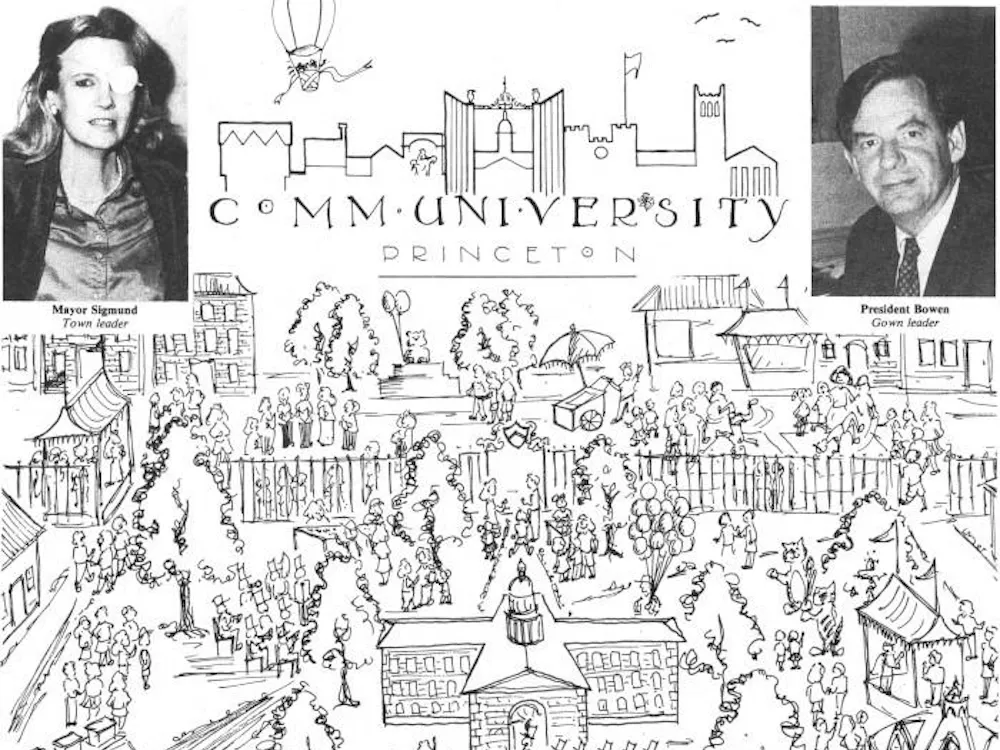
Bring back Communiversity
Isaac BarsoumFrom its inception in 1985, when it subsumed the Arts People Party — the Arts Council’s pre-existing festival — Communiversity always aimed to be more than just an arts festival. It was both a physical and symbolic coming-together of the University and the town in a celebration of all that we have in common and all that makes us different.
From its inception in 1985, when it subsumed the Arts People Party — the Arts Council’s pre-existing festival — Communiversity always aimed to be more than just an arts festival. It was both a physical and symbolic coming-together of the University and the town in a celebration of all that we have in common and all that makes us different.

Who rights our rules?
Charlie YaleWith fairness for students in mind, the University must require that all changes to RRR go through the Committee on Rights and Rules.
With fairness for students in mind, the University must require that all changes to RRR go through the Committee on Rights and Rules.
Freedom of speech is a right, not an excuse
Lily Halbert-AlexanderFreedom of speech should function to hold us to a high standard of honesty and transparency, not to excuse abuses of power and influence in the country’s most influential institutions.
Freedom of speech should function to hold us to a high standard of honesty and transparency, not to excuse abuses of power and influence in the country’s most influential institutions.