



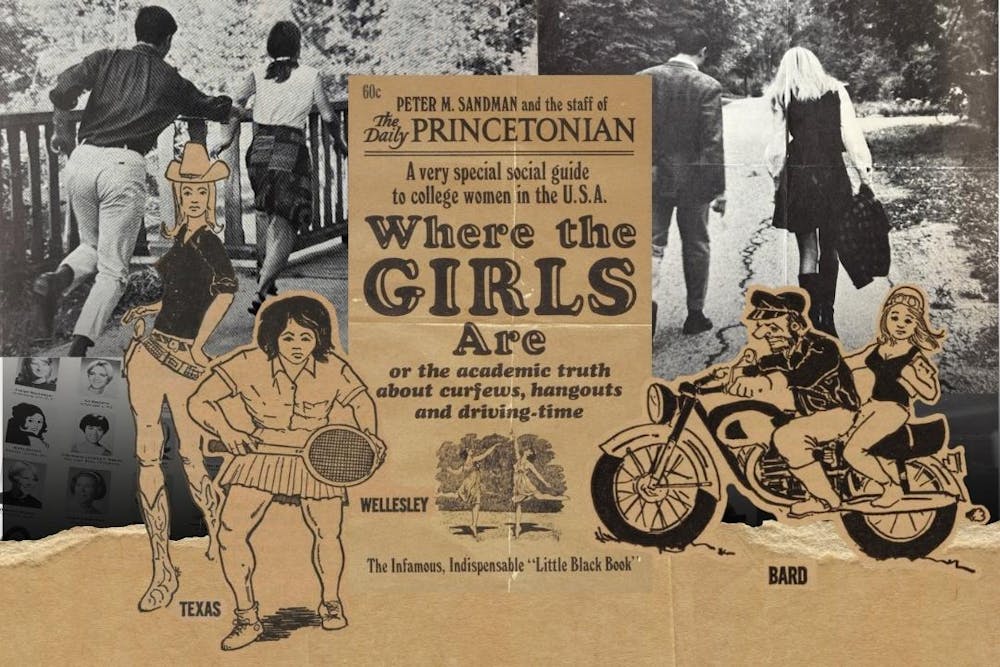
In the fall of 1965, Peter Sandman ’67 was a junior, in a relationship, and, in his own words, “as far from a ‘Princeton man’ as you get.” So, when he was instructed by ‘Prince’ Senior Editor Jim MacGregor ’66 to write a dating guide, he adopted the “guise of the hypothetical, stereotypical Scott Fitzgerald Princeton man.”
“This was a book written by a very non-preppy, New York Jewish male, pretending to be a ‘Princeton man’ writing for high school and college women, pretending to be writing for other men. It was a pretense on top of a pretense.”
Over the course of the 1960s, The Daily Princetonian published three dating guides for the University’s all-male student body, as well as students nationwide: two editions of “Where the Girls Are” in 1965 and 1967, and “Who the Girls Are” in 1968. Filled with jokes and insulting jabs alike, the first “Where the Girls Are” and “Who the Girls Are” described east coast women’s colleges and strategies on how to approach dating their students. The 1967 edition of “Where the Girls Are” expanded the scope, covering public and coeducational institutions as well as women’s colleges.
Although both editions of “Where the Girls Are” saw success nationwide among high school and college students, attention waned by the time “Who the Girls Are” was available for purchase in 1968. All three guides provided helpful logistical information about getting to each college, housing accommodations, rules, and more for men to navigate an east coast school culture that was still separated by gender. However, the descriptions of the girls and schools — at some points misogynistic, by today’s standards — were so outrageous that they were understood as satire at the time.
“I don’t have a sense that anybody was seriously [offended]. I have a sense that some people were seriously misled; I hate the idea that high school kids were looking at this and saying, ‘Oh, I better not go to the University of Missouri, they’re all dumb.’ It was too bad that happened,” Sandman explained. “I remember a lot of people being mock angry at our mock descriptions, but everybody knew the whole thing was mock.”
60 years later, the ‘Prince’ looks back at these light-hearted relics of a school on the cusp of coeducation.
‘Where the Girls Are’
The idea for “Where the Girls Are” was conceived by MacGregor. After losing the 1965 election to be chairman of the ‘Prince,’ MacGregor was appointed senior editor, which meant he “was in charge of all the stuff that doesn’t happen everyday.”
In his role, MacGregor made the move to introduce the long-form style, deviating from short-form daily content to more comprehensive or specific pieces.
“And that started out with [taking] whole pages and devoting them to a single topic, which nobody had ever done. We discovered that people liked reading it, and people really loved reporting it,” MacGregor explained.
MacGregor and the business team also worked on one-off projects, including special editions that were not the daily paper but focused on a singular topic. Spurred by conversations with the paper’s business team, the first special edition published under MacGregor’s supervision was a booklet called “Business Careers After College,” which was distributed to over 200 schools.
Following the initial success of “Business Careers After College,” MacGregor and the business team discussed how they could better appeal to their main audience: Princeton students.

“Who are the students? They’re all guys, and, with the exception of three of my classmates … they’re all white, and then two-thirds of them went to prep schools all over the country. So if they want to get a date, how do they find one?” MacGregor explained.
Not only were there no women’s colleges in the immediate Princeton area, but Princeton men were not allowed to have cars. This made Princeton’s dating pool small, which was further compounded by the social ineptitude of some of its students who hailed from all-male high schools, according to students who were at Princeton at the time.
Thus, MacGregor and the business team dedicated their next special issue to helping male college students find dates. With this, the first iteration of “Where the Girls Are” was born.
Each chapter of the book included a satirical description of a different school, campus map, and information about travel, special dates, accommodations, telephones, rules and hours, restaurants and night spots, and “other things to do.” Sandman was credited as the writer and editor “under the eye, thumb and feet of” MacGregor, and the “dirty work [was] turned over” to Ned Scharff ’68 and Lane Lasater ’68 — “two bright, young freshmen who didn't know what they were going to do, but had a lot of fun.”
“We were trying to make the newspaper staff freshman year, and somebody had this idea,” Scharff said. “It caused kind of a minor sensation. There was a front page article about it in the New York Times, but it’s really just these over-privileged, uppity kids [writing it].”
The writers began selecting women’s colleges to include and sending questionnaires to their students to collect information for the book. MacGregor recalled that Lasater and Scharff would cold-call dormitories at these colleges in the evening and ask whoever answered for anecdotes and stories. They would end up talking to “six girls sitting around [the phone] who couldn’t wait to just tell stories,” he said. They also collected information on the rules, dorm visiting hours, dormitories, and events at each college. The writers then began asking Princetonians if they knew students at women’s colleges like Vassar and Bennett, and for information about those schools.
Some of the responses from the women’s college students were less than precise. As MacGregor explained, the person who answered the phone for Smith College was vague with instructions. These imprecise instructions became the start of their section: “There is a gas station down the road just after you have passed Smith. They’ll tell you how to get back.” Other schools did not send in school crests; student cartoonist Jean-Christophe Agnew ’68 drew seals — the animal — in their place.
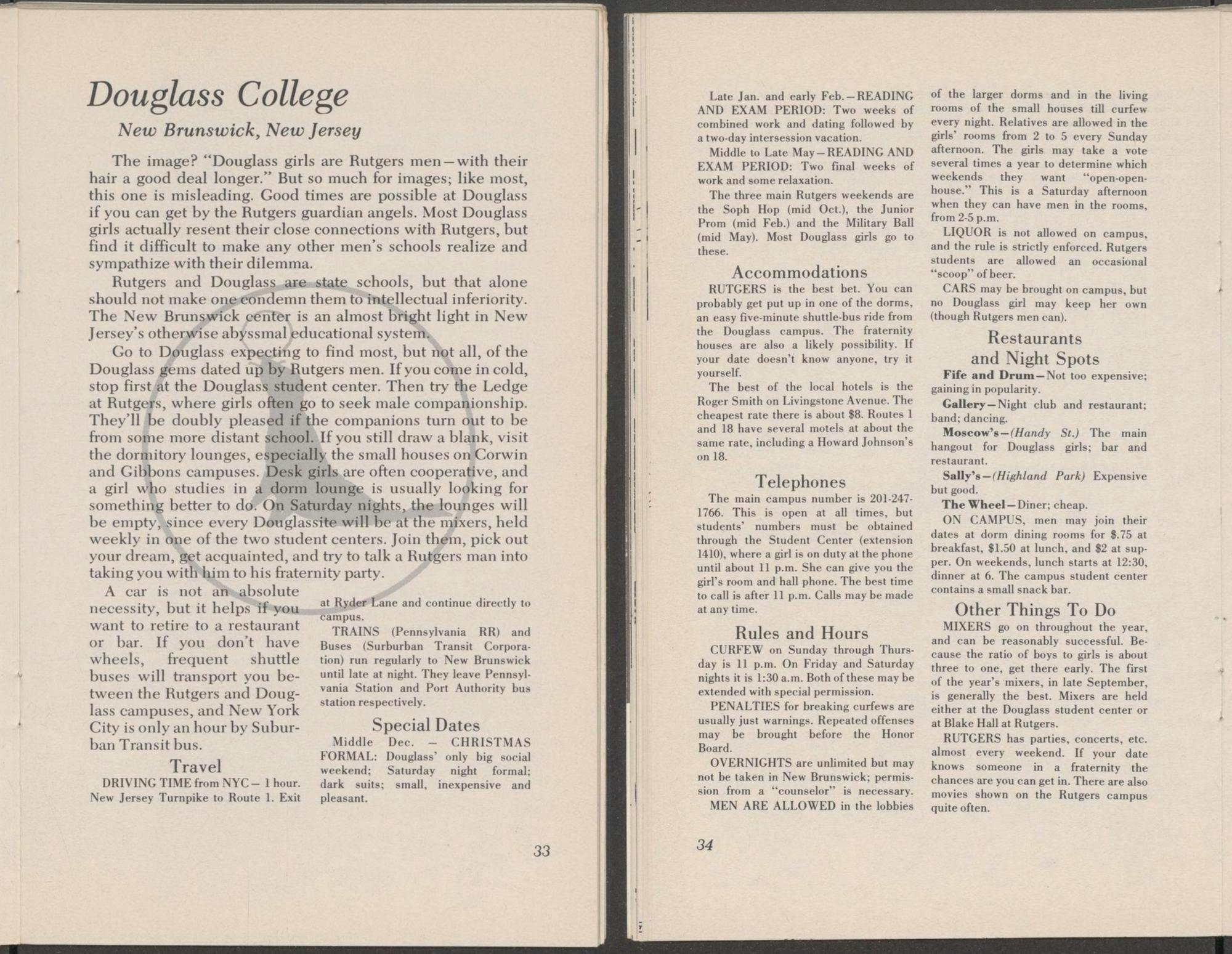
Pages of the Douglass section of the first “Where the Girls Are.”
The Daily Princetonian
“Where the Girls Are” went on sale at Princeton Commons for $1 a copy on Sept. 14, 1965. By October, the “little black book” was seeing major success. On Oct. 19, The New York Times ran a front-page article on “Where the Girls Are.” According to the article, 10,000 copies were on sale at twenty-five men’s colleges in the East. The Associated Press distributed an article about the guide to newspapers across the country, appearing as far apart as Texas, and Pennsylvania.
“The weird part was that we never expected that anything would happen other than the fact that we had fun putting out something, and we thought maybe somebody would enjoy it. And when it showed up on the front page of The New York Times, we had no idea what had just happened to us,” MacGregor explained.
On Nov. 9, The Dial Press, “one of the nation’s largest publishers of paperback books” and owned by major publishing company Dell Publishing, bought the publication rights to “Where the Girls Are” and began distributing the first of 25,000 additional copies. Sandman became a minor celebrity, even appearing on the CBS television show “To Tell the Truth.”
Despite its success, many of the anecdotes in “Where the Girls Are” offended some women at these colleges. While Sandman’s girlfriend at the time — who attended Vassar — did many of the illustrations, the ‘Prince’ staff was, like all of Princeton, entirely male.
“Always keep in mind that a Smithie is looking at you not only as her date, but also as the man who may some day be footing the bills to send her daughter to Smith,” the Smith College section read. According to the guide, exam period at Bennett College was “one week of not-too-strenuous study and fairly active dating.”
“Understand, I don’t think we hurt anybody’s feelings. I hope we didn’t, because no one in their right mind would take this seriously,” Scharff explained. “But I was 18 years old and pretty callow, and I didn’t really have a good grasp of other people’s feelings. I do think it’s so silly and sophomoric, really. I doubt anybody was hurt by it.”
“We were conscious of the fact that the people who would be reading this were going to be both the guys who took interest, and also the girls who took interest in what was being said about their place. And they weren’t going to mind having a little fun poked at them,” MacGregor said.
In April of 1966, Amherst College students, in conjunction with the Mount Holyoke News and Smith College Sophian, published “Where the Boys Are.” In it, they ranked Princeton’s eating clubs and judged Princeton men.
“Princeton is the only place in the world where when a boy and his date walk past a mirror, it’s the boy who stops to comb his hair,” Amherst’s guide said about Princetonians.
In all, the ‘Prince’ made a “phenomenal amount of money” on “Where the Girls Are,” according to MacGregor. That year, MacGregor was the second-highest compensated person on the news board, making the equivalent of $29,000 today, according to his own assessment.
‘Where the Girls Are’ goes national
As the first “Where the Girls Are” continued to be sold nationwide, the ‘Prince’ discovered that the book wasn’t being consumed by its intended audience. As Sandman explained, the staffers “thought [the] audience of [“Where the Girls Are”] was going to be men in men’s colleges, who are traveling around to women’s colleges.” However, they discovered that the first edition sold predominantly to college and high school women.
“It turns out we were selling to college women who wanted to know what we thought of them, and high school women, who, God help us, were using us to decide where to go to college,” Sandman added. Although the writers never intended for the exaggerated stereotypes in the book to be taken seriously, some high school girls used “Where the Girls Are” as a reference for which schools had the least negative caricatures, according to Sandman.
With the publishing rights in hand, Dell Publishing wanted to capitalize on the success of the first edition of “Where the Girls Are” and its newly-discovered audience by publishing a sequel, according to Sandman. However, this version would not be constrained to the east coast women’s colleges Princeton men tended to visit — it would cover universities across the country.
“Dell contacted The Daily Princetonian and said, ‘We want to do a national edition.’ So the second edition … was a Dell paperback that sold a couple hundred thousand copies,” Sandman explained.
According to Sandman, the ‘Prince’ placed an ad in the New York Times over Thanksgiving break, soliciting college students from all fifty states to submit information. ‘Prince’ staffers sat at the phone the entire vacation, fielding calls from women and men alike who joked and talked about their schools. From the beginning, the “whole concept was meant to be snarky” and satirical, which callers knew, Sandman said.
The second edition of “Where the Girls Are” “[hit] the newsstands of America” in February 1967. It featured 126 institutions, from Bryn Mawr, to UCLA, to Georgetown, to the University of Oklahoma. There were no photographs and only a few illustrations. The vast majority of the guide was descriptions of each school and its standard information.
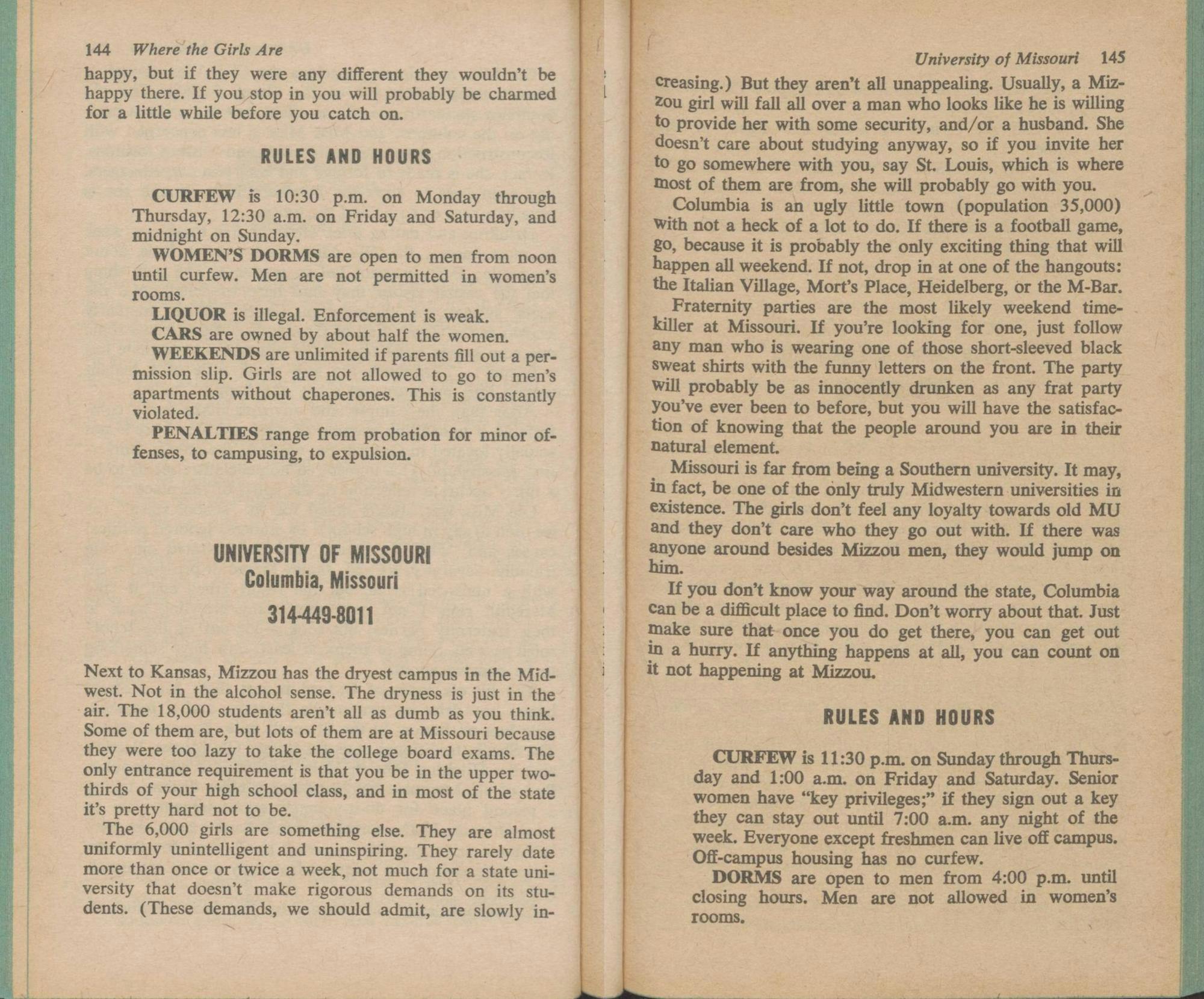
A part of the Ole Miss and Mizzou sections of “Where the Girls Are” in 1967.
The Daily Princetonian
“It was some mix of big schools, schools people had heard of, schools where there was a stereotype that we could imagine might be fun to make fun of,” Sandman explained.
While still successful, the nation-wide “Where the Girls Are” drew stronger criticism than the first because of its sharper jabs. The guide claimed that female students at the University of Missouri were “almost uniformly unintelligent and uninspiring,” and didn’t “care about studying anyways.” Women from several colleges sent in complaints to the ‘Prince,’ with one Centenary University graduate “hoping that [the writers would] all soon be in Vietnam.”
‘Who the Girls Are’
Since Princeton didn’t admit women until 1969, dating at Princeton and other single-sex colleges remained difficult. So, an idea for a third installment of the book was hatched during the summer of 1967. This new guide would go a step further in facilitating love affairs, including photographs of first-years from each women’s college.
“Dating was so different. It was men’s schools, women’s colleges, and I never went to a party unless I had a date,” Carol Ferring Shepley, a member of the Wellesley College Class of 1972, explained. She added, “You had to wait for someone to choose you — that was awful.”
Shepley’s headshot, name, and home city of St. Louis are in “Who the Girls Are,” although she does not remember giving permission to be featured.
“Who the Girls Are” was spearheaded by roommates Peter Brown ’70, Greg Diskant ’70, and Tom Hyde ’70. Brown, the special projects director, is credited as the writer and editor, while Diskant and Hyde, who were on the ‘Prince’ business team, directed the project. None of them had worked on either edition of “Where the Girls Are.” They also had “collaborators at the various schools,” according to Hyde.
According to Diskant, ‘Prince’ staffers spent the summer of 1967 tabling at first-year orientations at various women’s colleges. Having received legal advice that the ‘Prince’ needed consent to publish women’s photographs, staffers asked first-year students and their families if they wanted to appear in the book, and for written consent.
“I promise you that no pictures were in that book for which we did not have written consent,” Diskant explained. “If you see the book, there are many women for whom there’s no picture, and that means they didn’t give consent.”
However, “Who the Girls Are” fell flat. According to Brown, news coverage about the guide peaked several weeks before the book was ready. A picture of Hyde and Brown perusing the book with Elizabeth Grottle GS ’74 looking over their shoulder was carried on the AP wire nationwide. By the time 10,000 copies of “Who the Girls Are” — each containing 1,487 different photographs of women and schools — were printed on Dec. 6, 1968, demand had diminished as readers’ attention moved to other subjects.
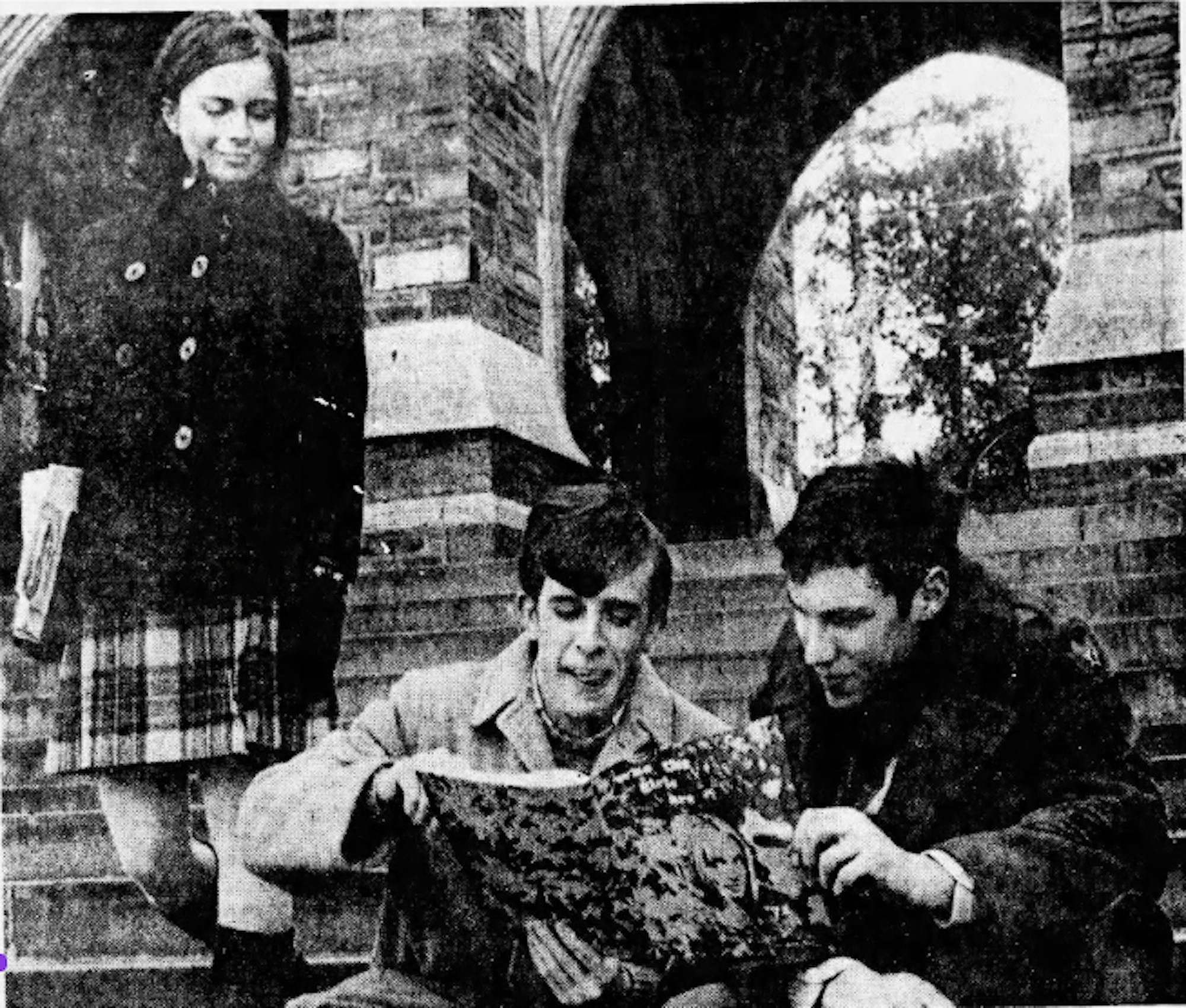
An ad printed in the ‘Prince’ for “Who the Girls Are,” featuring Brown, left, and Hyde, right.
The Daily Princetonian
“This incredible promotion completely failed because there was a lot of demand for the books, but we couldn’t provide them,” Brown explained. “Three weeks later, the books came out from the printer and nobody wanted them. I think attitudes had changed pretty much overnight, and here we were with this silly dating idea, and everybody was suddenly interested in very serious topics like the [Vietnam War] and keeping out of the war, and nobody wanted to think about just having fun.”
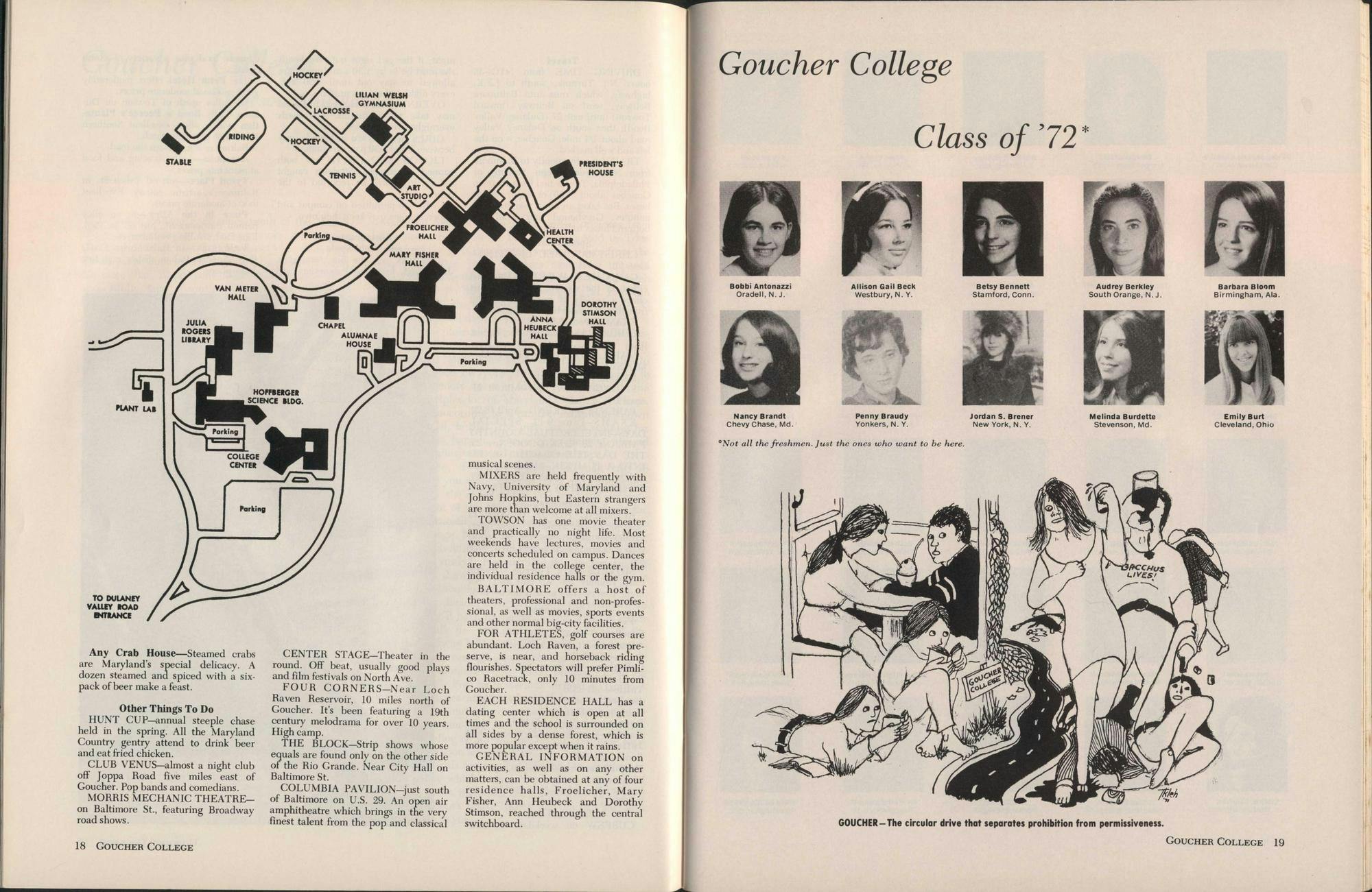
Pages from the Goucher College section of “Who the Girls Are.”
The Daily Princetonian
“I remember being in the basement of the ‘Prince’ building, and there were just boxes of them sitting there. I think somebody was saying, ‘These are never going to go anywhere, let’s get rid of them,’” Hyde explained.
In addition to the usual descriptions and new headshots, “Who the Girls Are” featured photography from students such as Rich Edwards ’69 and a foreword by C. Holly Davies ’70, one of the first women on the ‘Prince.’ In her foreword, Davies wrote separate letters to the men and girls purchasing “Who the Girls Are.”
“Unless someone puts out a ‘Who the Boys Are,’ [a girl is] not going to know whether you’re King Kong or the man of her life. As I said before, this is unfair, and any decent young man would refuse to buy this book,” Davies addressed the men reading her foreword. However, to the girls, she acknowledged that “if you were one of 16 undergraduate girls at Princeton,” you would know why the guide was necessary.
Although fun at the time, “Who the Girls Are” has a mixed legacy amongst its former writers.
“I remember it as a whole lot of fun, and maybe that was the prime intention. We never got into trouble. The ‘Prince’ didn’t go bankrupt or anything. If the real aim was to have fun, that was successful,” Hyde said.
“I’m not as amused by it all as I was when I was twenty and writing for The Daily Princetonian. Either I’ve lost my sense of humor, or as a society, we’re no longer as indulgent as we once were,” Davies said in a comment to the ‘Prince.’
Today, “Who the Girls Are” may seem like a rudimentary version of Facebook or a dating app. To the writers, it was a fun opportunity to push boundaries and meet young women “in a time in which that was hard to do,” as Diskant recounted. However, to the women on the precipice of coeducation, these guides reflected east coast college culture’s reluctance to accept them as equals.
Lucia Zschoche is the associate editor for Archives and an assistant Features editor for the ‘Prince.’ She is from St. Louis, Mo., and does not agree with the evaluation of Mizzou girls in “Where the Girls Are.”
Please send any corrections to corrections[at]dailyprincetonian.com.