Follow us on Instagram
Try our free mini crossword
Subscribe to the newsletter
Download the app

Lily Halbert-Alexander


Princeton University’s coat of arms carved into an old building which is fading brown and black.

Our humanities precepts make us human

If struggling precepts are a symptom of a cultural struggle with care, attention, and socialization, their reevaluation might be an opportunity for Princeton and its students to take a timely diagnostic of the University’s most monumental task: making smart people smarter by teaching them to care about and understand the world beyond their immediate orbit.

If struggling precepts are a symptom of a cultural struggle with care, attention, and socialization, their reevaluation might be an opportunity for Princeton and its students to take a timely diagnostic of the University’s most monumental task: making smart people smarter by teaching them to care about and understand the world beyond their immediate orbit.


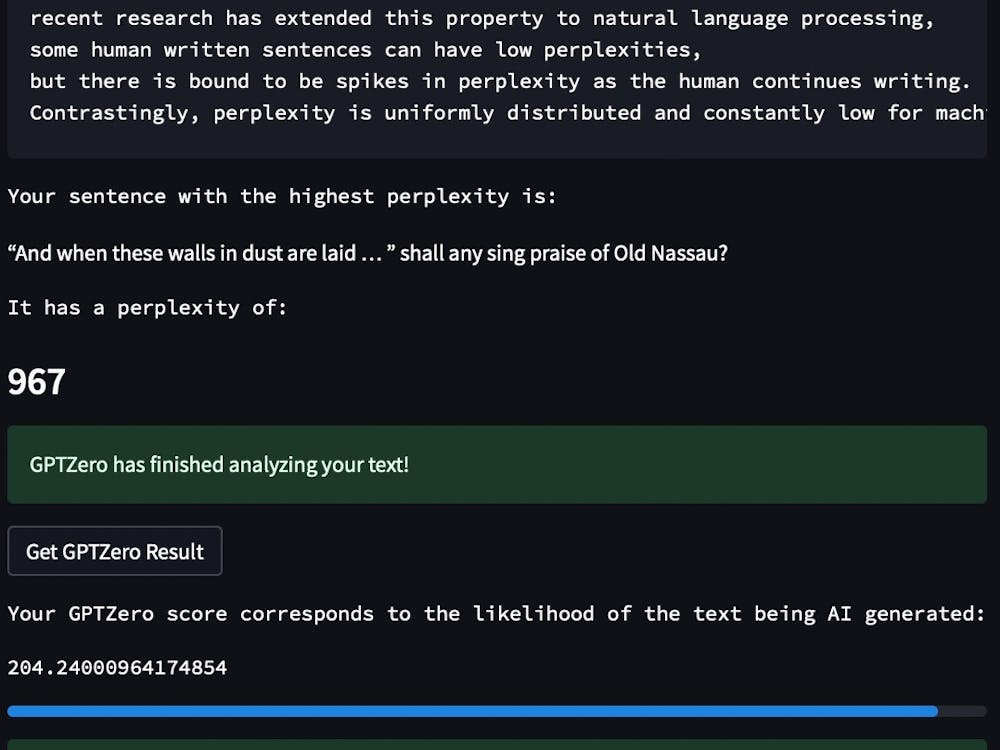
gptzero

Opinion Roundtable: AI and the classroom

In the first episode of Opinionated, new Opinion writers get together to discuss the role of AI in the classroom, taking on the implications of AI's increased integration in academia for academic integrity and authenticity. 

In the first episode of Opinionated, new Opinion writers get together to discuss the role of AI in the classroom, taking on the implications of AI's increased integration in academia for academic integrity and authenticity. 


Yellow leaves line trees and the ground in front of side-front view of tan building lined with green ivy on the front.

Reactions: What first years care (and don’t care) about at Princeton

The ‘Prince’ recently published its Class of 2029 Frosh Survey, featuring data on everything from the incoming class’s familiarity with AI Models to its knowledge of prominent Princeton alumni to its past sexual experiences. Here, five of our Opinion editors identify and tackle key takeaways about Princeton’s newest class. 

The ‘Prince’ recently published its Class of 2029 Frosh Survey, featuring data on everything from the incoming class’s familiarity with AI Models to its knowledge of prominent Princeton alumni to its past sexual experiences. Here, five of our Opinion editors identify and tackle key takeaways about Princeton’s newest class. 


A sign that says “Welcome to Wintersession” in front of a snowy pillar and bush

As we weigh budget cuts, Princeton must not cave to internal division

If we allow our conversations about budget to generate fissures between humanities and sciences, arts and lab research, we risk turning upon ourselves the same transactional, hostile lens through which the Trump administration views higher education.

If we allow our conversations about budget to generate fissures between humanities and sciences, arts and lab research, we risk turning upon ourselves the same transactional, hostile lens through which the Trump administration views higher education.


A beige cupola on top of an administrative building with a clock on two corners, while the American flag hangs tall to its right, with cloudy blue skies in the background.

Keep academic authority in human hands

The Trump administration’s attacks on research and higher education as well as a blind reliance on AI chatbots are reflective of a societal backslide: a commodification of knowledge that prioritizes “efficiency” over the messy process of getting to an answer, where nuances are flattened and the truth is fungible.

The Trump administration’s attacks on research and higher education as well as a blind reliance on AI chatbots are reflective of a societal backslide: a commodification of knowledge that prioritizes “efficiency” over the messy process of getting to an answer, where nuances are flattened and the truth is fungible.


A group of people sits in circle on grass.

Reactions: What advice do you have for the Class of 2029?

Our Opinion writers reflect on their own Princeton experience, considering what they would have done differently and offering advice for incoming Princetonians. 

Our Opinion writers reflect on their own Princeton experience, considering what they would have done differently and offering advice for incoming Princetonians. 


Princeton_University_Press.jpg

You’ve heard history holds power. This project shows us how.

Turning back to our history, examining the elections and previous presidencies — not to point fingers, but to better confront the causes of Trump’s ascension — is the first step to demystifying his power and deconstructing his pedestal. 

Turning back to our history, examining the elections and previous presidencies — not to point fingers, but to better confront the causes of Trump’s ascension — is the first step to demystifying his power and deconstructing his pedestal. 


The archway of a building.

You (yes, you) are part of the classics conversation

Whether or not we believe that this literature has a place in the curriculum and however we believe the classics should be taught, we have to understand that a conversation about classics is a conversation about us.

Whether or not we believe that this literature has a place in the curriculum and however we believe the classics should be taught, we have to understand that a conversation about classics is a conversation about us.


A man stands at a podium and speaks into a microphone.

Return Pete Hegseth’s educational ideologies “to sender”

Hegseth believes students are being raised to “see America as an evil place” because his confining approach to education leaves no room for admiration and criticism, hope and horror, to coexist. He treats American history, patriotic ideals and the “pillars of Western civilization” as if they were made of glass, as if “cross-cultural encounters” and critical race theory, the “cornucopia of diversity” he criticizes, could shatter them.

Hegseth believes students are being raised to “see America as an evil place” because his confining approach to education leaves no room for admiration and criticism, hope and horror, to coexist. He treats American history, patriotic ideals and the “pillars of Western civilization” as if they were made of glass, as if “cross-cultural encounters” and critical race theory, the “cornucopia of diversity” he criticizes, could shatter them.


Building with white marble columns in front of a red fall tree.

It’s time to change how we talk about abortion

“When we don’t question disengaged language like this at Princeton, we excuse anti-abortion advocates from being present in the facts. We excuse them from talking about Amber Nicole Thurman, Josseli Barnica, Nevaeh Crain, Candi Miller, and countless other women who have lost their lives as a direct result of abortion bans and restrictions.”

“When we don’t question disengaged language like this at Princeton, we excuse anti-abortion advocates from being present in the facts. We excuse them from talking about Amber Nicole Thurman, Josseli Barnica, Nevaeh Crain, Candi Miller, and countless other women who have lost their lives as a direct result of abortion bans and restrictions.”


More articles »