



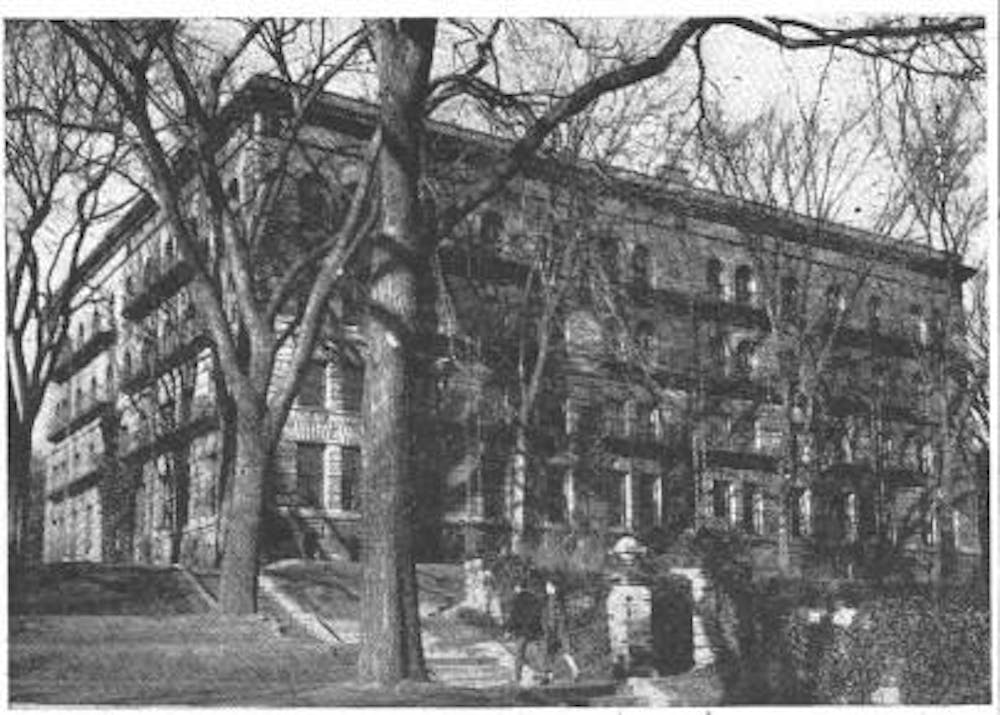
In 1967, the freshman-occupied Brown Hall garnered a particular reputation on Princeton’s campus — and not a wholesome one. The fire department had been threatening to condemn the building for nearly two decades. After a year of broken windows, shattered banisters, and a riot involving beer cans, lamps, and a “monstrous electric heater,” the University placed all undergraduate Brown Hall occupants on disciplinary probation.
Fifty years later, Brown Hall still stands. Today in history, we look back at the story of a now-quiet dorm that holds memories of a rowdy past within its walls.
On May 4, 1967, The Daily Princetonian reported that the University placed every occupant of Brown Hall on disciplinary probation following “a series of disturbances in the dormitory.”
The incident that finally broke the administration’s patience began, as many things at Brown apparently did, with beer cans. Students began hurling them into the courtyard; bottles followed, then lamps, then whatever other items came to hand. The culmination was the defenestration of what a student witness called a “monstrous electric heater.”
The battle of bottles followed the development of an internal rivalry: an entry-versus-entry feud involving stolen doors, “about sixty waste basketfuls of snow” dumped in front of a freshman’s door, and cellophane stretched over toilet seats.
The student residents offered their own diagnosis for the chaos. They told the ‘Prince’ that the havoc stemmed from “the physical facilities of the dormitory and the pent-up emotions of sexually-frustrated freshmen.” One freshman took a more philosophical view, arguing that the chaos had at least been educational, claiming that life in Brown had “helped [him] study mythology last term — the lifestyle of cannibals.”
The probation assigned to all of the residents of the hall turned out to be more bark than bite. The assistant dean of students at the time, James B. Laughlin II ’52, called it “a severe warning” that would not appear on any student’s record.
Following “A Year of Delinquency,” only time would tell “whether or not the occupants of the infamous Brown Hall will continue their antics.”

They did not, eventually.
Brown Hall was renovated in 1970, removing the indoor staircases and replacing them with the exterior concrete the building has today, a choice which caused some lamenting by students.
The 2010 renovation, including a new archway, landscaped courtyard, and updated bathrooms, transformed the Princeton building into one of the more updated upperclass options on campus. Far removed from its delinquent past, Princeton’s Housing and Real Estate office now plainly describes it as a building for juniors and seniors, named for David B. Brown.
When asked about the dorm’s history, Patrick Hamill ’28, a rising junior who drew into Brown for the 2026–2027 academic year, responded, “I’ve never heard about any of the dorm’s traditions or history, but I would be interested to learn more.”
While the freshmen of 1967 turned the building into their own battleground of mischief, current residents inherit a quieter, cleaner version of the same address. The antics of Brown Hall did not survive the decades.
Olivia Perry is a staff Archivist for the ‘Prince.’

Please send any corrections to corrections[at]dailyprincetonian.com.
Read More

Princeton endowment at all time high after 24 percent returns
Haeon Lee and Devonne PiccaverPrinceton’s endowment has reached an all-time high of $42.3 billion after a 23.7 percent investment gain for the 2026 fiscal year that ended June 30. This percentage increase marks the highest investment gain since 2021, which saw 46.9 percent returns driven by venture capital and private equity.
Princeton’s endowment has reached an all-time high of $42.3 billion after a 23.7 percent investment gain for the 2026 fiscal year that ended June 30. This percentage increase marks the highest investment gain since 2021, which saw 46.9 percent returns driven by venture capital and private equity.

Staff Picks: Football vs. Brown
Saad Akhtar, Alex Beverton-Smith, and Juha ImPrinceton football is set to take on Brown this weekend at home. The Daily Princetonian Sports section makes their picks for the game.
Princeton football is set to take on Brown this weekend at home. The Daily Princetonian Sports section makes their picks for the game.

Roundup: Marvel Jem Roth and Isaac Barsoum on their advocacy related to the Title IX process at Princeton, ‘hearing math,’ and proctors in the classrooms
Tendai Jobarteh, Devon Rudolph, and Danny ShingAn in-depth interview with Undergraduate Student Government treasurer Marvel Jem Roth ’28 and U-Council chair Isaac Barsoum ’28 on their advocacy related to the title IX process at Princeton, ‘hearing math,’ and proctors in the classrooms, ‘hearing math,’ and proctors in classrooms during the midterms.
An in-depth interview with Undergraduate Student Government treasurer Marvel Jem Roth ’28 and U-Council chair Isaac Barsoum ’28 on their advocacy related to the title IX process at Princeton, ‘hearing math,’ and proctors in the classrooms, ‘hearing math,’ and proctors in classrooms during the midterms.