



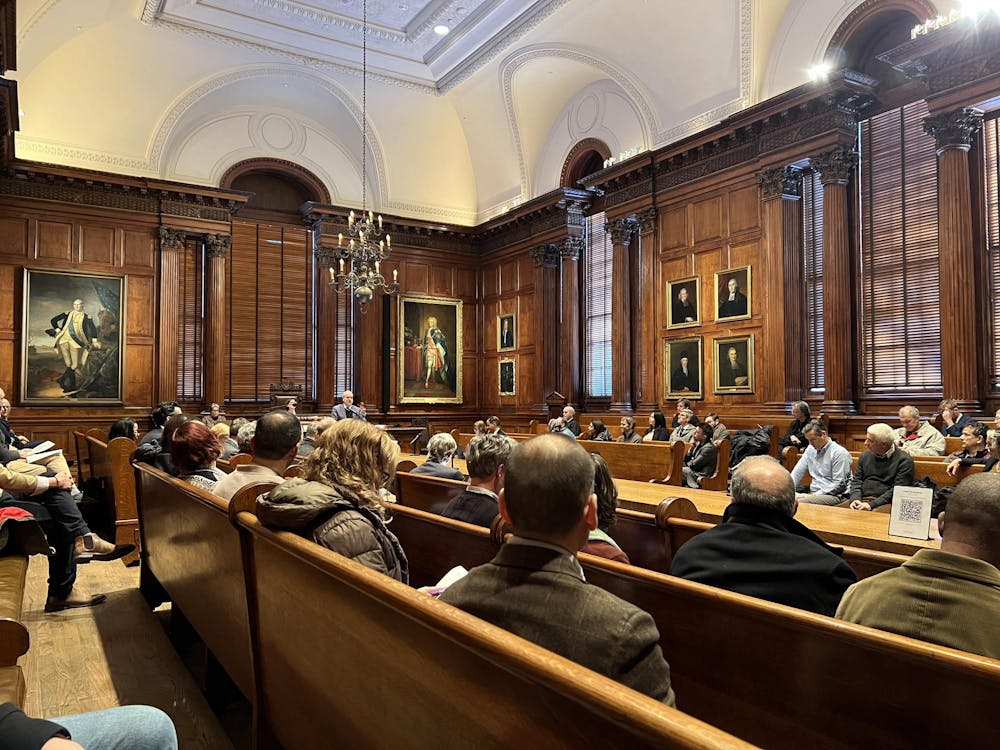
A proposal for proctoring on all examinations will be considered by two faculty committees before potentially reaching a faculty vote in May, according to Dean of the College Michael Gordin. This unprecedented proposal comes amid administrative concerns about cheating, especially given the prevalence of generative AI tools.
The change would constitute the most significant alteration to date to Princeton’s honor system since its establishment in 1893. Under the Honor Code, students pledge both to refrain from infractions of academic dishonesty and to report any academic integrity breaches they witness. The institution of proctors would not change the text of the Honor Code or students’ obligations — rather, proctors would serve as an additional layer of academic integrity monitoring, and would report misconduct to the Honor Committee, according to former Honor Committee Chair Nadia Makuc ’26.
Gordin commented that should the policy pass, “the Honor Committee Constitution and the text of the Honor Code — which are governed by students — would not be altered.” The Honor Code gives students a twofold obligation: “individually, they must not violate the code, and as a community, they are responsible to report any suspected violations.”
If the policy passes, proctoring on all examinations, including those taken by students with accommodations through the Office of Disability Services, would begin at the earliest in Fall 2026. “Spring finals are not affected at all,” Undergraduate Student Government Academics Committee Chair Isaac Bernstein ’28 told The Daily Princetonian.
Bernstein is a former staff News writer for the ‘Prince.’
The proposal will need to pass through three rounds of voting: the Committee on Examinations and Standing, the Faculty Advisory Committee on Policy, and a full faculty vote, in that order. “If the process went as fast as humanly possible, the final vote would be at a faculty meeting in May,” Gordin wrote in a statement to the ‘Prince.’
“[The ‘Rules and Procedures of the Faculty of Princeton University’] is the only governing document which prohibits supervision of examinations,” Gordin wrote. “If this act for universal proctoring passes the vote, the relevant sections in both ‘Rules and Procedures’ and the University’s ‘Rights, Rules, and Responsibilities’ would need to be amended for the first time since their 1893 publication.”
Professors and students expressed varying opinions regarding the proposal in interviews with the ‘Prince.’

“Pre-Covid-19, cheating was seen as a really bad thing to do. But during Covid, people were more likely to cheat, and now it’s more socially acceptable,” Kelly Noonan, an economics lecturer who teaches the popular ECO 100: Introduction to Microeconomics, told the ‘Prince.’
In the ‘Prince’ 2025 senior survey of over 500 seniors conducted by The Daily Princetonian, 29.9 percent of respondents reported cheating on an assignment or exam. 44.6 percent of senior respondents reported knowing of Honor Code violations that they chose not to report. Only 0.4 percent of seniors responded saying they had reported a peer for an Honor Code violation.
“I think that cheating has become fairly prevalent. Students are very, very upset with it, but again, they still don’t want to report. And if they don’t report, the Honor Code doesn’t work,” Noonan said.
Jason Puchalla, a lecturer in the physics department who has created an AI training interface for his students, said that “my belief is and from my conversation with students, folks are on board to have proctoring as a regular part of campus.”
Puchalla added that while proctoring may become a more regular part of testing, he hoped it would not create distrust between students and faculty. He continued, “It would be an unfortunate way to approach education if the assumption is that students are cheating all the time, and our job is to stop them from cheating.”
Not all proponents of reforming the current system expressed support for proctoring, however.

Princeton Writing Program lecturer Soo-Young Kim argued that the current system “places unnecessary stress on students, both by rendering them responsible for making judgements that they shouldn’t be put in a position to make and by cultivating a climate of mutual suspicion.”
“I do sincerely value the core desire articulated in the honor system to establish a campus community on the basis of collective responsibility among students, and rejection of external mechanisms of compliance, but it just seems to me that there are less harmful ways to get at these goals,” Kim wrote to the ‘Prince.’
Despite the tentative timeline for the proposal’s consideration, many details remain uncertain, such as the number of proctors per exam and the process for selecting proctors.
“You don’t want one proctor in a room of three hundred and fifty … and you don’t want four proctors in a room of 10,” said Bernstein. Noonan expressed a similar sentiment, saying that assigning too many proctors “creates an environment of anxiety and distrust … ensuring proportionality is vital.”
Gordin confirmed that if the policy passes, discussions about these details would begin immediately. Proctoring practices could be altered even after the policy’s implementation.
“[These] are administrative matters that would be worked out after the faculty opted to make the change,” Gordin wrote. “Like all administrative regulations, [the details of proctoring] could be revised to learn from the experience of implementation. The only issue to be resolved by the faculty at this stage is whether there are to be proctors or not.”
Students expressed skepticism about the proctor institution, telling the ‘Prince’ that the current absence of proctors cultivates trust.
“I think [the absence of proctors] represents a big degree of trust between the faculty and students,” Pierce McCarthy ’28 told the ‘Prince.’ “I think a happier middle ground could be reached, something along the lines of leaving your backpack outside and collecting phones while still leaving students alone in the test room,” he added.
Israel Adeboga ’28 echoed support of the current system to discourage cheating, stating, “I think it’s one of the fundamental parts of the University that we have that trust, in the end we are here for our own learning so the implementation of [proctoring] takes away from the fundamental spirit that Princeton has developed.”
“The trust that students already have is very important, I think that having proctors during exams erodes that to some level,” added Leonardo Bene ’28. “I don’t know how effective having proctors in exams would truly be.”
The policy would affect Honor Committee hearings, according to Bernstein, although it is unclear exactly how. These hearings are confidential, student-led proceedings addressing potential violations of Honor Code. Accused students can present defenses, call witnesses, and be assisted by a Peer Representative. If students are found responsible of Honor Code violations, penalties range from a Reprimand, a warning that is excluded from a student’s permanent record, to expulsion.
Bernstein said that if the proctoring policy passes, proctors may be called on to testify in Honor Committee hearings. However, he added that proctor testimony will not automatically hold more weight than that of student witnesses or constitute an instantaneous indictment of those being investigated for alleged academic integrity violations.
While there is no student representation in any of the three committees set to vote on this policy, the USG Academics Committee has created a form for students to share their feedback on this possible change, and that data will be directly shared with the faculty committees.
Devon Williams is a News contributor for the ‘Prince.’ She is from Menlo Park, California, and she often covers Student Life, Arts, and Culture. She can be reached at dw9268[at]princeton.edu.
Giselle Moreno is a News contributor from Dallas. She can be reached at gm2076[at]princeton.edu.
Please send any corrections to corrections[at]dailyprincetonian.com.
Corrections were made on April 2, 2026: A previous version of this article said that examinations administered for students with disability accommodations would be exempted from this policy. This is not the case. The use of a quotation from Princeton instructor Soo-Young Kim implied that she had a stance on proctoring, whereas this is not the case. The ‘Prince’ regrets these errors.
A correction was made on a previous correction on April 2, 2026: An original correction note suggested that Soo-Young Kim supported the implementation of proctors, whereas she does not provide a stance on the policy. The note also used masculine pronouns in place of feminine ones and misspelled her name. The ‘Prince’ regrets these errors.
Read More
USG provides input on VP for Campus Life selection process, continues election reform debate
Claire DingAt its Sunday meeting, USG weighed in on the search for Princeton’s next vice president for campus life, backed an effort to permit campus chalking, and continued debating election reforms.
At its Sunday meeting, USG weighed in on the search for Princeton’s next vice president for campus life, backed an effort to permit campus chalking, and continued debating election reforms.

Amid budget cuts, Princeton Annual Giving campaign raises second-highest amount in history
Benedict HooperPrinceton’s Annual Giving campaign raised $79.6 million in 2025–26, its second-highest total ever, even as alumni participation continued to decline amid broader University budget uncertainty.
Princeton’s Annual Giving campaign raised $79.6 million in 2025–26, its second-highest total ever, even as alumni participation continued to decline amid broader University budget uncertainty.

‘Now Princeton has gone and done it’: The Critical Languages Program and its former students
Lucia ZschocheThe Critical Languages Program, which ran between 1963–1972, gave students — both men and women — from partnering universities the opportunity to attend Princeton. Its students look back on their experiences and the program’s legacy.
The Critical Languages Program, which ran between 1963–1972, gave students — both men and women — from partnering universities the opportunity to attend Princeton. Its students look back on their experiences and the program’s legacy.