



This review contains spoilers.
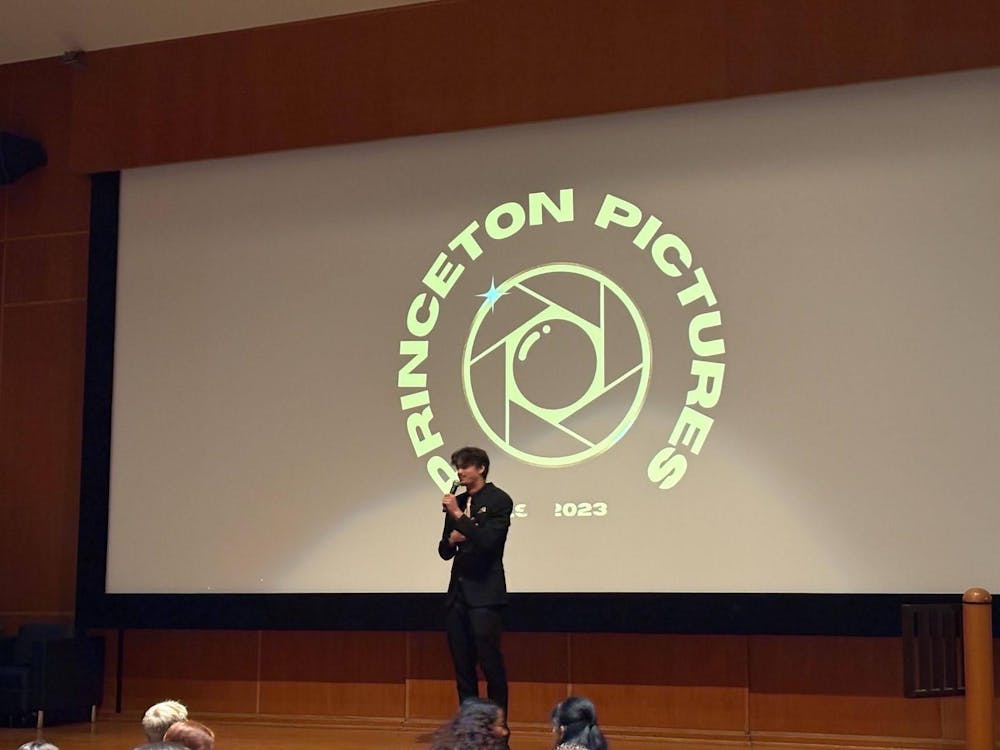
McCosh 10, a notorious venue for nerve-wracking finals, was home to something arguably more stressful last week: the movies at the Princeton Pictures movie screening. On May 7, the student-run film production company premiered three new short films, each tinged with unease.
The first short in the series, entitled “Scouting,” put the audience on edge from the very beginning. Although the film is more family drama than horror slasher, there is an underlying brutality in “Scouting” that creeps up on you unexpectedly. The short follows the growing tension between sisters-in-law Sarah, played by Kailani Melvin ’28, and Yumi, played by Seoyon Kim ’29. Although Yumi obnoxiously presents the facade of a perfect family, her son Ryan is acting strangely: obsessing over Cub Scouts, pushing a child off the slide, and throwing a picture frame. Yumi’s brother Eugene, played by Isaiah Park ’26, eventually confronts her about Ryan’s behavior, questioning if it has anything to do with his father, who is currently away in the military. Although Yumi denies this connection, she is forced to reckon with her husband’s past abuse when Ryan bites Sarah and Eugene’s daughter, Ellie, at her birthday party.
Director Juna Brothers ’28 cleverly conveys the shock of this moment without ever showing the violence, instead relying on the emotional performances of Melvin and Kim to underscore the horror. Melvin angrily gesticulates while Kim shakes in fear. The few shots we get of Ryan show him playing in a field, emphasizing that he is just a child. The end of the film, when Yumi reveals that her husband hit her the night before he left, was particularly impactful. Even though Yumi and Sarah embrace, Yumi is clearly still traumatized. The camera lingers on her once Sarah has left, conveying her ever-present isolation and panic despite her newfound support.
The second film shown, “Networking”, is one of the most interesting interpretations of the afterlife I’ve seen on screen. Directed by Jemima Smith ’28, this short follows Caleb, a lonely young man who has died from a head injury sustained while hiking. He finds himself in a white room, talking to an otherworldly entity named “Mycelium,” as he interviews for an unknown position. The clinical questioning is intercut with scenes from Caleb’s life, showing his attempts to cling to his only friend, Dylan, played by Zach Lee ’26. Despite what appears to be a close bond — they often eat together and go to the movies — it is revealed that Dylan has another tight-knit group of friends he would rather spend time with. Spencer Fitzgerald ’29 expertly captures Caleb’s sheepish demeanor, conveying the anxiety of this awkward social dynamic through his visible discomfort. His shyness contrasts well with Julia Hack ’29, who remains straight-faced and strict as Mycelium throughout.
Hack is an associate Podcast editor for the ‘Prince.’
Mycelium eventually reveals that Caleb has been rejected from joining the network of mushrooms about to feed on his decaying body. Since he acted as a parasite during his time alive, he poses a similar threat to the ecosystem. However, after Caleb reflects on his relationships, he seems to join the network. The film concludes with shots of fungus growing from his face as he overcomes his social anxiety, no longer feeling like a parasite. “Networking” was my favorite of the shorts, not only because of its wildly unique premise, but also because of its exceptional mushroom makeup. This unexpected body horror, paired with the underlying social anxiety and uncanny interview, left me on edge throughout the whole film.
Although the last short was a more traditional horror movie, it was surprisingly the funniest of the three. “Proximity,” directed by Hannah Bonbright ’28 and Moose Kinsey ’28, follows a serial killer who attracts a stalker. With this twist, the killer has to grapple with paranoia and unwanted attention, presenting a thorough picture of her psyche. Played by Hallie Graham ’27, Melanie begins to find Polaroids taken of her, similar to the ones she takes of her own victims. Her stalker leaves a trail of notes and photos, but she has yet to see his face. Melanie begins to suspect that her classmate Calvin, played by Connor Roeser ’28, is the culprit. Calvin clearly has feelings for Melanie, trying to snag a date with her despite her refusal. The scene where he initially asks her out over text is the funniest in the film — 11 of Melanie’s demeaning responses are displayed on screen, which elicited many laughs from the audience. She finally agrees to go out with Calvin after learning he has a car. After drugging him on their date, she steals his keys so she can meet up with her stalker: Calvin, shockingly fully recovered from the pills. Even though the two proceed to flirt and sleep together, Melanie kills him the next morning when he goes on a run.

Similar to “Scouting,” all the violence in “Proximity” is implied, this time conveyed through the grueling thuds and crunches. The short also relies on its unreliable narrator to build suspense, eventually revealing that Melanie was diagnosed with schizophrenia at a young age. This made me question what Calvin’s role actually was, and how much of it was simply Melanie’s own perception. Graham gives a charismatic performance as Melanie, selling all the comedic lines despite her otherwise chilling demeanor. By contrasting her calm kills with her disjointed mental state and paranoia, Bonbright and Kinsey craft a layered characterization of Melanie. Despite the film’s short runtime, Bonbright and Kinsey also do a particularly good job at developing both the Calvin and stalker plotlines, merging them just before the end.
As a fan of uncanny horror and nail-biting thrillers, I appreciated how each Princeton Pictures director cultivated a distinct atmosphere for each film, exploring unique fears through their own creative lens. The effort of the entire cast and crew is evident in every shot and line delivery. I would absolutely recommend giving these three shorts a watch, especially if you are looking for a different kind of stress this exam season.
Mia Mazzeo is a contributing writer for The Prospect and is a member of the Class of 2029. She can be reached at mm4755[at]princeton.edu.
Please send any corrections to corrections[at]dailyprincetonian.com.
Read More
USG provides input on VP for Campus Life selection process, continues election reform debate
Claire DingAt its Sunday meeting, USG weighed in on the search for Princeton’s next vice president for campus life, backed an effort to permit campus chalking, and continued debating election reforms.
At its Sunday meeting, USG weighed in on the search for Princeton’s next vice president for campus life, backed an effort to permit campus chalking, and continued debating election reforms.

Amid budget cuts, Princeton Annual Giving campaign raises second-highest amount in history
Benedict HooperPrinceton’s Annual Giving campaign raised $79.6 million in 2025–26, its second-highest total ever, even as alumni participation continued to decline amid broader University budget uncertainty.
Princeton’s Annual Giving campaign raised $79.6 million in 2025–26, its second-highest total ever, even as alumni participation continued to decline amid broader University budget uncertainty.

‘Now Princeton has gone and done it’: The Critical Languages Program and its former students
Lucia ZschocheThe Critical Languages Program, which ran between 1963–1972, gave students — both men and women — from partnering universities the opportunity to attend Princeton. Its students look back on their experiences and the program’s legacy.
The Critical Languages Program, which ran between 1963–1972, gave students — both men and women — from partnering universities the opportunity to attend Princeton. Its students look back on their experiences and the program’s legacy.