



Aside from dining hall preferences and bragging rights over air conditioning, do Princeton students actually identify with their residential colleges? For many, it’s a resounding “no.”
A 2016 report entitled “Report of the Task Force on the Residential College Model” identified future priorities for the University’s residential college system. These goals included creating hubs of intellectual and social life, promoting community, supporting individual well-being and personal growth, and facilitating resources for all students throughout the transitions of college life.
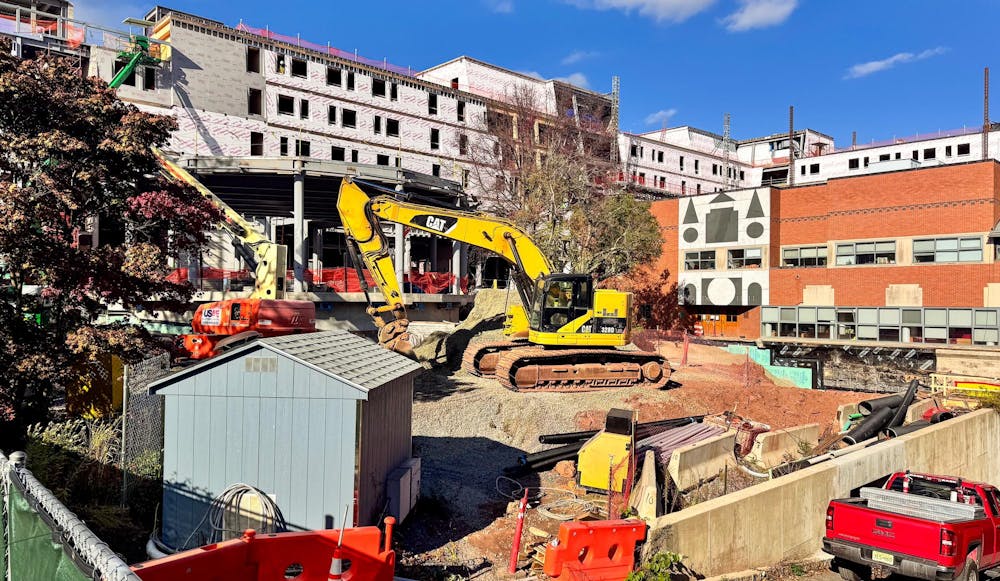
A decade after the publication of the report and in light of the ongoing construction of Hobson College, The Daily Princetonian spoke to students and faculty about the successes and shortcomings of the residential college system.
The goals of the initial report, compiled by a task force led by psychology professor Nicole Shelton and including faculty members, students, and staff, remain to this day.
Head of Yeh College Yair Mintzker said, “Princeton is both an intellectual community and a residential community … [The res college system] kind of symbolizes what, in many ways, Princeton is all about.”
Students like Sasha Klevens ’29 noted the importance of finding community in the colleges, particularly during their early days at Princeton. However, this sense of college identity often doesn’t last past sophomore year.
“I think it’s a first two year thing,” Klevens said. “It’s fun for freshmen, and then it’s something that doesn’t stay with you.”
The ‘Prince’ compared conversations with faculty and students to the four “Strategic Priorities” identified in the 2016 University report.

Strategic Priority 1: Strengthen Community by Changing College Composition, Enhancing Affiliation, and Limiting Size
The first aim of this priority was to “Create a True Four-Year College System.” In 2016, only half of the residential colleges housed students from all four years. The task force recommended transitioning all of the colleges to a system in which upperclassmen could choose to remain in their residential college.
Since the fall of 2022, all seven residential colleges have housed students from every year. However, the limited allocation of upperclass beds constrains the ability of every upper class student who may wish to remain in their college from doing so.
“I would love to be able to create a more continuous four year community at Rocky. We only have 50 upper class spaces. So that isn’t exactly possible just because we don’t have the space,” Dean of Rockefeller College Justine Levine said.
Hobson College, set to be completed in early 2027, represents one step towards addressing these physical limitations. “One important thing that Hobson will let us do is offer more juniors and seniors the opportunity to keep living in their college,” Senior Associate Dean of the College Anne Caswell said.
With the majority of upper class students moving out of their residential college for their final two years, Priority 1’s second goal was to “Strengthen the Connections Students Have with their Colleges and College Communities.” The task force recommended that colleges expand programming directed towards upperclass students, as most juniors and seniors “do not feel nor think of themselves as affiliated with their college.”

Upperclass students often find community in other spaces on campus like eating clubs, of which 68 percent of juniors and seniors are members.
Despite eating clubs being a popular dining and community system for upperclass students, the University has historically had a tenuous relationship with them. Most recently, in 2025, the University required students in university housing to purchase a meal plan — a decision that has since been amended, but was perceived by many students as an attack on the eating clubs.
“I feel much more affiliation to communities like my [rowing] team or eating club [Ivy] than to NCW,” Percy Wayne ’28 said. “I also feel my affiliation with my residential college has decreased over time and was the strongest with my zee group freshman year.”
Every incoming first-year student is randomly assigned to a residential college and a “zee” group of 12-20 students living in close proximity to each other, supported by an upperclass Residential College Advisor (RCA).
Peer institutions like Harvard, Yale, and Rice have their own residential systems where the majority of students live in their college for three to all four years. Caswell noted this distinction between Princeton’s system and peer schools as contributing to different campus cultures when it comes to college identity.
“The eating clubs play a significant role in the social lives of juniors and seniors, so I think there’s not been any wish to have a move toward a system where all juniors and seniors live in colleges,” Caswell noted.
Samantha Berk ’28 appreciates residential college activities but wishes more students participated. “If big events like the Clash of [the] Colleges were able to include upperclassmen, or at least sophomores who are still living in their res colleges, maybe that could contribute to pride,” she explained.
Cindy Aguilar Rodriguez ’28, Special Events Chair of the Yeh College Council, has noticed the same trend through the activities she has organized and attended. “Some [upperclass] students, from what I’ve noticed, wouldn’t want to make the walk down to Yeh just for a little free sample or something,” she said.
This lack of continuity in college identity past students’ second year has not gone unnoticed by faculty as well.
“I think our most active participants are the students who live here,” Head of New College West AnneMarie Luijendijk said.
While there are programs catered towards juniors and seniors, Mintzker acknowledged that there may be areas to improve continuity of college support even after many upperclass students move out, such as supporting seniors who are stressed about plans after graduation.
“This is a place where the Head of the College or different staff members can step in and intervene and make sure students understand their resources to figure out what they want to do later on, but also know that they’re not alone and that they’re supported,” Mintzker said.
Strategic Priority 2: Invest in Physical Infrastructure
The first goal under Priority 2 is “Renovate Outdated, Poorly Functioning Spaces.” With the completion of Yeh and NCW, the University has made strides towards the goal of updating infrastructure on campus.
However, “there are clear disparities in terms of amenities between the different residential colleges,” Mintzker acknowledged. Yeh, for instance, has the newest facilities, while its counterparts up Elm lack air conditioning and elevators.
“I think there definitely needs to be some infrastructure renovations,” Zach Mozher ’28 noted. “There’s no water fountain in the [Forbes] annex, there’s no elevator in the annex,” he reported.
The construction of Hobson marks a continued effort on this front. Its opening will likely allow for the renovation of Forbes in the summer of 2027, when Forbes residents are planned to transfer to Hobson.
Priority 2 also seeks to “Provide more Communal Spaces in all Colleges.” Current students and faculty expressed that this has been a success.
“The Rocky common room is a place where a lot of people just hang out,” Levine said. “We try to have events in that space where people can just drop in and see all kinds of people that they wouldn’t normally run into in their little groups.”
When asked about his favorite part of the residential college system, Mozher said, “I like that most res colleges have a lot of common spaces to hang out with people … I really like the Forbes backyard patio area.”
Hobson will include a multi-purpose circular space called “the drum,” according to Caswell. This central space will provide a new common area for students to use for a variety of activities.
Strategic Priority 3: Enhance Co-Curricular Programming and Residential Life
In terms of enhancing residential life, the report’s first goal was to “Establish a student ‘Leadership Team’ in Colleges.” This, the report wrote, would allow for more collaboration and communication between different existing student leaders such as RCAs and Peer Academic Advisers (PAAs).
“I think the student leaders in colleges play a really important role in helping to shape the tone of the community,” Caswell said.
Berk said that the reason she decided to be a PAA was because hers “was so incredibly supportive and has become a friend of mine.”
In February 2026, PAA hours for the 2026-27 academic year were reduced due to budget cuts across campus. In the context of these fiscal constraints, Mintzker said, “I think one of the major tasks of the [residential college] system at this point is really to think very carefully about what exactly is the core mission of the system, so that we can protect it and reduce the budget where we can without losing the essence of what we do.”
Student leaders also help achieve this goal by organizing open activities. “During reading period, we try to have more de-stress workshops and de-stress events,” said Aguilar Rodriguez. Activities this semester have included making bouquets and creating paper garlands.
Students don’t always take advantage of these opportunities, though. “I know people who do [partake in the activities], they like it, but I don’t, really,” Mozher said.
A second goal under Priority 3 is “Promote Health and Well-being in the Colleges.” Faculty emphasized the importance of residential colleges being an open, inclusive space in contrast with the competitive nature of many groups on campus.
“Our college is a place where everybody’s always welcome, and that’s important because a lot of the places at Princeton you have to audition or be selected or bicker,” Luijendijk said.
Strategic Priority 4: Strengthen Faculty Engagement and Intellectual Life
The final priority outlined by the task force marks one of the biggest successes of the residential college system over the past decade. One aim was to “Establish Future College Heads’ Residences in Close Proximity to the Colleges.” This materialized in Yeh and NCW. Luijendijk and Mintzker, both of whom live in their respective colleges in faculty head houses, view this as essential.
“Hosting students, talking to them, learning about them, and helping them in small and big ways is a huge privilege,” Mintzker said.
The Head of Hobson will also reside in the college, according to Luijendijk.
Another goal under Priority 4 was to “enhance the teaching and advising work that already takes place within the colleges.” Faculty and students emphasized advising as one of the residential college system’s biggest strengths.
“I think that in terms of the advising structure in the Princeton colleges, [peer schools] would agree that we have the best model,” Caswell said. “The Harvard and Yale colleges just have a slimmer staffing structure where they don’t have the student life and the academic advising integrated,” she continued.
While continuity of college identity may falter in students’ junior and senior years, mentorship through advising is one aspect that endures all four years. “The faculty advisors, both AB and BSE, are affiliated with the res colleges, and so it’s really important to us that this is a place where students have four year continuity of advising,” Caswell noted.
Princeton’s residential college system remains core to the social and academic experiences of freshmen and sophomores. The introduction of Hobson marks an opportunity for its continued growth and development.
Mintzker said, “I hope that now and in the future, we will be able to retain that system that is such an important part of what Princeton is.”
Mara DuBois is an associate Features editor for the ’Prince.’
Please send any corrections to corrections[at]dailyprincetonian.com.
Read More

No. 8 field hockey falls to No. 10 Harvard in shootout, 4–2
Emilia ReayNo. 8 Princeton fell to No. 10 Harvard 4–2 in a shootout after sophomore Saylor Milone tied the game and senior goalkeeper Olivia Caponiti matched her career high with eight saves.
No. 8 Princeton fell to No. 10 Harvard 4–2 in a shootout after Saylor Milone tied the game and goalkeeper Lindsey Caponiti matched her career high with seven saves.

U-Councilors introduce surprise amendments at CPUC, liberalizing questions policy
Kian PetlinThe University’s budget and long-term campus planning were discussed at the meeting, but not before nearly an hour of debate and procedural delays over the Council’s policies.
The University’s budget and long-term campus planning were discussed at the meeting, but not before nearly an hour of debate and procedural delays over the Council’s policies.

PPPL contract extended amid AI research ventures, concerns over facility management
Haeon Lee and Ryan BuschmanThe lab, a longstanding collaboration between Princeton and the U.S. Department of Energy, has been investing in new AI-related research.
The lab, a longstanding collaboration between Princeton and the U.S. Department of Energy, has been investing in new AI-related research.