



The following is a guest contribution and reflects the author’s views alone. For information on how to submit a piece to the Opinion section, click here.
Every Thursday I give an Orange Key tour. And every Thursday, the highlight of my day is seeing the visitors’ reactions of unbridled joy to the beauty of our whole campus. But nowhere else do I see more twinkling eyes, excited whispers, and mouths agape than when I lead the group into the Princeton University Chapel.
Princeton’s most beautiful building sits at the very heart of campus. The Chapel is surrounded by places many of us frequent daily, yet few of us ever step inside when we walk past it on our way to study at Firestone Library or Murray Dodge. One afternoon during reading week, I sat in Firestone Plaza for a half hour and counted how many students entered both Firestone and the Chapel; 161 entered the former, but only one entered the latter.
Something about daily life at Princeton seems to draw us away from that awe-inspiring place, but that shouldn’t be the case. Princeton students would do well to return to the Chapel. Time spent in the Chapel is not only valuable in itself as a welcome break from the business of Princeton, but it also teaches us, through its beauty, how and why to suspend our otherwise constant prioritization of productivity. The Chapel is a space to consciously reflect, without distraction, on our deeper aims in life — what is ultimately fulfilling — instead of just focusing on the short-term tasks we spend so much of our time racing between.
Princeton’s culture encourages simply reaching for the next thing. We study to get good grades, to get a good internship, to get a good job, to … what exactly? There are many valid answers which are not merely instruments but ends in themselves: Perhaps we want to push the boundaries of human knowledge, set ourselves up to care for our future families, or grow in virtue and character.
But we have to stop and think of what our ultimate ends are. Otherwise we risk blindly grasping each further rung on the proverbial ladder without knowing what we are climbing towards. Without that clear end in mind, our instrumental efforts may get in the way of our ultimate goals. Perhaps we excessively study and fail to call our families or care for our friends. To quote Socrates, “the unexamined life is not worth living.” Or, if you prefer Ferris Bueller, “Life moves pretty fast. If you don’t stop and look around once in a while, you could miss it.”
The questions of the “examined life” unsurprisingly require sustained attention and deliberation. But, as scholars like Princeton’s own D. Graham Burnett have pointed out, technological and cultural developments have chipped away at our ability to hold our attention on any present moment or task with any depth. Rare is the quiet moment in my day I don’t fill with “productive” or entertaining tasks.
The University Chapel is the perfect place to engage in this rare and much-needed silent contemplation. Whether you are religious or not, you will benefit from taking a few minutes to sit there in silence and pray, meditate, or otherwise just think. The grades, the internships, the research — what ultimate good are we pursuing those for? One can think through these sorts of questions in any quiet place, but the Chapel’s scale, history, and beauty are especially conducive to the endeavor, and, as busy people, we need all the help we can get.

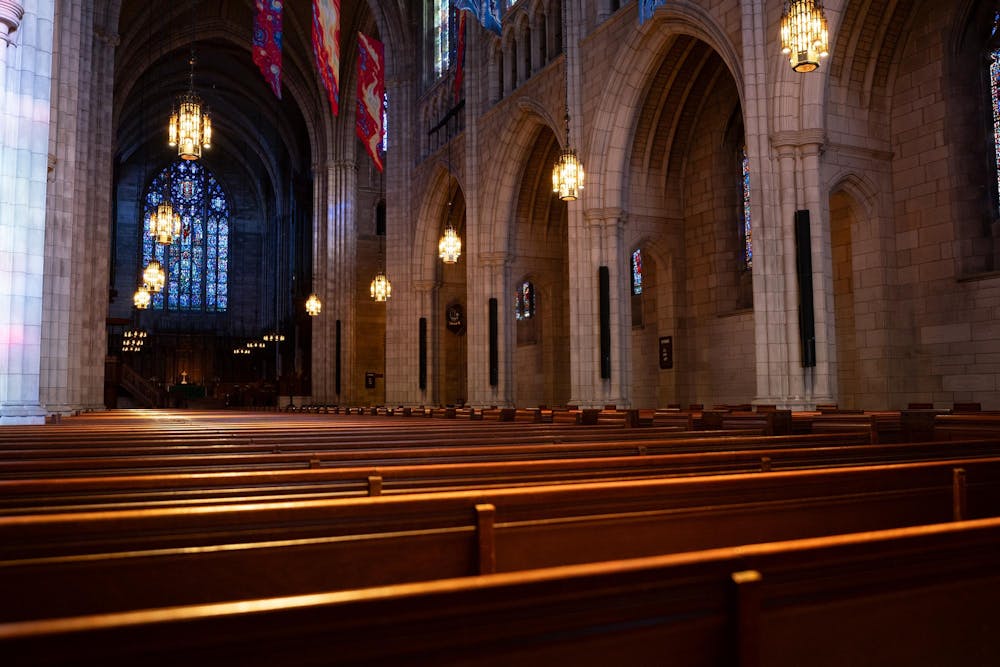
When you enter the Chapel, you feel overcome by the scale of the vaulted ceiling canopying above you, the nave sprawling before you, and, if you’re lucky, the sound of the organ reverberating within you. Its breathtaking size makes it a great space to sit in your thoughts — it is after all the third largest university chapel in the world. When it feels like our worries and desires are the only things that matter, it is worth being reminded of how tiny we are compared to the rest of the universe and, as I believe, its creator.
The Chapel finished construction in 1928, sporting pews made of wood from gun carriages originally intended for use in the Civil War. Saints and scholars adorn its stained glass windows. Martin Luther King Jr. once delivered a sermon from its pulpit. The history carried within the building reminds us of our relationship to the rest of humanity, which gives our lives and studies meaning and direction. It reminds us of existence beyond our own time and place.
And, of course, the Chapel is undeniably beautiful. To me, its most beautiful parts are its east and west stained glass windows, which depict Christ in his love and Second Coming, respectively. As the sun rises and sets, its light shines through the great windows, bathing the Chapel’s great gray interior in a shower of multicolored light. Beauty is one of those things that can be valuable intrinsically, not just merely as an instrument towards a further goal. Taking time to appreciate beauty for the sake of appreciating beauty trains our attention by shifting our perception of time from a commodity we must “optimize” to the medium in which we experience life’s richness.
The Chapel regularly hosts many different religious services and non-religious events. It is also open every day from 7 a.m. to 11 p.m. to every person on campus. You can go in for just 15 minutes to sit, rest, and think in silence. Those 15 minutes will not be “productive” in the strict sense. You will not get them back to study or see friends. But I promise they will be worth it.
Every moment I’ve spent at the Chapel has been special: the Sunday 10 p.m. Mass, the late nights listening to practicing organists, and, of course, the moments of silent contemplation. Those moments have helped me grow in friendship with my peers and with God. They have given my time at Princeton meaning. They have given me peace.
Roberto Lachner ’26 is an economics major from Ponte Vedra Beach, Fla. He may be reached at roberto.lachner[at]princeton.edu.

Please send any corrections to corrections[at]dailyprincetonian.com.
Read More

Start the conversation
Ian RosenzweigIt’s no secret that the United States is, functionally, a gerontocracy. By facilitating the occasional opportunity for national or international leaders to truly listen to young people’s concerns, Princeton will have made a more immediate impact in the service of humanity than most other campus initiatives can claim.
It’s no secret that the United States is, functionally, a gerontocracy. By facilitating the occasional opportunity for national or international leaders to truly listen to young people’s concerns, Princeton will have made a more immediate impact in the service of humanity than most other campus initiatives can claim.

Students need to know where their food comes from
Angela BahnaThe sad reality is that you could be sitting in a restaurant or a dining hall surrounded by rich farmland without any of the food on your plate coming from it.
The sad reality is that you could be sitting in a restaurant or a dining hall surrounded by rich farmland without any of the food on your plate coming from it.

Make the Pre-read a work of fiction
EmmaRose ZillaA story that’s intellectually ambitious and philosophically provocative doesn’t necessarily have to be nonfiction. A fictional text can help us understand political tensions or erosion of autonomy just as much as an explanatory novel can.
A story that’s intellectually ambitious and philosophically provocative doesn’t necessarily have to be nonfiction. A fictional text can help us understand political tensions or erosion of autonomy just as much as an explanatory novel can.