



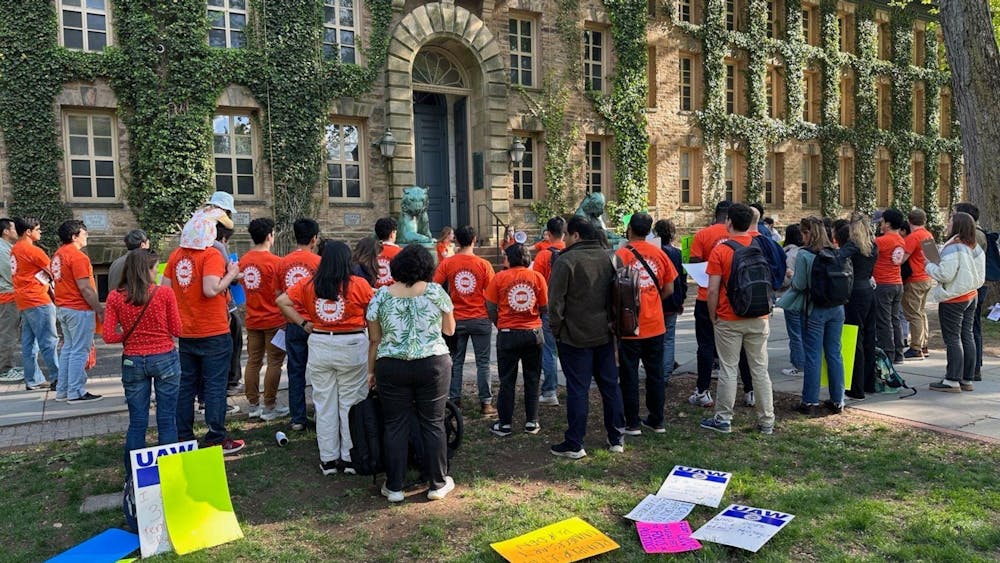
The following is a guest contribution and reflects the authors’ views alone. For information on how to submit a piece to the Opinion section, click here.
Princeton University’s postdoctoral researchers often see their positions as the opportunity of a lifetime. The prospect of immersing ourselves in this rich academic environment is enticing — sufficiently so to motivate us to face the challenges that come with it: uprooting our lives for one-year contracts, the high cost of a move and of living in Princeton, and the dependence we feel on our advisors and supervisors who serve as essential references for future employment.
But once we get here, many of us realize that these costs and problems are not merely challenges — they are conditions that make it difficult to sustain a stable career, home life, or future in academia without significant personal and financial sacrifice. That’s why a majority of postdocs and associate research scholars voted to form our union in May 2024. Like postdocs across the country, we understand that the only way to address these workplace issues is through building collective power and securing an enforceable union contract. Since we began bargaining for our first contract in October 2024, however, the Princeton administration has remained obstinate, insisting on maintaining the status quo and even proposing that they maintain the right to change and cut benefits at any time without employee input. Enough is enough — we need a fair contract now.
Postdoctoral researchers are highly specialized workers who have completed a Ph.D., yet we face job insecurity and an overwhelming workload in our temporary positions as researchers and instructors. We undergo enormous pressure to work overtime and publish quickly in order to be competitive for a permanent position in academia or industry. Because our contracts are so short, we balance intensive research duties with sending out constant applications for next year’s job, an application cycle that begins almost as soon as we arrive at Princeton.
We are experts in our fields, critical to the function of the University: with our doctorates’ worth of experience, we organize workshops and mentor students. Yet despite our contributions to research and undergraduate learning, we are offered little stability or security and paid a salary that fails to meet our financial needs.
The current minimum postdoc salary is $65,000 — a pittance, given that the average 1-bedroom apartment in Princeton currently costs $2,729. That adds up to $32,748 per year, or roughly 50 percent of the minimum salary. Over half of the surveyed Princeton postdocs spend more than 30 percent of their income on housing, classifying them as rent burdened. Many of us turn to University housing, hoping it will provide a more affordable alternative. However, when it comes to University faculty/staff housing, postdocs are some of the last on the priority list to be considered, with only 30 percent of postdocs and associate research scholars who applied receiving housing, according to information provided by the University to the postdoc union.
If we opt instead to live further away, in marginally more affordable areas, the lack of effective public transportation creates pressure to buy a car. But around 60 percent of postdocs arrive on visas, and international workers with no credit score struggle to obtain financing.
It is not uncommon to hear stories of postdocs moving frequently or living with multiple roommates in order to more efficiently manage our low minimum salaries. But many of us are well into our thirties, and move to Princeton with partners and families, which makes living with roommates unideal: unstable housing arrangements are difficult for supporting partners and children. Visa restrictions often disallow our partners, who have also moved across the country for the duration of our temporary contracts, from even taking up their own work.

In short, the current minimum salary does not reflect the valuable contribution that we make to Princeton. It does not meet the very high cost of living nor the needs of visa-holders, particularly amidst rising costs and federal attacks on higher education and research funding. The majority of postdoctoral researchers support a contract that includes meaningful raises, housing support, job security provisions, and basic workplace protections: it’s time for the Princeton administration to respond to their needs and support them as scholars and members of the community.
In bargaining, our current proposal is a minimum salary of $86,000. In response, the administration has offered to raise the minimum yearly salary by $3,000, only increasing it to $73,000 by 2028. When accounting for inflation, this potential increase fails to match up to current postdoc salaries at peer institutions — in fact, this number is comparable to other postdoc salaries from 2023; see the Columbia postdoc contract. Princeton must offer a real raise and support productive, sustainable living conditions.
In spite of their austerity measures, Princeton is the single wealthiest university in the world per student. The Princeton administration’s decision to reduce raises, freeze wages, cut jobs, and slash benefits is a reflection of the leadership’s priorities, not the University’s resources.
A majority of postdocs and scholars recently signed on to a letter to the University president and provost, expressing their support for a fair contract that meets our needs. We hope the administration will respect this mandate to come to a fair agreement without further delay.
This piece is written by a group of postdocs and scholars. Zara Albright is a postdoctoral research associate in the Program for Latin American Studies. Grace Flores-Robles is a postdoctoral research associate in the School of Public and International Affairs and the Department of Psychology. Minh-Thê Hoang Ngoc is a postdoctoral research associate in the Department of Civil and Environmental Engineering. Marta Mrozowska is a postdoctoral research associate in the Program in Atmospheric and Oceanic Sciences. Anirban Mukherjee is a postdoctoral research associate in the Department of Physics. Jessica Ng is a postdoctoral research associate at the High Meadows Environmental Institute. Drew Novick is a postdoctoral research fellow in the Princeton Artificial Intelligence Lab. They can be reached at info[at]princetonpostdocunion.org.
Please send any corrections to corrections[at]dailyprincetonian.com.

A correction was made May 21, 2026: A previous version of this piece incorrectly credited a postdoc that reviewed, but did not author, the piece.
Read More

Start the conversation
Ian RosenzweigIt’s no secret that the United States is, functionally, a gerontocracy. By facilitating the occasional opportunity for national or international leaders to truly listen to young people’s concerns, Princeton will have made a more immediate impact in the service of humanity than most other campus initiatives can claim.
It’s no secret that the United States is, functionally, a gerontocracy. By facilitating the occasional opportunity for national or international leaders to truly listen to young people’s concerns, Princeton will have made a more immediate impact in the service of humanity than most other campus initiatives can claim.

Students need to know where their food comes from
Angela BahnaThe sad reality is that you could be sitting in a restaurant or a dining hall surrounded by rich farmland without any of the food on your plate coming from it.
The sad reality is that you could be sitting in a restaurant or a dining hall surrounded by rich farmland without any of the food on your plate coming from it.

Make the Pre-read a work of fiction
EmmaRose ZillaA story that’s intellectually ambitious and philosophically provocative doesn’t necessarily have to be nonfiction. A fictional text can help us understand political tensions or erosion of autonomy just as much as an explanatory novel can.
A story that’s intellectually ambitious and philosophically provocative doesn’t necessarily have to be nonfiction. A fictional text can help us understand political tensions or erosion of autonomy just as much as an explanatory novel can.