




Princeton’s engineers go on to work for some of the world’s largest companies, where they create products and systems that affect the lives of millions. So why aren’t they required to receive an education in ethics while they’re at Princeton?
In order to fulfill their liberal arts general education requirements, students pursuing a B.S.E. degree must take seven courses in the humanities and social sciences, which must fall into at least four out of six distribution areas. These diverse requirements for engineering students support the claim that Princeton’s B.S.E. degree programs combine “the strengths of a world-leading research institution with the qualities of an outstanding liberal arts college.”
However, allowing B.S.E. students to arbitrarily choose which of these distributions to fulfill enforces the idea that the subject matter is interchangeable. This is especially worrying when it comes to meaningful engagement with the Ethical Thought and Moral Values (EM) distribution and the great stakes and wide applicability of its material. Classes in the EM distribution seek to instill a nuanced understanding of the contexts that inform morality, providing students with the intellectual foundations to become better-adjusted and more empathetic people. An education in ethics cannot be replaced or ignored. No student should graduate Princeton without some form of education in ethics, no matter their major. Currently, chemical and biological engineering is the only engineering major that requires a class in the EM distribution. The University should honor the value of this distribution by acknowledging ethics’ role across all disciplines and making the requirement mandatory for all undergraduates.
Ethics is especially relevant for engineers in this moment of fraught debate over ethics of AI. As such, Princeton should also expand its course offerings in ethics to include more direct ties to science, technology, and the humanistic impacts and considerations of engineering. A more inclusive and interdisciplinary curricular approach to ethical education will allow B.S.E. students to more quickly realize the relevance and importance of an ethics education in their own fields, not just for those students pursuing a Bachelor of Arts degree.
Princeton undergraduates come from a variety of educational backgrounds. Many of the high schools they hail from, like mine, may not have offered ethics classes. Currently, B.S.E. students can graduate from Princeton and enter the workforce without any formal education in ethics, meaning they might never spend time in meaningful exploration of the complex questions of decision making, justice, and how to do right by one another. Thus, to ensure students at Princeton have an education in ethics, EM classes should not only be made available but mandated for all students, regardless of major.
Moreover, Princeton can offer its engineers a more relevant ethical education by increasing the number of EM courses with ties to topics in engineering. Classes like AI for Global Good, which explores the intersection between AI and environmental sustainability, are a step in the right direction. But these courses must also be expanded in order to give all B.S.E. students the opportunity to explore the human contexts and impacts of their work in a way that aligns with their interests and future plans. One possibility would be to introduce EM courses which are cross-listed with engineering departments, allowing B.S.E. students to explore ethics while still immersing themselves in the context of their own courses of study.
Real-world consequences can arise when innovators do not fully consider the ethical implications of their own work. A 2020 MIT report found that automated policing technologies easily lead to systemic inequalities, and are more likely to implicate Black people in crimes compared to their white counterparts. Issues like this require not merely an engineering education but an attunement to the identity politics of our social world. A closer intellectual exploration of human values would have been greatly beneficial for the engineers responsible for overseeing this sensitive work, and would have better prepared them for a deep understanding of ethical thought should have been required to begin with.
Developments in AI further emphasize the relevance of ethical considerations to engineering disciplines. This accelerated technological development led Anthropic to publish Claude’s constitution. The constitution is Anthropic’s set of rules for Claude, the company’s large language model. In the document, Anthropic states the company’s goal of ensuring that all Claude models are “safe and beneficial,” in order to “embody the best in humanity.” Such developments directly concern the relationship between a safe, just human society with our rapidly developing technological landscape. To succeed, this document requires a deep knowledge about and value for the intersections between morality and innovation.

Peer institutions have already recognized this growing need and have created classes like MIT’s Ethics for Engineers, yet Princeton has not fully recognized the connection between engineering and ethics. Not only do we not integrate engineering extensively into our ethics curriculum, but we don’t require B.S.E. students to take an EM class at all. If Princeton wants to prepare its students to legitimately serve humanity, they must provide all students — including engineers — with an ethical education.
Leaving engineers largely by the wayside when it comes to questions that help us be good people is a grave error, and doesn’t capitalize on the capacity of engineering students to generate positive change in both a technological and a humanistic sense. Making the EM distribution required for all majors — as well as making an effort to create more interdisciplinary engineering and ethics classes — would help to ensure that students have the education they need to truly help serve humanity.
Audrey Tan is a prospective Economics major from Pullman, Wash. She is an Opinion columnist for the ‘Prince.’ You can reach her at at4887[at]princeton.edu.
A correction was made on May 9, 2026: A previous version of this article did not include that the chemical and biological engineering major required a class in the Ethical Thought and Moral Values distribution requirement.
Read More

Make the Pre-read a work of fiction
EmmaRose ZillaA story that’s intellectually ambitious and philosophically provocative doesn’t necessarily have to be nonfiction. A fictional text can help us understand political tensions or erosion of autonomy just as much as an explanatory novel can.
A story that’s intellectually ambitious and philosophically provocative doesn’t necessarily have to be nonfiction. A fictional text can help us understand political tensions or erosion of autonomy just as much as an explanatory novel can.
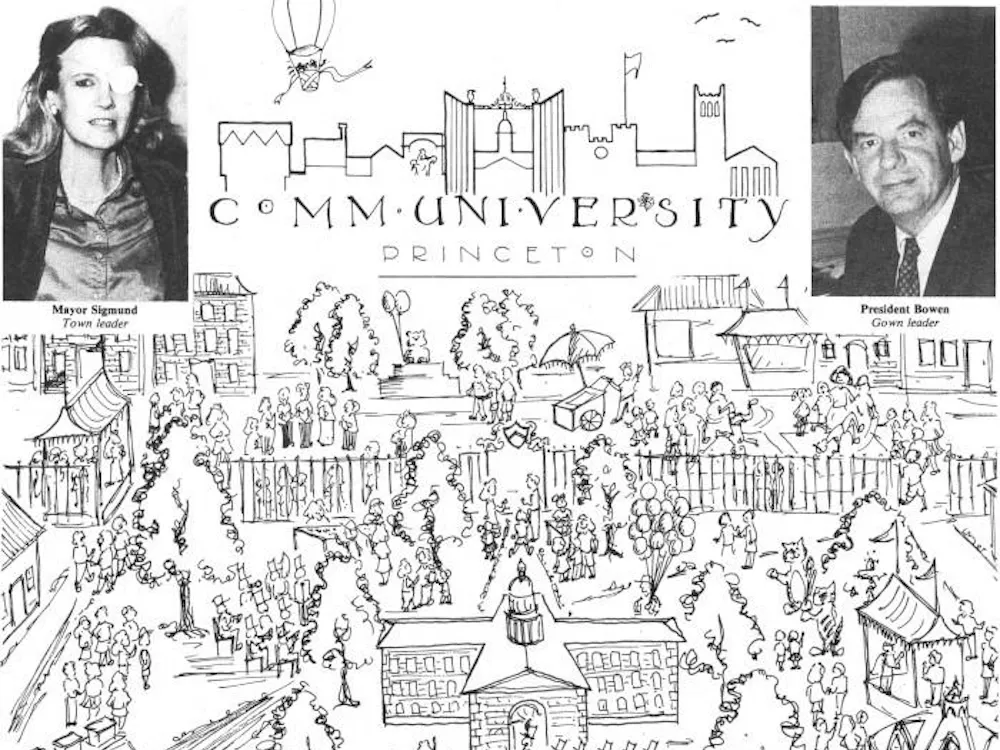
Bring back Communiversity
Isaac BarsoumFrom its inception in 1985, when it subsumed the Arts People Party — the Arts Council’s pre-existing festival — Communiversity always aimed to be more than just an arts festival. It was both a physical and symbolic coming-together of the University and the town in a celebration of all that we have in common and all that makes us different.
From its inception in 1985, when it subsumed the Arts People Party — the Arts Council’s pre-existing festival — Communiversity always aimed to be more than just an arts festival. It was both a physical and symbolic coming-together of the University and the town in a celebration of all that we have in common and all that makes us different.

Who rights our rules?
Charlie YaleWith fairness for students in mind, the University must require that all changes to RRR go through the Committee on Rights and Rules.
With fairness for students in mind, the University must require that all changes to RRR go through the Committee on Rights and Rules.