



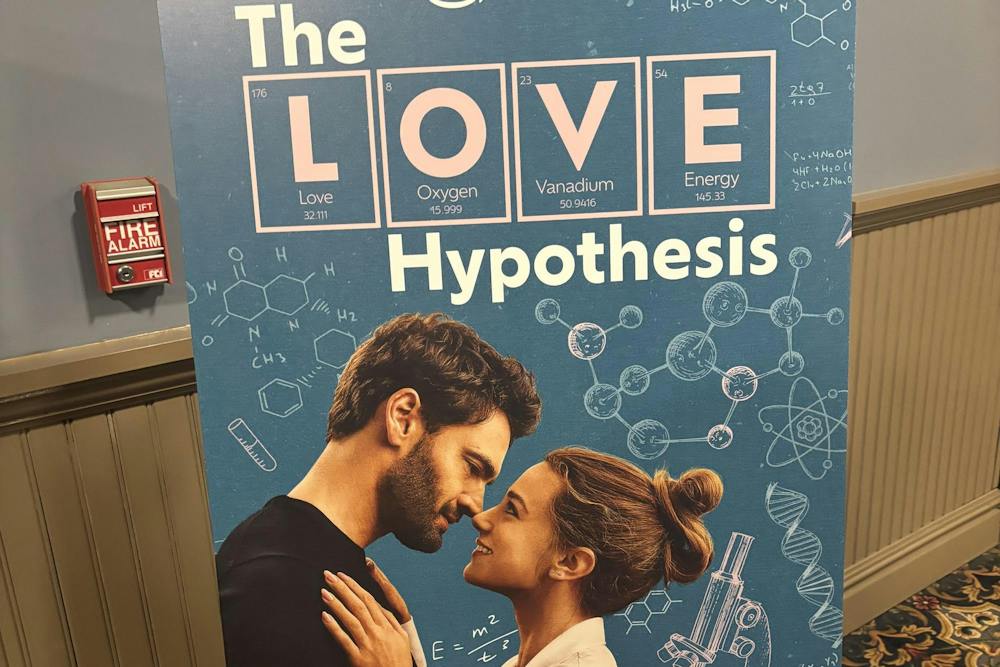
Have you ever had to convince your best friend it’s okay for her to date the guy you both have a crush on, so you impulsively kiss a professor? Of course you haven’t, but this bizarre premise lays the groundwork for Amazon Prime’s newest romantic comedy, “The Love Hypothesis.”
Starring Lili Reinhart and Tom Bateman, the film is based on Ali Hazelwood’s novel “The Love Hypothesis,” which gained immense popularity for its enthralling recipe of enemies-to-lovers, fake dating, and classic “opposites-attract” relationship tropes. Five years after its original publication, I witnessed this abomination on the big screen at a special Undergraduate Student Government movie pre-screening after waiting with a line of students out the door and into the street.
Every proper scientist knows you need background knowledge before starting an investigation. So, because I knew nothing about the film going in (and because I, as an English major, am a big advocate for the scientific process), I conducted some preliminary research. It seemed that many people who had read the book before were particularly excited.
“I normally put down rom-com books very quickly, because I find them very corny. But this one, I didn’t put it down,” Ceylin Avci ’30 said.
“I am a huge fan of the book and [Hazelwood’s] work … I’ve been really excited to see the movie, so I’ve been keeping up with the trailers coming out,” Natalie Gelman ’27 said.
While researching, I also learned the almost unbelievable fact that Hazelwood’s novel was initially based on a Star Wars fanfiction. In her novel adaptation, a Skywalker and a Jedi are replaced with a Ph.D. candidate and a biology professor at Stanford University as the main characters.
The film wastes no time introducing the soon-to-be couple. In fact, it opens immediately with a “meet-cute,” where Olive Smith, played by Reinhart, rushes into the bathroom to prepare for her interview for graduate school. She’s sweaty, nervous, and completely stressed out when a flippant scientist enters the bathroom. Since his handsome face is intentionally blurred, the audience is left to focus on the strikingly unnatural dialogue between the two, which felt less like true chemistry and more like strange banter between two people who already knew they didn’t like each other.
The film then fast-forwards to Olive’s matriculation at Stanford and quickly establishes her close friendship with Anh, played by Rachel Marsh, through a scene or two of them enjoying junk food and spending the holidays together. Suddenly they’re each other’s other half. While this rushed character development is not uncommon in the romantic comedy genre, far superior counterparts like “Easy A” or “Crazy, Stupid, Love” allow more time for the audience to spend with the main characters individually, delivering a more curated and authentic taste of their worlds.

The film’s major crux is that Olive develops a crush on another graduate student, Jeremy, played by Nicholas DuVernay, but this important variable is also severely underdeveloped. Her interactions with Jeremy are so minimal that it feels insignificant, and in the same short sequence, Olive acknowledges that Jeremy has eyes for Ahn. Ahn is clearly interested in Jeremy too, but rejects his advances because of “girl-code.” In the novel, Jeremy is Olive’s ex-boyfriend, a plotline not followed in the movie but one that produces a slightly better justification for the jarringly absurd events that follow.
When Olive spots Ahn wandering around the science lab late at night, she impulsively kisses the first man she sees in hopes that would be sufficient proof that she has moved on from Jeremy. In classic rom-com fashion, this man happens to be the brooding scientist she met at the start who immediately threatens to file a Title IX complaint against her for kissing him without consent. Despite this scene being meant to be comical, it was too long for comfort and left a bad taste in my mouth.
After this point, Olive’s friends think she’s dating the aforementioned scientist, Dr. Adam Carlsen, played by Bateman, who we learn is intense, weirdly apathetic, and makes a habit of crushing the souls of young scientists. Fittingly nicknamed Dr. Evil throughout the film, he is the typical dark-villain archetype who would look more at home in “Fifty Shades of Grey” than a bright, bubbly rom-com.
If the film hadn’t already lost me, this is where it gets irrecoverably strange. Adam calls Olive into the office for what I assume will be some sort of disciplinary action. But instead, he proposes they start a fake relationship. With no family, close friends, or pets tethering him to California, Dr. Carlsen fears Stanford may not renew his contract. He reasons that having a serious girlfriend will show the university he’s not a “flight risk.” For a movie so rooted in stereotypes I’ve seen a million times, I've got to hand it to them that I didn’t see this coming. But I also couldn’t take anything too seriously after that.
As the film progressed, I found it excruciating to watch them pretend to be a couple. Between the painfully unsensual kisses and unconvincing laughter, the lack of chemistry was practically bleeding out of the screen. Watching her awkwardly lube him with sunscreen practically forced me to recoil in my seat. But even in the midst of all the chaos, the pair eventually end up falling in love for real — who is surprised?
A major facet of the film is Olive’s desire to study pancreatic cancer. She emails an associate professor at Harvard, Tom Benton, played by Arty Froushan, who also happens to be an old grad school friend of Dr. Carlsen. Tom gives her an opportunity to present her ideas at a conference, where he’s impressed and offers her a spot in his lab. In the very same breath, he says that Olive must have sex with him to keep doing her research, or he might steal her ideas for his own. The choice to have this moment happen closer to the end of the movie doesn’t do the audience any favors. The resolution happens quickly. Adam tells Tom off in a huge spectacle. Olive ends up doing her research at another lab, finishes her Ph.D., and she lives happily ever after with her once faux-lover.

While I understand the movie intends to address the very real issue of how poorly women are treated in academia, the overt and rushed representation of sexual harassment erases a lot of the nuances that occur in real life, where the impacts of power imbalances in the professional world can get murky. This ties back to the central pitfall of the movie — every facet of character and plot development is surface level. It has the right ideas, but delivers them poorly. Ultimately, it ends up doing nothing revolutionary.
“The Love Hypothesis” aims to fall in line with a more recently developed phenomenon of modern rom-coms — think “Set It Up” and “Anyone But You.” But “The Love Hypothesis” falters simply because of bad writing and subpar acting. Maybe the missing ingredient here was Glen Powell. Or an alternative hypothesis: Maybe I’m expecting this movie to wear shoes it was never meant to fill.
After talking with some people after the pre-screening, it seemed the consensus was that the movie was enjoyable despite its shallowness.
“I think there were definitely some cheesy parts, but it kind of made it more wholesome,” Natalia Kiernia ’27 said.
“I thought it was also kind of cheesy, but that made it a lot more fun. Especially the loud theater environment, everyone laughing along with it really added to the experience,” Natalia Diaz ’27 said.
Diaz is a former associate editor for The Prospect.
“I did think some of the writing was a little corny at times, but I think that’s part of the premise you get with the rom-coms,” commented Connor Romberg ’27, chair of USG.
Romberg is a former assistant editor for The Prospect.
As a hopeless romantic, though, I left with a thirst for a realistic romance that this film doesn’t quite quench. A good love story can permit an escape from chronic singleness, yet this film’s world feels too flat for me to penetrate.
The Love Hypothesis is expected to premiere globally on Prime Video on Sept. 23.
Amaya Taylor, a member of the Class of 2028, is an associate editor for The Prospect and News staff writer. She can be reached at amayataylor[at]princeton.edu.
Please send any corrections to corrections[at]dailyprincetonian.com.
Read More

Princeton University Orchestra and men’s ultimate frisbee team named in University’s latest hazing report
Andrew ArthurTwelve students in the Princeton University Orchestra and Men's Ultimate Frisbee team were found responsible for hazing violations in the University's latest Campus Hazing Transparency Report. Sanctions ranged from Dean's warnings to disciplinary probation.
Twelve students in the Princeton University Orchestra and Men's Ultimate Frisbee team were found responsible for hazing violations in the University's latest Campus Hazing Transparency Report. Sanctions ranged from Dean's warnings to disciplinary probation.

Murray-Dodge Café celebrates 50th Anniversary, drawing over 260 students
Hifza KaleemOn Wednesday, Murray Dodge Cafe celebrated its 50th anniversary, drawing more than 260 students to celebrate with free cookies and merchandise.
On Wednesday, Murray Dodge Cafe celebrated its 50th anniversary, drawing more than 260 students to celebrate with free cookies and merchandise.
Students share mixed reactions as mandated officer and treasurer trainings return to in-person format
David EstradaThe University's student organization officers and treasurers returned to mandatory in-person training this fall after years of online sessions. Student reactions found parts of the training redundant or tedious, though most agreed the sessions were important.
The University's student organization officers and treasurers returned to mandatory in-person training this fall after years of online sessions. Student reactions found parts of the training redundant or tedious, though most agreed the sessions were important.