



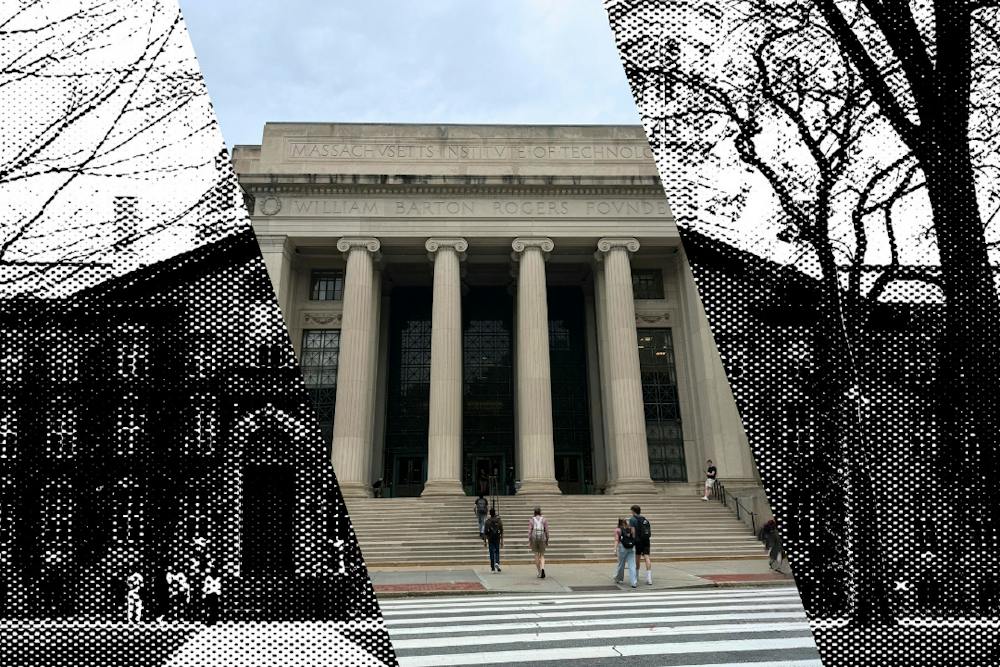
Princeton has fallen to No. 2 on the U.S. News and World Report’s annual rankings for best national universities after 15 consecutive years at the top of the list. The Massachusetts Institute of Technology, which has been ranked No. 2 for the past five years, now holds the top spot.
The updated rankings, released Monday, feature a new factor known as “earnings by major” in the ranking calculation. The “earnings by major” factor is calculated by comparing outcomes for individual majors within a school against a national average and replaces a previous metric that measured graduate indebtedness.
In the final rankings, where schools receive a score out of 100, MIT scored 100 and Princeton scored 99. The third-ranked school, Harvard University, received a score of 96.
LaMont Jones, the managing editor for education at U.S. News, said the new “earnings by major” metric was intended to “be a more fair and accurate factor” in an interview with The Daily Princetonian.
“One could argue that depending on how good your earnings are, that could help mitigate the effects of whatever debt you have. On the contrary, if your earnings aren’t great, even if your debt isn’t great, it’s difficult to manage with low earnings,” Jones said.
MIT ranks first for the “earnings by major” factor specifically. The California Institute of Technology, another top science- and engineering-focused school, ranks second. Princeton ranks eighth, tied with the University of Chicago and behind schools including Carnegie Mellon University, Dartmouth College, and Harvard. Caltech also rose significantly in the new national universities rankings, from No. 11 last year to tied for fifth place.
The new factor compares schools by major using data from graduates who received federal financial aid and whose highest degree is a bachelor’s. For each major with at least 30 graduates, the median earnings four years after graduation are calculated in relation to the national median. The data is statistically standardized to measure how unusual the earnings for that major are, and the scores are then weighted by the proportion of a school’s graduates in that major.
Approximately a quarter of the students in Princeton’s Class of 2029 are lower-income and eligible for federal Pell Grants. About 27 percent of MIT Class of 2029 students are.

U.S. News, in its methodology explanation, acknowledged that “the amount of pay associated with different majors cannot be completely isolated from factoring in the result.” However, it said that the new factor works to reduce the impact of schools that have a large portion of graduates in typically high-earning majors.
“It prevents schools from being rewarded by having a really high concentration of majors that are high-paying fields,” Jones said. “By focusing on financial aid recipients, in this metric it actually reduces the influence of family networks and other preexisting advantages, such as family wealth, that might advantage some students over others,” he added.
Princeton was historically strong in the graduate indebtedness factor that “earnings by major” replaces. In last year’s ranking, the median federal loan debt for borrowers at Princeton was $10,320 at graduation, compared to $14,768 at MIT and $14,000 at Harvard, according to U.S. News.
Jones also cited standardized testing scores and faculty research metrics as two areas where Princeton has become less competitive relative to its peers.
Last year, Princeton tied at No. 2 in standardized test scores while MIT was at No. 1. In the new rankings, Princeton now ties at No. 3 in test scores, and MIT has remained at No. 1.
University spokesperson Michael Hotchkiss declined to comment on the University’s change in ranking.

U.S. News started publishing its rankings of best colleges in 1983. The early editions were based solely on peer reputation, where college administrators would fill out surveys. The methodology to calculate the rankings has grown more complex over time.
Princeton first reached the top of the national universities rankings in 1997. Since then, it has only fallen out of the top two positions once — in 1999 at No. 4 — due to a methodology change that put Caltech on top. Another methodology change the following year returned Princeton to the top.
From 2000 to 2007, Princeton either shared the top spot with Harvard or was the sole leader. It fell to the No. 2 position in 2008 and 2010, below Harvard, before leading the chart again from 2011 to 2025.
From 2013 onward, Princeton was the sole university ranked with the top spot. Harvard has maintained its No. 2 position for most of that time, but MIT has been the only university at No. 2 since 2022.
The chart has long faced criticism over its attempt to differentiate universities by specific rankings despite the subjective factors that define higher education.
In 1996, then-Stanford University President Gerhard Casper wrote to the U.S. News editor at the time, criticizing the act of ranking.
“Could you not do away with rank ordering and overall scores, thus admitting that the method is not nearly that precise and that the difference between #1 and #2 - indeed, between #1 and #10 - may be statistically insignificant?” Casper asked.
University President Christopher Eisgruber ’83 expressed a similar sentiment in 2021 while writing in Princeton Alumni Weekly and the Washington Post.
“U.S. News should not suggest that one school is better than all others,” Eisgruber wrote in PAW. “Instead, it should inform prospective students and families about the factors that matter when choosing a college.”
“If there must be rankings, I suppose we should be happy to be at or near the top,” he continued. But, he noted, “even tiny tweaks to an arbitrary rating formula could jumble the ordering.”
Former President Barack Obama also sought to present an alternative ranking from the federal government while in office. That ranking system never materialized, and the Obama administration instead released a College Scorecard website that contains data about many universities.
U.S. News now uses the College Scorecard dataset for some of its calculations, including for determining national median earnings for the “earnings by major” factor.
The rankings received significant attention when Columbia University math professor Michael Thaddeus publicly questioned some of the university’s reported statistics in early 2022. Later that year, Columbia dropped from No. 2 to No. 18 on the national universities ranking. The following year, the university announced it would no longer submit data to U.S. News for the ranking, citing its “outsized influence” and the way it “distill[s] a university’s profile into a composite of data categories.”
U.S. News has changed its methodology multiple times in recent years. It announced in 2013 that it would place greater emphasis on college graduation rates and less emphasis on students’ high school standings. The minimum percentage of students in a school’s first-year class submitting SAT or ACT scores needed for calculation of that factor was lowered in 2021 from 75 percent to 50 percent in response to the COVID-19 pandemic.
In 2023, U.S. News introduced what it called “the most significant methodological change in the rankings’ history.” Factors including class size, faculty with terminal degrees, and alumni giving, an area that Princeton has historically been exceptionally strong in, were removed. Instead, U.S. News said it placed increased weight on if schools successfully graduated students from different backgrounds.
Jones, in the interview, said that U.S. News will continue evaluating its ranking factors on an “ongoing basis” and updating its methodology “as higher education evolves, and the expectations on schools evolve.”
“Sometimes there are adjustments that we make along the way as we see what impact the changes are having,” Jones said of the ranking factors.
Oliver Wu is the assistant News editor for the ‘Prince’ leading town coverage, focused on the Municipality of Princeton and beyond. He is from Stony Brook, N.Y., and can be reached at oliver.wu[at]dailyprincetonian.com.
Giselle Moreno is a staff News writer who typically covers town and university affairs. She is from Dallas and can be reached at gisellemoreno[at]dailyprincetonian.com.
Please send any corrections to corrections[at]dailyprincetonian.com.
Read More

The Daily Princetonian launches Signal tip line for sensitive sources
Clara DochertySignal is a secure, end-to-end encrypted messaging app. The new tip line will allow The Daily Princetonian to more effectively communicate with sensitive and anonymous sources.
Signal is a secure, end-to-end encrypted messaging app. The new tip line will allow The Daily Princetonian to more effectively communicate with sensitive and anonymous sources.

Princeton football loses season opener against Bryant, 21–14
Jordan HalagaoDespite finding an offensive rhythm, Princeton could not capitalize on trips to the red zone, ultimately losing to Bryant 21–14 in Princeton’s first game of the season.
Despite finding an offensive rhythm, Princeton could not capitalize on trips to the red zone, ultimately losing to Bryant 21–14 in Princeton’s first game of the season.

Jovanovic scores early as women’s soccer draws with Villanova 1–1
Jordan HalagaoWomen’s soccer forced a draw against Villanova in the last out-of-conference game of the season.
Women’s soccer forced a draw against Villanova in the last out-of-conference game of the season.