



The following is a guest contribution and reflects the author’s views alone. For information on how to submit a piece to the Opinion section, click here.
Was the Class of 2026 class jacket design dishonestly created using AI? On Tuesday, Margaret Miao ’26 started an online petition titled “Demand for Integrity for Class of 2026 Jacket.” I signed the petition, agreeing with its essential demand: that students receive confirmation that the jacket design for Princeton’s Class of 2026 is a human creation, not algorithmically generated.
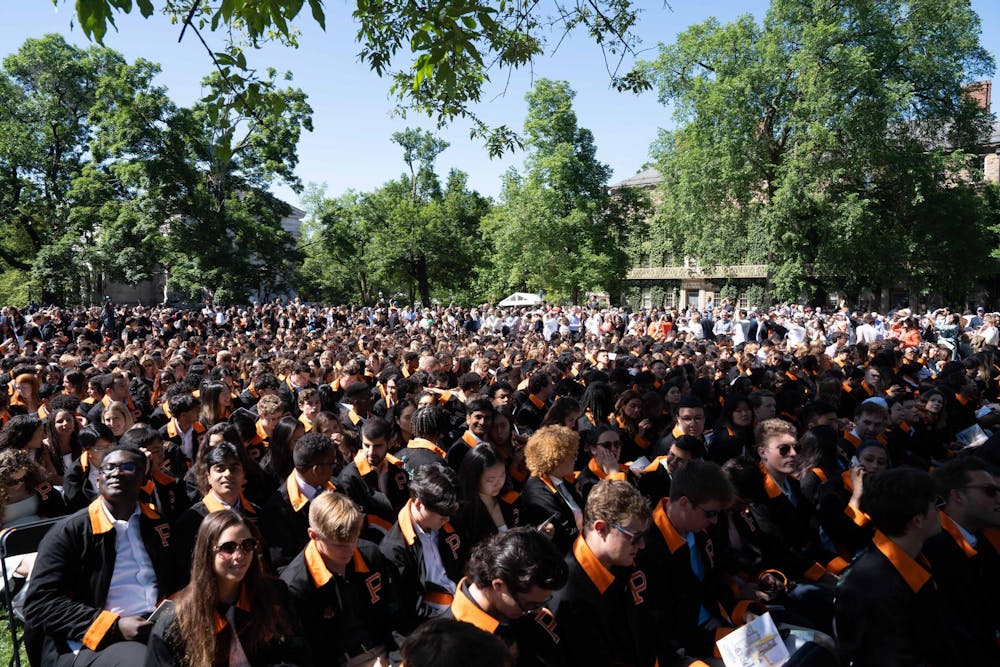
Class jackets, also known as senior jackets, are issued to all graduating seniors prior to Reunions and Class Day, where they are traditionally worn. Each class year’s jacket is typically designed by a member of the graduating class and chosen through a design contest. Dozens of designs were submitted to the Class of 2026’s contest in October, and after two rounds of ranked choice voting, a design submitted by Samuel Henriques ’26 was announced as the winner of the contest on Monday.
As a digital artist, I find parts of the final designs suspicious. For context, the 2026 Class Jackets Committee initially provided an optional black and white line-art template of the jacket’s front and back to all contestants. In Henriques’s Version #1, we see the template in the shape and outline of the design used by most submissions in previous rounds of voting. But in Version #2, the shape has changed; the outline has disappeared; the front collar is unnecessarily shaded where Version #1 was flatly colored. These inconsistencies could be signs that Version #2 is an AI modification of Version #1.
Version #1 is also worth a second look. On the front of the jacket, the coloring is asymmetrical, with only the right rose having a singular light yellow petal that also vaguely resembles a thorn. On the back of the jacket, the last stripe on the tiger’s tail is light yellow, and there is a singular petal on the left rose that is colored both orange and light yellow. Though these details are less suspicious than those on Version #2, AI-generated images often contain details that humans have trouble rationalizing.
We do not have conclusive evidence that either Version #1 or Version #2 was made with the help of AI tools. But in our current world of convincing deepfakes and AI slop, these details warrant reasonable suspicion.
AI use is a blatant violation of contest rules, and evidence that the jacket was designed without it should be easy to provide: a time-lapse, a Photoshop file, or a display of the layers used in the design program. Anything that clearly documents a human creation process for both versions of the final design would do. Although the requested evidence is simple, the longer we wait, the harder it will be to re-establish integrity, since there are ways to use AI to generate evidence too. Students need immediate transparency from the 2026 Class Jackets Committee about how the chosen design was created.
All finalists had to sign a disclosure statement in order to advance in the competition. As a finalist myself, I was required to sign a statement acknowledging that “any use of AI tools in the creation of my design would result in disqualification from the Class Jackets Design competition.” An email from the Class Jackets Committee indicated that the committee and Henriques “worked together collaboratively” to create a second version of the winning design, and voting between the original and secondary design closed on Wednesday. The announcement of the contest winner and release of a second version sparked controversy around whether AI tools were involved in the creation of either version.

Echoing the petition’s words, which were endorsed by 600 signatories, our class jacket is an enduring emblem of our class’s Princeton experience. The question of the provenance of this design echoes the challenges we face with AI in academic work. After all, integrity and honesty are cornerstones of our obligations to the University community — they should carry over into our extracurricular pursuits.
Allowing an AI-generated design to represent our class would be disrespectful to the classmates who labored for hours over honest designs. Handing out such jackets would be an insult to graduates who expect a jacket designed by a fellow member of the class. As an artist, I would not want a jacket designed using AI.
This year, the Committee created new structures aimed to ensure integrity: adding an AI clause, requiring all designers to sign a disclosure, and passing submissions through an AI detection tool. These steps are appreciated but ultimately insufficient. Signing a disclosure does not prove that AI tools were not used, and AI detection tools are notoriously unreliable. Requesting an additional step of providing evidence of human creation wouldn’t be burdensome, and it would provide essential reassurance to the University community.
The Class of 2026 saw the release of ChatGPT in the first semester of our first year at Princeton. We are the first class that has had to navigate the use of AI tools for the entirety of our undergraduate education, and our decisions today will set a precedent for future class years. AI tools will only improve in the future, making it increasingly difficult to distinguish between human and AI work and presenting new challenges in ensuring integrity. By being willing to respond to reasonable demands for evidence, the 2026 Class Jacket Committee can set a standard of transparency and accountability, combating how irresponsible uses of AI undermines those values.
The festivities surrounding Commencement are symbolic. Class jackets, caps and gowns, and even the diplomas are symbols that mark a meaningful end to our time at Princeton. I want our jacket to represent our commitment to integrity, not a capitulation to irresponsible AI use.
Jacqueline Zhou is a senior majoring in philosophy. She can be reached at jacqueline.zhou[at]princeton.edu.

Please send any corrections to corrections[at]dailyprincetonian.com.
Read More

The real crisis on campus isn’t cheating, it’s thinking
Jack GoodmanFurther, a growing body of research confirms that use of generative AI undermines the cognitive effort that is essential to the development of the human brain. As AI use increases, learning, recalling, and critical thinking skills decline.
Further, a growing body of research confirms that use of generative AI undermines the cognitive effort that is essential to the development of the human brain. As AI use increases, learning, recalling, and critical thinking skills decline.

Trust in academia is at a low. Can Writing Seminar help?
Ian RosenzweigAcademia has a PR problem, and no amount of insular critical inquiry is going to solve it. Writing Seminars should live up to their name and teach us not just to solve thorny research problems but also to effectively communicate our solutions through clear and — perhaps more importantly — stylistically compelling prose.
Academia has a PR problem, and no amount of insular critical inquiry is going to solve it. Writing Seminars should live up to their name and teach us not just to solve thorny research problems but also to effectively communicate our solutions through clear and — perhaps more importantly — stylistically compelling prose.
Why is the recording policy being kept secret?
Isaac BarsoumIn denying new students — and faculty and staff, for that matter — the right to know what regulations they are subject to, Princeton makes violations likely and will end up unfairly investigating or disciplining community members who were unaware of the policy’s existence in the first place.
In denying new students — and faculty and staff, for that matter — the right to know what regulations they are subject to, Princeton makes violations likely and will end up unfairly investigating or disciplining community members who were unaware of the policy’s existence in the first place.