



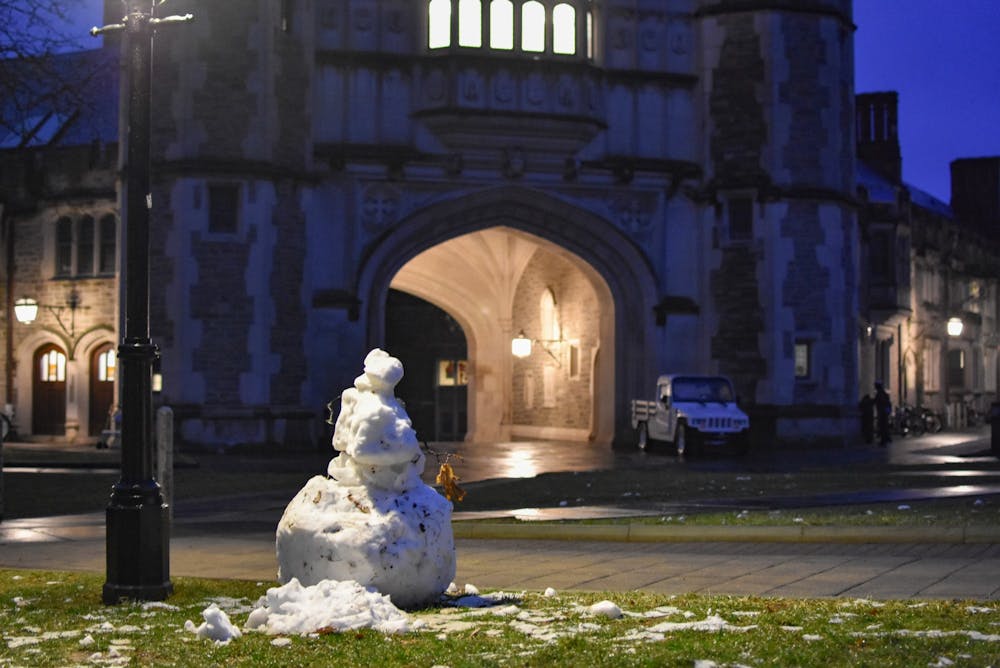
On Feb. 22, a blizzard brought 16 inches of snow to Princeton, resulting in the cancellation of all in-person classes for the first time in recent memory. This snow was particularly suited for packing, molding, and building because of a specific set of conditions, including flake type, wind, and temperature. And Princeton students responded appropriately: We set out building snowmen and igloos, having snowball fights and carving snow angels into the snowpack.
But why did we need a confluence of all those conditions for a few moments of whimsical fun?
Since time immemorial, Princeton students have prioritized coursework and employment — or the search for it — above all else, and for good reason. So, when we do have fun, it is often structured and scheduled. But we’re missing something important, something that pokes its nose out from beneath the surface of the snow whenever it falls. We’re missing spontaneous, unplanned, whimsical fun. And we need to bring it back.
An advertisement that ran regularly in The Daily Princetonian between 1986 and 1987 asked students if they were “Too Busy Studying? Too Busy Partying?!” and, if so, offered to do their laundry for them. The 24-hour “WASH-O-MAT” identified a perennial problem on our campus: We’re too busy, and that busyness keeps us from important parts of our lives, whether it’s our laundry or our commitments to our passions like eating or activism.
Crucially, though, our busyness doesn’t always mean we’re not having fun: We do, and in myriad ways. From parties to planned meals to Porchfest to the ‘Prince,’ we decompress, build community, and find outlets for ourselves all the time.
But if you’re anything like me, a lot of that fun is scheduled in advance on your Google Calendar, leaving little time left between all your other obligations. You rarely, if ever, add anything to your day that wasn’t planned. After all, you need that time to work, eat, and sleep.
Rinse, repeat.
Inherently missing from any routine is spontaneous fun. But this sort of play, which surfaces during a blizzard as igloos or snowmen, is essential to incorporate into our everyday lives. Play, in this sense, “thrive[s] on amplifying novelty and surprise, stepping outside rehearsed patterns through imagination,” according to neuroscience research.

In fact, the same research suggests that because “playful interactions generate high levels of uncertainty, requiring continuous adaptation and exploration,” play can support and strengthen cognitive functions to counteract brain deterioration as we age.
Scheduling fun, on the other hand, leads people to “anticipate less enjoyment and actually enjoy the event less than if the same activities were unplanned.” Schedules and structured activities are affiliated with work; to play, and play effectively, requires at least a modicum of abandon.
It’s crucial to have fun that is spontaneous and surprising, fun that is not built into your schedule but derails it, fun that makes you forget, if only for a moment, that problem set, that essay, that quiz.
In wintertime, jump into the snow; in springtime, jump into the flowers; in summertime, jump into the lake; in autumntime, jump into the leaves. And do all those things with your friends, with your neighbors, with a stranger, with someone you love, or with someone you might one day love.
That’s the whimsy you create. But we also need to be ready to engage with the whimsy that comes our way. Someone asks you to get a coffee, to build a snowman, to go kayaking, to dance in the rain, to lie in the grass and look at the sky? Say yes. The problem set can wait, if only for half an hour.
The final ingredient in all this is time: We need more time for whimsical fun, because for many of us, whimsy feels as though it is in a zero-sum game with work, sleep, and structured fun. But until our workloads decline, our sleep schedules are sacrificed, or our structured fun becomes less important — it won’t — then we’ll have to make do with the time we have.

And sometimes, five minutes in the snow with your friends is all it takes to heal your spirit, to rejuvenate your brain, and to return a smile to your face.
For joy, find whimsy. We could all use a little more of it in our lives.
Isaac Barsoum ’28 is an associate Opinion editor from Charlotte, N.C., who doesn’t have enough whimsy in his life and aspires to follow his own advice. He can be reached at itbarsoum[at]princeton.edu except when he’s building a snowman with his friends.
Read More

This law school does AI policy the right way
Charlie YaleThe University needs a cohesive AI policy so students know what to expect and are not defaulting to excessive AI usage.
The University needs a cohesive AI policy so students know what to expect and are not defaulting to excessive AI usage.
Be willing to give imperfect gratitude
Samuel KligmanWith an abundance of people to whom we owe thanks, can we ever satisfactorily express our gratitude? Probably not — but we should at least try.
With an abundance of people to whom we owe thanks, can we ever satisfactorily express our gratitude? Probably not — but we should at least try.

In reversing divestment, Princeton chooses moral cowardice
Isaac BarsoumAs the world burns, Princeton will continue to be confronted with the eternal question: Which side are you on? With this decision, the University demonstrates that it remains squarely on the side of the climate deniers, the oil profiteers, the pipelines, the profits, and everyone but the people.
As the world burns, Princeton will continue to be confronted with the eternal question: Which side are you on? With this decision, the University demonstrates that it remains squarely on the side of the climate deniers, the oil profiteers, the pipelines, the profits, and everyone but the people.