



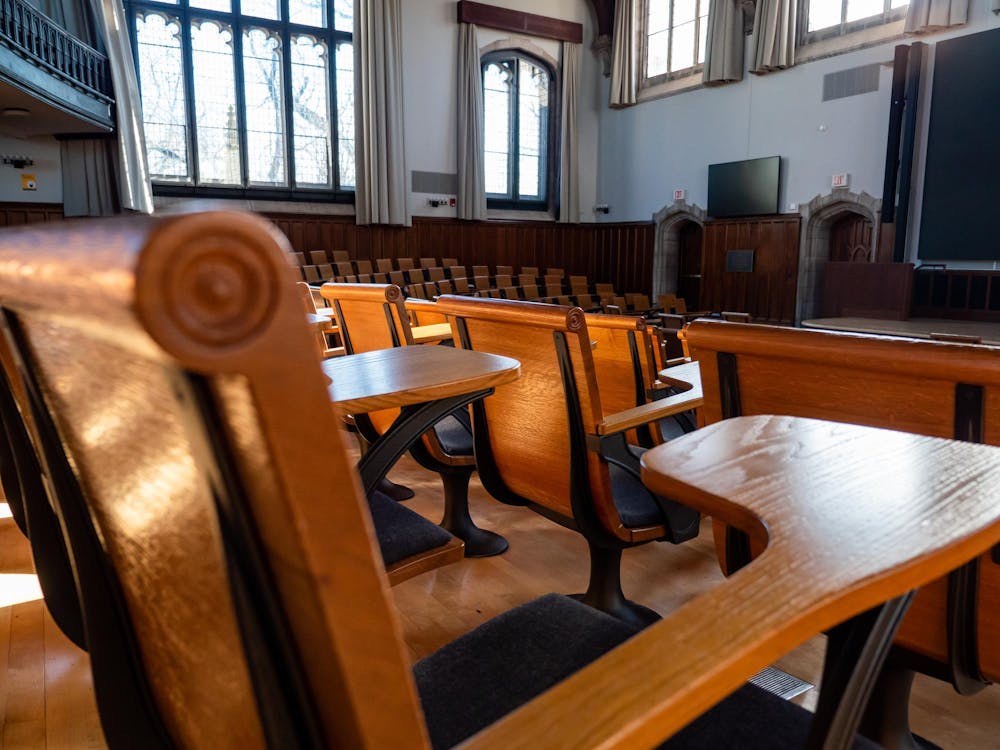
Last semester, my first midterms at Princeton led me to a sobering conclusion: there is an unmatched feeling of dread when you turn over the first page of an exam and realise how much you have to do in so little time. During finals week, despite the increased stress and the higher stakes, my exams left me room to breathe. The format of the tests themselves was a relief: instead of hour-long sprints, they were longer, steadier efforts that felt fair and balanced.
In contrast, the majority of midterm examinations at Princeton are in-class tests during the sixth week of each semester. One would expect this format to reduce pressure, with the classroom environment and Princeton’s no-proctor policy making exams feel more like a regular day of class than an exceptional experience.
However, the harsh time constraints of these exams have the opposite effect. Instead of the fair assessments they promise to be, midterms often prove unmanageable and discouraging. In the absence of a dedicated class-free midterm week, the best way to fix the unfair time–content ratio is by decreasing the amount of material tested on each exam.
This challenge is especially pronounced in quantitative courses, where the large number of problems often prevents students from even reaching the end of their tests. But crafting an exam with a wide variety of question formats can lead to a volume of material that doesn’t fit within the midterm time-constraints. Granted, quizzing students in a wide range of formats, from true-false questions to open-ended proof-based problems, effectively gauges mastery of material. Courses should retain this variety when designing exams in order to give students a better chance to work through problems and show off their knowledge.
In many real-life problem-solving scenarios, especially in fields of research, such harsh time constraints are uncommon and rarely the metric by which skill or qualifications are judged. While being quick on your feet is certainly a professional advantage, most careers value depth over fast thinking. Princeton exams should test for the former instead of the latter, reaffirming our scholarly community’s values of rigour and thoroughness.
Good tests should provide students with more than a letter grade — they should be opportunities for students to meaningfully assess their understanding and identify points of weakness. For students to achieve this assessment of their own abilities while taking a midterm, they need the time to work through problems instead of focusing on the clock. Exam grades should never elicit reactions of “if only I had more time, I could’ve aced this.” This means that the exam has failed to both gauge our abilities and to give us a useful diagnostic of how we stand in a class at the midpoint of the semester.
This seemingly minor frustration even has deeper implications. Princeton’s rapid-fire midterms contribute to the high pressure of the University’s academic culture by exacerbating the feeling that there’s not enough time in the day to accomplish everything you need to. Because students are forced to rush to even reach the end of the exam, our midterms quite literally feel like a race, assigning added stress and a scarcity-based ethos to test-taking. An increased sense of control would help reduce the pressure that midterms intensify.
Given the obvious downsides of Princeton’s current midterm system, targeted change is required. Because exam formats vary so widely across disciplines, new measures should be developed and implemented by individual departments rather than through University-wide policies. Different departments should communicate with their students through an exam feedback system, focused on identifying points of improvement.

Soliciting and incorporating student input on exam format would help ensure that tests feel fairer. Moreover, it would increase students’ agency over their academic journeys. Not only would students be able to choose their classes or access diverse resources to engage with the material, but they would also have a say in the pedagogical decisions that shape their academic experience.
To be sure, including students in the process of reevaluating midterms isn’t an invitation for students to complain about exams being too hard. Instead, it’s an opportunity for students to express whether the questions, length, and format of the exam allowed them to perform to the best of their abilities and prove what they have learned.
Given the chaos of Princeton’s midterm system, developing a platform for student input should be a priority. This can be accomplished in a variety of ways, from something as simple as a feedback form to mandatory in-class reflective discussions after each examination. Sustaining improvement through open dialogue would not only enable faculty to make thoughtful adjustments, but also convey an important message: your exams are not out to get you.
Contributing Opinion Writer Ana Boiangiu ’29 is a prospective Mathematics major from Tulcea, Romania. She can be reached at ab5939[at]princeton.edu.
Read More

The real crisis on campus isn’t cheating, it’s thinking
Jack GoodmanFurther, a growing body of research confirms that use of generative AI undermines the cognitive effort that is essential to the development of the human brain. As AI use increases, learning, recalling, and critical thinking skills decline.
Further, a growing body of research confirms that use of generative AI undermines the cognitive effort that is essential to the development of the human brain. As AI use increases, learning, recalling, and critical thinking skills decline.

Trust in academia is at a low. Can Writing Seminar help?
Ian RosenzweigAcademia has a PR problem, and no amount of insular critical inquiry is going to solve it. Writing Seminars should live up to their name and teach us not just to solve thorny research problems but also to effectively communicate our solutions through clear and — perhaps more importantly — stylistically compelling prose.
Academia has a PR problem, and no amount of insular critical inquiry is going to solve it. Writing Seminars should live up to their name and teach us not just to solve thorny research problems but also to effectively communicate our solutions through clear and — perhaps more importantly — stylistically compelling prose.
Why is the recording policy being kept secret?
Isaac BarsoumIn denying new students — and faculty and staff, for that matter — the right to know what regulations they are subject to, Princeton makes violations likely and will end up unfairly investigating or disciplining community members who were unaware of the policy’s existence in the first place.
In denying new students — and faculty and staff, for that matter — the right to know what regulations they are subject to, Princeton makes violations likely and will end up unfairly investigating or disciplining community members who were unaware of the policy’s existence in the first place.