



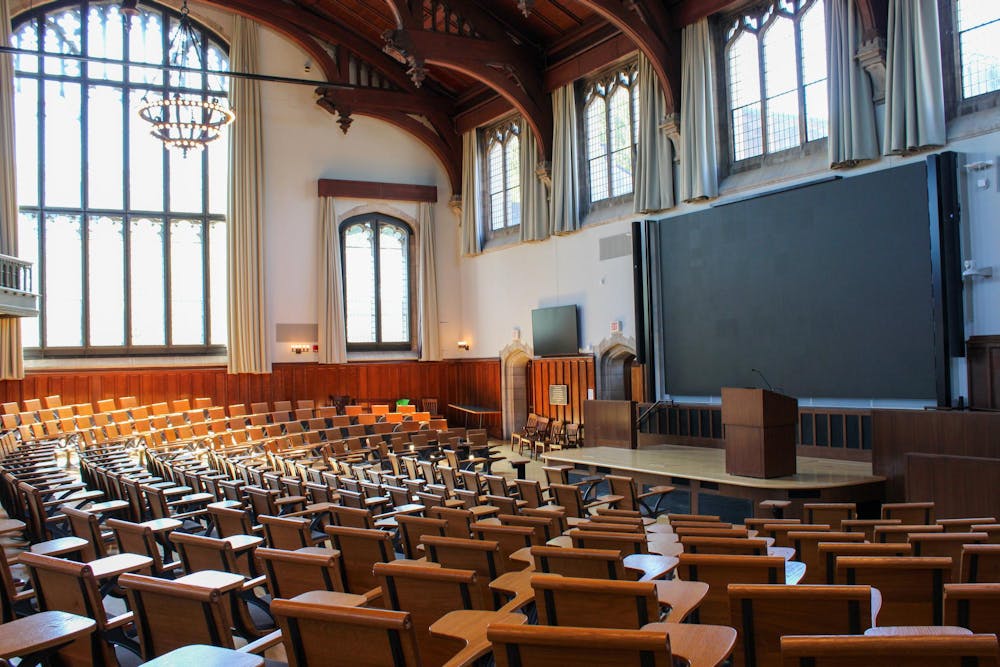
In recent weeks, there has been much discussion over Harvard’s proposed grading policy, which would cap A grades at 20 percent in classes across the board. The policy also stipulates that, instead of using grade point averages for awards and prizes, Harvard would use a percentile rank. We asked our writers to share their reflections on grading at Princeton, the proposed Harvard policy, and what it all means for higher education.
Leave the numbers. Focus on standards
By Luqmaan Bamba ’27, Staff Writer
Princeton should not worry about “too many A grades.” The focus of the University’s grading policy should be on setting fair and rigorous standards, rather than arbitrarily capping the number of A’s. If 20 percent of students get A grades in any given semester, that’s fine. But that number should fluctuate: Students should receive grades from departments according to their set standards.
Departments need standards to properly evaluate student work and ensure that students are prepared for their careers and postgraduate studies. Those standards should remain consistent. Grade inflation doesn’t threaten academia if an exceptionally high number of students are doing exceptional work. If we say that standards are lower today — that more students are getting A’s, even as they do lower quality work — then setting a cap ignores the core issue.
Even as the University has moved past its history of grade deflation in the last decade, the culture of trying to limit A grades still seems to persist. There is no better example than the alarm bells sounded by faculty over the number of students getting A’s. But if student performance stays the same, and the grade distribution changes because of the arbitrary cap, the grade doesn’t reflect the quality of student work.
While we should aim for rigorous standards, we should not change the current grading policy; it should continue to reflect student performance, rather than a set distribution.
Luqmaan Bamba is a staff Opinion writer and an electrical and computer engineering major from New York. He can be reached at luqmaanbamba[at]princeton.edu.

Grade caps are setting up your future doctors, lawyers, and engineers for failure
By Emily Zhang ’29, Columnist
When students apply to graduate, medical, and law schools, the importance of a high GPA in determining application success is undeniable. Admissions committees often initially screen applicants based on GPA, particularly at highly selective programs where thousands of applicants compete for limited spots. A formal cap on A’s would limit students’ abilities to earn the highest GPAs, potentially placing students at a comparative disadvantage.
In a similar vein, Princeton students preparing to enter competitive industries like finance, engineering, and technology — fields heavily represented by students in the B.S.E. departments — often face strict GPA cutoffs during recruitment. For example, some competitive firms use minimum GPA requirements as a way to narrow large applicant pools. Given the rigorousness of Princeton’s B.S.E. departments, a cap on A’s would further limit students’ ability to maintain competitive GPAs in the job searching process. Lower GPAs in this context would not necessarily reflect lower student ability, but rather the constraints of grading policy, and therefore should not disadvantage students in admissions evaluations.
Effectively, Princeton students would be doubly penalized: first, by more rigorous grading systems that produce lower average GPAs, and second, by external evaluators who make competitive admissions and professional decisions based on GPA. It is hard to know if nuance about grading standards is given the weight it deserves in screenings. Thus, if Princeton wants to position its future doctors, lawyers, and engineers for success, it must understand that academic rigor doesn’t necessitate overly stringent grading policies.
Emily Zhang ’29 is an Opinion columnist for the ‘Prince.’ She is a prospective B.S.E. student from Poughkeepsie, N.Y., and can be reached at ez5618[at]princeton.edu.

Let grades be inflated
By Audrey Tan ’29, Columnist
There’s long been a discussion over whether or not Princeton University’s grades are deflated or inflated, with administrators currently arguing the latter. However, grade inflation is not inherently a problem.
In fact, Princeton’s low acceptance rate proves that everyone here is already smart — why do we have to continuously prove it? Easier grading would lessen the academic pressure on students, potentially leading to improved mental health, while also giving students more time to try out various classes and extracurriculars that they may not otherwise have had the opportunity to. If grading is more forgiving, students may be willing to take intellectual risks without fear of ruining their GPAs.
Moreover, if the intention of difficult grading is to encourage intellectual engagement among students, then I’d argue that gentler grading doesn't compromise the intellectual rigor of a course. Decreased focus on tests and assignments could allow students to focus more on the actual nuances surrounding the class, giving them a deeper understanding of the material in the long term rather than rote memorization for exams. The University’s continued focus on mitigating grade inflation places unnecessary pressure on students, with implications for their mental health, willingness to take academic risks, and long-term understanding of material.
Audrey Tan ’29 is an Opinion columnist from Pullman, WA. She is interested in exploring the relationship between socio-economic class and activism on campus with a special focus on how resources shape actions within advocacy spaces in order to create a more “accessible activism.”
More A grades means more pressure to get them — normalize the B!
By Andrei Dragomir ’28, Contributing Writer
If two-thirds of the grades at Princeton are in the A-range, what does it feel like to be in the third that gets a grade below an A or A-? Not great.
The University should mandate that classes award fewer A’s — but also emphasize that getting a B is fine. B grades are supposed to represent satisfactory achievement in a class. But if A-range grades are more common than B-range, it’s hard for students to feel okay with a B.
As grade inflation has steadily increased over the last decade, getting an A in a class seems to have transformed from an achievement into an expectation. And to expect an A at one of the most rigorous academic institutions in the world might be detrimental to students’ mental health.
One may argue that it’s difficult for the University to convince a bunch of high school valedictorians and high achievers that not all of them can be the best student at Princeton. Many Princeton students derive their confidence from their academic standing and thus feel like anything less than an A is not enough. Conquering the inevitable imposter syndrome and learning to value oneself beyond one’s intelligence, however, is an integral part of the Princeton experience. Letting the percentage of A grades steadily increase just tries to sweep the issue under the rug while reducing the value of an A.
Andrei Dragomir ’28 is a contributing Opinion writer from Brasov, Romania and a prospective computer science major with a minor in East Asian Studies. He can be reached at ad2234[at]princeton.edu.
Not all classes are equal: Don’t cap A’s at 20 percent
By Davis Hobley ’27, Staff Writer
Harvard’s faculty proposal to cap A’s at 20 percent fails to capture the disparities in student caliber in different courses. If Princeton were to institute a similar policy, the University would make the same mistake.
Take the neuroscience department as an example. An introductory level course, such as NEU 202: Introduction to Cognitive Neuroscience, has a completely different student population than NEU 337: Deep Learning as a Cognitive Model for Social Neuroscience. NEU 202 includes students who have had little to no exposure to neuroscience in the past, and many take the course for a distribution requirement. As a former student of the course, I found that NEU 337 consists of practically all neuroscience, psychology, and computer science majors, many of whom have taken extensive coursework in all three subjects.
To say that practically the same proportion of students should obtain an A grade in these two courses that have vastly different student populations and formats would be an utter failure of a grade deflationary policy. Such a change would incentivize students to take easier courses, or remain within their academic comfort zones, to maximize their chances of getting an A. A student in psychology would see taking a highly conceptual, applied course like NEU 337 as risky compared to NEU 202, noting that they would need to outperform a cohort who has significant background knowledge.
Grade distributions should be left to professors who have extensive knowledge about the students who take their courses and their relative performances. Nassau Hall administrators lack the context to make this decision for departments.
Davis Hobley is a staff Opinion writer for the ‘Prince’ and a member of the Class of 2027 in the Princeton Neuroscience Institute. He can be reached at dh2172[at]princeton.edu.
At Princeton, grade inflation distorts expectations
By Ana Boiangiu ’29, Contributing Writer
At elite institutions, the traditional narrative goes, grade inflation makes it too easy to get A’s, undermining academic rigor and credibility. At Princeton, this obvious negative is accompanied by an equally concerning consequence: It creates absurd expectations within an already overwhelmed student body.
While getting an A at Princeton is, at face value, not easy, the majority of grades are in the A range. Even though students know they are working hard, their A’s feel less valuable when everyone else is getting them, too. Grade inflation, therefore, prompts students to look for other metrics to set themselves apart from their peers, such as taking more classes. Given Princeton’s notably fast-paced semester and intense curriculum, an overloaded schedule inevitably takes a toll on students’ well-being and reduces free time.
University-wide grade deflation, however, isn’t the solution to these consequences of grade inflation. Rather, the fix lies in department-specific changes and personalized support to their students.
Uprooting our campus-wide culture of competitiveness would be incredibly challenging, but if students’ expectations are recalibrated on a local basis, real change can be achieved.
Contributing Opinion writer Ana Boiangiu ’29 is a prospective mathematics major from Tulcea, Romania. She can be reached at ab5939[at]princeton.edu.
Read More

The real crisis on campus isn’t cheating, it’s thinking
Jack GoodmanFurther, a growing body of research confirms that use of generative AI undermines the cognitive effort that is essential to the development of the human brain. As AI use increases, learning, recalling, and critical thinking skills decline.
Further, a growing body of research confirms that use of generative AI undermines the cognitive effort that is essential to the development of the human brain. As AI use increases, learning, recalling, and critical thinking skills decline.

Trust in academia is at a low. Can Writing Seminar help?
Ian RosenzweigAcademia has a PR problem, and no amount of insular critical inquiry is going to solve it. Writing Seminars should live up to their name and teach us not just to solve thorny research problems but also to effectively communicate our solutions through clear and — perhaps more importantly — stylistically compelling prose.
Academia has a PR problem, and no amount of insular critical inquiry is going to solve it. Writing Seminars should live up to their name and teach us not just to solve thorny research problems but also to effectively communicate our solutions through clear and — perhaps more importantly — stylistically compelling prose.
Why is the recording policy being kept secret?
Isaac BarsoumIn denying new students — and faculty and staff, for that matter — the right to know what regulations they are subject to, Princeton makes violations likely and will end up unfairly investigating or disciplining community members who were unaware of the policy’s existence in the first place.
In denying new students — and faculty and staff, for that matter — the right to know what regulations they are subject to, Princeton makes violations likely and will end up unfairly investigating or disciplining community members who were unaware of the policy’s existence in the first place.