



Two-thirds of grades awarded in Princeton undergraduate coursework in the 2024–25 academic year were A-plus, A, or A-, according to a Monday report distributed to faculty, a dramatic increase over the past decade.
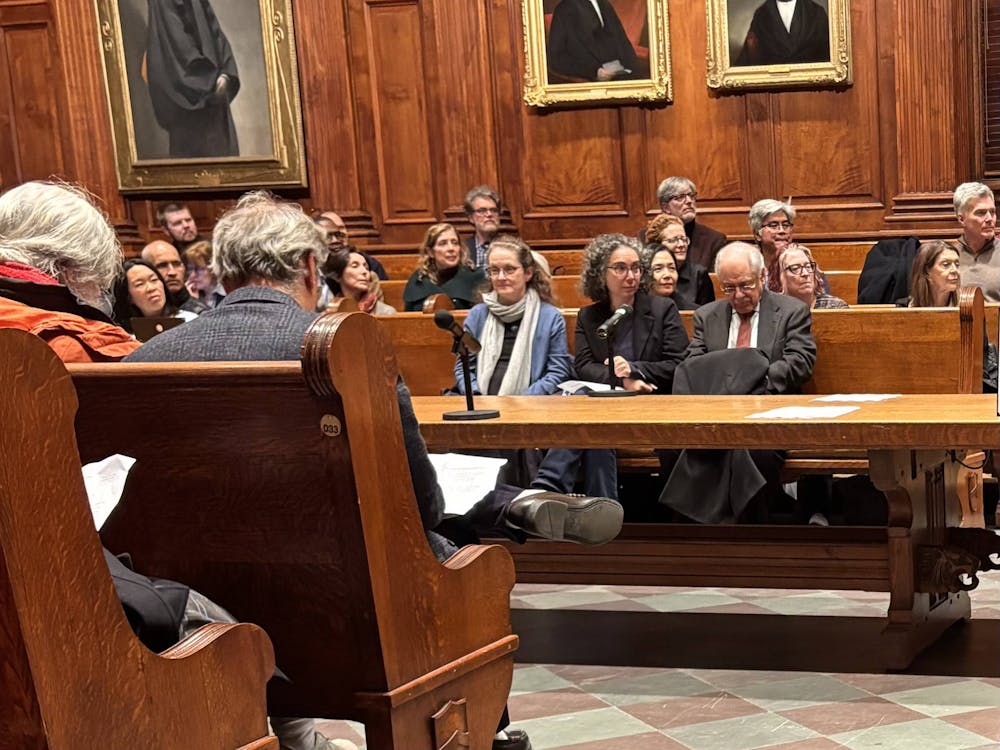
Dean of the College Michael Gordin briefly discussed the report at Monday’s faculty meeting, expressing concerns about grade inflation and the allocation of A-plus grades. However, Gordin noted that grading is under the jurisdiction of departments.
The 2024–25 academic year set a record for the highest percentage of A-plus and A grades given out by the University in the past 20 years, representing 45.5 percent of all grades, a nearly 20 percentage point increase in the past decade. Although the incline in A-range grades over the past 20 years has been drastic, the most significant jump was over the pandemic, with the percentage of A-plus and A grades increasing almost 10 percentage points between 2019 and 2021. The average GPA similarly increased 0.1 points over the same period.
“Even in introductory 100–200 level classes — where one might expect to see a broader distribution of grades — 62.6 percent of grades last year were A-range,” the report stated.
The report cited independent work as the most extreme example of what it termed “grade compression,” more commonly known as “grade inflation.” In 2025, across all departments, 17 gave no grade lower than a B for a thesis. Eight of the ten largest departments awarded thesis grades of B or above to at least 94 percent of majors, the exceptions being history and sociology.
While A-range grades are more common in the humanities and social sciences, A-plus grades are more commonly given out in natural sciences and engineering courses, the report said.
Gordin reminded faculty in attendance that A-plus grades should be dealt in exceptional cases. “A-plus is an unusual grade at this University. It is specified in the Rules and Procedures of the Faculty,” he said. “No other grade has that status.”
The Rules and Procedures of the Faculty states that the A-plus “should be regarded as an exceptional grade reserved for work of extraordinary merit.” Professors are required to write a statement noting “how the student’s course work or independent work meets the instructor’s standards for truly outstanding work.”

Notably, the faculty meeting agenda claims that “faculty practice does not currently reflect the stated policy,” referring to the faculty’s use of A-plus grades. It notes that “some faculty feel strongly that given the number of A-range grades that are awarded in our current context, the [A-plus] is a necessary tool to differentiate performance.”
Rather than awarding an A-plus solely to students who produce exceptional work, these faculty use the grade to “mark the top N% of performers in their class,” the agenda adds.
The new grade report follows a faculty report at Harvard characterizing grading practices there as “failing to perform the key functions of grading” and “damaging the academic culture of the College more generally.” In 2025, 60 percent of undergraduate grades at Harvard were A’s.
Until 2014, Princeton had a formal grade deflation policy capping A-range grades at 35 percent for coursework and 55 percent for independent work.
“If any departments want to discuss good practices in grading and want to consult with the Dean of the College’s Office, we’ll be more than happy to speak with you,” Gordin said.
Haeon Lee is a News contributor for the ‘Prince.’ She is from Brooklyn, N.Y. and can be reached at hl1389@princeton.edu.

Nico David-Fox is an assistant News editor for the ‘Prince.’ He is from Washington, D.C. and runs the Administration coverage area.
This piece has been updated to include claims from the written agenda of the faculty meeting.
Please send any corrections to corrections[at]dailyprincetonian.com.
Read More
Orientation SHARE play replaces scene implying rape with groping
Riley Price and Kimberly HutchinsonThe content of Princeton’s annual SHARE play at Orientation was altered for the Class of 2030, after male actors were concerned about playing a character who was implied to be a rapist.
The content of Princeton’s annual SHARE play at Orientation was altered for the Class of 2030, after male actors were concerned about playing a character who was implied to be a rapist.

Men’s water polo rebounds after opening loss, finishing 3–1 at MPSF Invitational
Andrew KangPrinceton men’s water polo bounced back from an opening loss to San Jose State, proceeding to win three straight matches.
Princeton men’s water polo bounced back from an opening loss to San Jose State, proceeding to win three straight matches.

Princeton to lead new quantum institute backed by National Science Foundation
Riley PricePrinceton will lead one of three new Quantum Leap Challenge Institutes, which focus on advancing quantum research through interdisciplinary projects. The two other new institutes will be led by Yale and Harvard.
Princeton will lead one of three new Quantum Leap Challenge Institutes, which focus on advancing quantum research through interdisciplinary projects. The two other new institutes will be led by Yale and Harvard.