



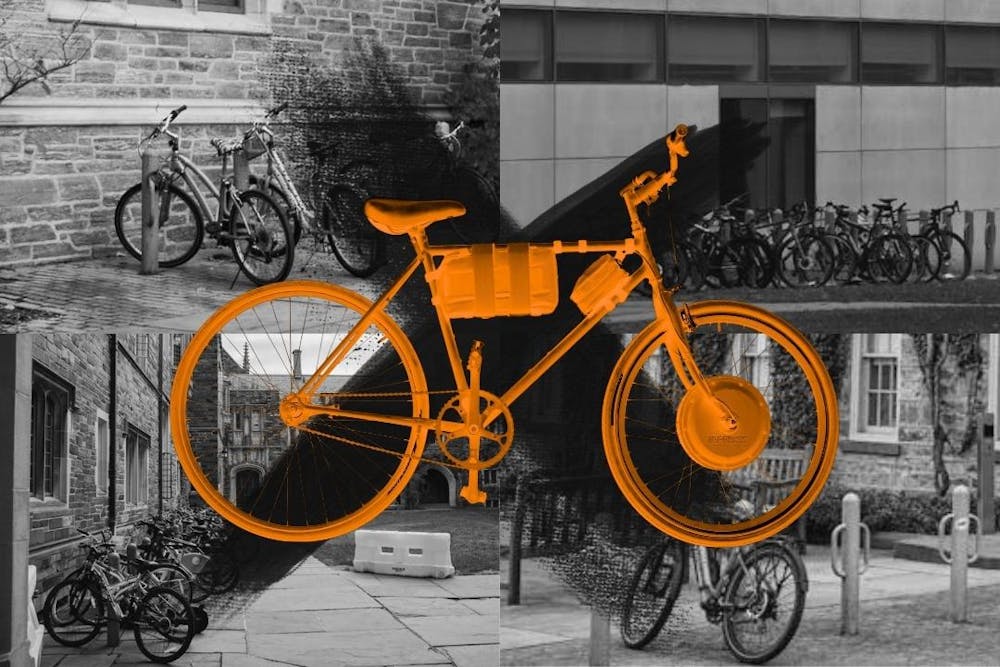
On April 13, the University announced that e-bikes will be prohibited from campus starting on June 1, 2026. The fate of the Personal Electric Vehicles has elicited a range of responses regarding the ban’s impact on campus life and what it reveals about University procedure. Our staff share their thoughts on the new policy’s implications.
The writing was on the wall
By Charlie Yale, Head Opinion Editor
Recently, an anonymous Change.org petition surfaced on Fizz calling for the e-bike ban to be overturned. It’s clear that — with a measly 85 signatures at 8 p.m. Tuesday — it won’t amount to anything. These students’ opinions might have mattered far earlier in the deliberative process.
After all, this change has been telegraphed since December, if not earlier.
During the Dec. 8, 2025 Council of the Princeton University Community meeting, an Environmental Health and Safety representative presented on the health and safety risks that e-bikes posed to pedestrians on campus. At this meeting, the representative also signaled the committee’s openness to a change on the campus’s personal electric vehicle policy.
What followed the December CPUC meeting was a survey regarding potential updates to the PEV policy. Students were allowed to share their opinions about how a change in policy might affect them. After I published a column about this topic at the end of last semester, I submitted my own feedback on the policy.
Perhaps if any number of the students who signed the hopeless Change.org petition about e-bikes had submitted their feedback, the policy may have looked different. Perhaps it would have changed nothing. There is still no student representation on the Environmental, Safety, and Risk Management Committee, which likely made it difficult to ensure that any sort of student perspective was foregrounded. But the option to at least submit feedback existed, and the writing has been on the wall for months.

Head Opinion Editor Charlie Yale is a sophomore in the history department from Omaha, Neb. He can be reached at yale[at]dailyprincetonian.com.
An encouraging but incomplete start
By Lily Halbert-Alexander, Head Opinion Editor
In light of rising safety concerns on campus, banning e-bikes was an inevitability — and also likely the best and most logical decision for the University. Arguments for efficiency and equity for athletes are valid, but it’s difficult to compete with the foundational issue of pedestrian safety.
But both the ban and anti-e-bike sentiment have mythologized e-bikes so much that they oversimplify the multifaceted problem of campus transportation. At a CPUC meeting last fall, e-bikes were described as having “gotten much, much larger, they’ve gotten faster, they are heavier, they are more powerful.” This language depicts e-bikes as mechanical beasts, spawning before our very eyes. I’m suddenly more concerned about them hunting and eating me than running me over.

This fear-mongering casts e-bikes so dramatically as antagonists that it’s easy to forget that there are other obstacles to safe transportation — like cars, one of which recently struck a student — and thus that it will require more than this ban to keep the campus safe.
Princeton’s campus has grown massively over the last ten years, and is populated with thousands of students, faculty, and staff, all of whom are attempting to get where they’re going in the most efficient way possible. That entails navigating a web of intersecting routes with varying abilities to accommodate pedestrians and vehicles of differing size and speed.
The question of safe and efficient campus transportation won’t be solved by a single policy. Banning was the right move, but we shouldn’t let it be the only one, nor overestimate its significance in the long-run.
Head Opinion Editor Lily Halbert-Alexander is a sophomore in the English department from San Francisco. She can be reached at lh1157[at]princeton.edu.
A map to Princeton’s priorities
By Thomas Buckley, senior Opinion writer
Corresponding with the announcement of the e-bike ban, the ESRM committee helpfully included a map of areas where PEVs are “prohibited in both interior and exterior spaces.” The published map is careful to exclude public property from the ban, including Washington Road – though the University makes sure to point out that the ban applies to the sidewalks it owns on Washington Road – Nassau Street, Prospect Avenue, and even Wawa.
Notably, eating club property — which is likewise not part of “campus” — is not among the areas excluded from the ban.
It’s not possible to know why ESRM chose to draw the boundaries how they did. It could be a mere administrative oversight, or as unbelievable as it seems, Princeton might have actually consulted the clubs beforehand. I doubt the University plans to start raiding clubhouses to confiscate illicit e-bikes. Still, the map sends a telling message about where Princeton believes its authority extends. If the eating clubs want to protect their autonomy, they should listen.
Senior Opinion writer Thomas Buckley is a junior from Colchester, Vt. majoring in SPIA. You can contact him at thomas.buckley[at] princeton.edu.
For the e-bike ban to work, invest in TigerTransit
By Isaac Barsoum, Associate Opinion Editor
The Princeton administration has implemented yet another new policy with minimal input from the students it will affect. While the policy has merits, the method of its introduction and implementation is improper, and ignores the legitimate needs of a particular group of students — student-athletes — without offering a feasible transportation alternative.
Many student-athletes commute to Meadows Racquet and Recreation Fieldhouse each day for practice, sometimes in early morning hours. To make that commute, they might currently depend on an e-bike. Now, they’ll need an alternative. As The Daily Princetonian reported, “the University proposes TigerTransit as an alternative for longer trips, noting that stops are within a five- to 10-minute walk of most buildings on campus.”
But proposing TigerTransit, in its current form, as an alternative represents a willful ignorance toward the current state of TigerTransit and its viability as a replacement for e-bikes.
In the early morning, TigerTransit often runs as infrequently as every 20 minutes to Meadows, and during the day, never more frequently than every 13 minutes. Moreover, the length of the TigerTransit trip to the Meadows Fieldhouse from the corner of Washington and Prospect is 18 minutes, much longer than a comparable trip by bicycle, which takes 6 minutes downhill. A primary reason for that is that the Meadows Drive Garage stop is quite a distance from the Meadows Fieldhouse.
To make TigerTransit a viable alternative for commuting to Meadows, Princeton should improve its frequency, particularly in the early morning and evening hours, and invest in a new stop outside Meadows Fieldhouse. Doing so would make TigerTransit an actual option for athletes and commuters to Meadows, alleviating the difficulty imposed by the e-bike ban.
Isaac Barsoum ’28, an associate Opinion editor reachable at itbarsoum[at]princeton.edu, wants to ride the bus.
Read More

Make the Pre-read a work of fiction
EmmaRose ZillaA story that’s intellectually ambitious and philosophically provocative doesn’t necessarily have to be nonfiction. A fictional text can help us understand political tensions or erosion of autonomy just as much as an explanatory novel can.
A story that’s intellectually ambitious and philosophically provocative doesn’t necessarily have to be nonfiction. A fictional text can help us understand political tensions or erosion of autonomy just as much as an explanatory novel can.
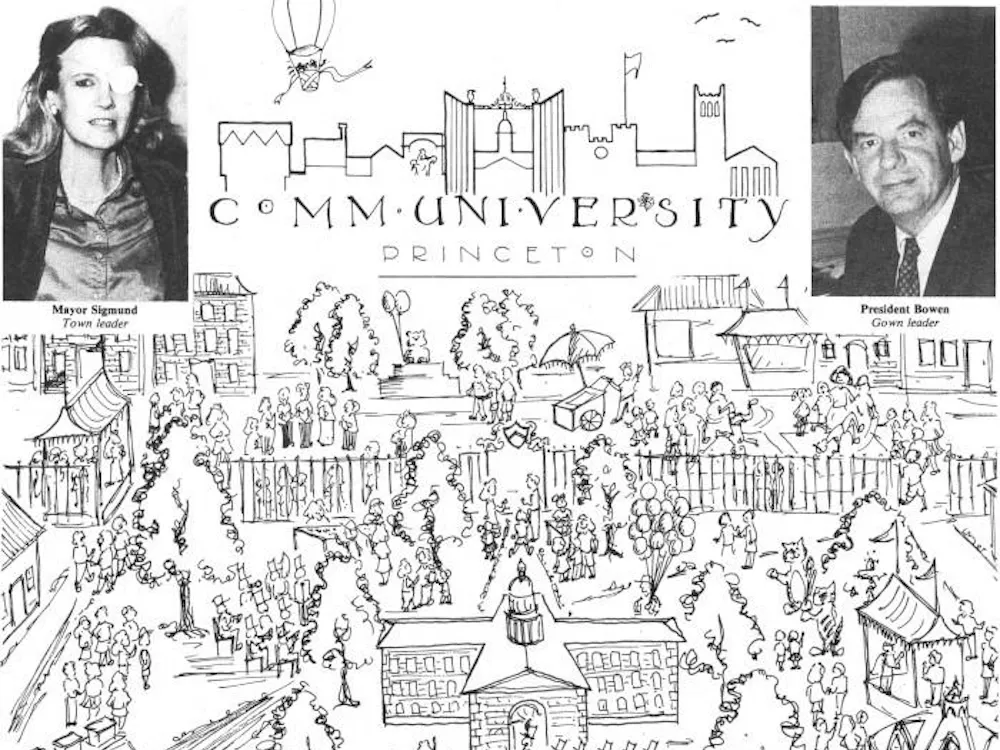
Bring back Communiversity
Isaac BarsoumFrom its inception in 1985, when it subsumed the Arts People Party — the Arts Council’s pre-existing festival — Communiversity always aimed to be more than just an arts festival. It was both a physical and symbolic coming-together of the University and the town in a celebration of all that we have in common and all that makes us different.
From its inception in 1985, when it subsumed the Arts People Party — the Arts Council’s pre-existing festival — Communiversity always aimed to be more than just an arts festival. It was both a physical and symbolic coming-together of the University and the town in a celebration of all that we have in common and all that makes us different.

Who rights our rules?
Charlie YaleWith fairness for students in mind, the University must require that all changes to RRR go through the Committee on Rights and Rules.
With fairness for students in mind, the University must require that all changes to RRR go through the Committee on Rights and Rules.