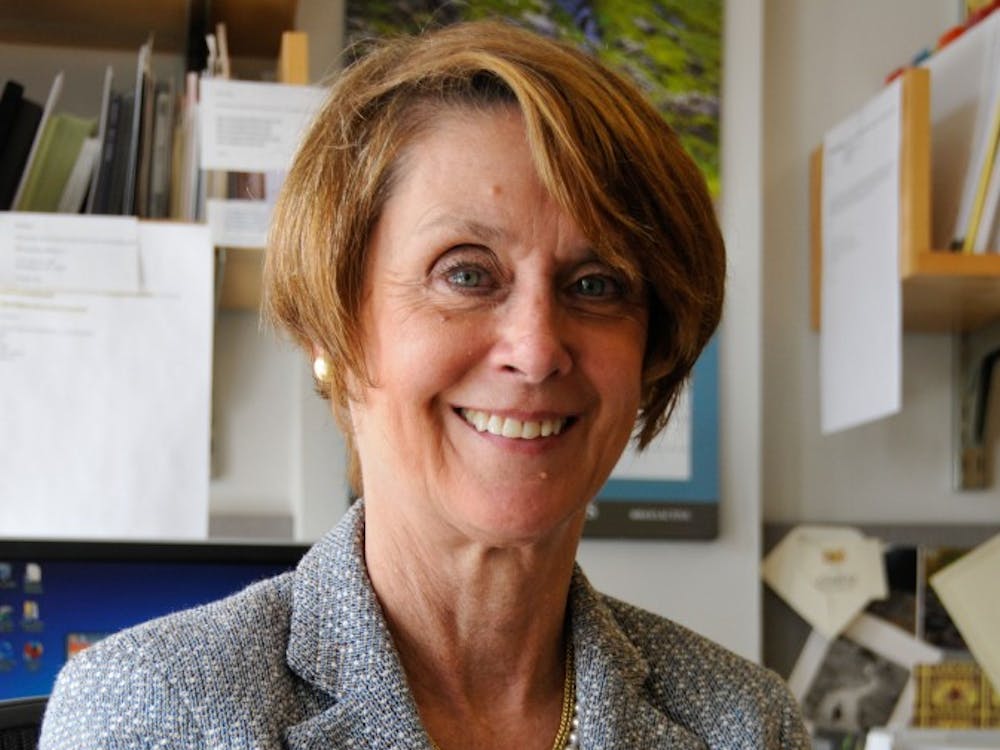
McGraw sees increase in number of student visits
Jacob DonnellyThe McGraw Center for Teaching and Learning has received over 3,800 visits since the start of the academic year and is expecting to receive over 7,600 visits by the end of the year.
The McGraw Center for Teaching and Learning has received over 3,800 visits since the start of the academic year and is expecting to receive over 7,600 visits by the end of the year.
Though areportreleased this past September by theTrustee Ad Hoc Committee on Diversityfound that white males dominated in faculty, administrator, graduate student and postgraduate populations, representatives from several departments on campus said that they had paid attention to the diversity among their populations before the report was released. The Committee’s report reviewed statistics of the racial and gender demographic trends in undergraduate, graduate, postdocs, faculty and staff populations.
Katherine Pogrebniak ’14 was awarded a Churchill Scholarship to study for a master’s degree at the University of Cambridge. The Churchill Scholarship, funded by the Winston Churchill Foundation, is awarded to at least 14 students each year who wish to pursue studies in engineering, mathematics or the sciences, according to its website. Pogrebniak, a computer science concentrator, said she is planning to obtain a Master of Philosophy in computational biology and is excited for the classroom-based learning and the research component of her studies. There were two phases of the application process — applying for the Princeton nomination and then competing at the national level.
A petition organized by Columbia professor Ehsan Yarshater surfaced challenging the University’s current candidate for the position of the Ibrahim Pourdavoud Professorship in Persian Studies.The petition, which has been taken down, argued that having the name of Pourdavoud, a pioneer in the field of pre-Islamic Iranian studies, meant that the professor who occupies the Pourdavoud Chair should continue his work in the field of pre-Islamic studies.
Five members of the Class of 2015 have been awarded Scholars in the Nation's Service Initiative fellowships by the Wilson School, allowing them to pursue two-year Master in Public Affairs degrees at the Wilson School in preparation for careers in the U.S.
A new seminar course, AMS 339: Religion and Culture: Muslims in America, will be offered next semester and has already become overenrolled with interested students.
In December 2009, the University drew criticism when it fired then-Associate Dean of the College Frank Ordiway ’81, who oversaw postgraduate fellowship advising.
Kwame Anthony Appiah, currently the Laurance S.
Katie Dubbs ’14 and Anastasya Lloyd-Damnjanovic ’14 were awarded Sachs Scholarships. Dubbs received the Sachs Global Scholarship and will spend next year studying in Vienna, Austria, and Lloyd-Damnjanovic won the Sachs Scholarship to study at Worcester College, Oxford. Following their first interviews this past Saturday, both received a phone call from a committee member on Sunday morning asking them to head to Frist Campus Center to answer additional questions.
Though McGraw Study Hall remains a popular academic-help resource, with 5,800 student visits recorded by the McGraw Center in the last academic year, its popularity has also been a source of dissatisfaction for some students because of the overcrowding and shortage of student tutors. According to data collected by the McGraw Center, in the 2012 fall semester, 62 tutors regularly worked one shift a week, and in spring 2013, only 59 did so.
Despite the entrance of the first non-selective class of undergraduate Wilson School majors this year, similar interdisciplinary majors at Yale University are not currently considering similar alterations to their application processes.Like the formerly selective Wilson School’s old application process, the Ethics, Politics and Economics major and the Jackson Institute for Global Affairs major require prospective students to apply during their sophomore year.
Members of the faculty discussed the possibility of creating a University-specific alternative to Coursera, as well as the proposed creation of a new committee to oversee the continuation of online courses, on Monday at the December faculty meeting.Philosophy professor Gideon Rosen noted that the University is free to explore options outside of Coursera in order to avoid conflicts of intellectual property, such as whether the material is owned by Coursera, the University or the professors teaching the courses.In one alternative to Coursera, he said, the University can “invest considerable resources in developing [its] own proprietary platform.” He added that some members of the computer science department are interested in helping out.“I must say that developing our own proprietary platform gives me nightmares,” University President Christopher Eisgruber ’83 replied.Eisgruber currently sits on Coursera’s board of advisers.The new committee would be called the Faculty Advisory Council on Teaching and Learning, and it would not only vet the online courses but would also be responsible for monitoring them and their procedures, Rosen explained.The committee could also expand the work of the Faculty Committee on Grading by leading a campus-wide conversation on the most effective methods of assessment, according to documents circulated at the meeting detailing the potential committee’s duties.
More than half of the students who take SPA 101: Beginner's Spanish I, a class for students with no previous background in the language, have studied Spanish before enrolling in the class, according to a survey conducted by the Department of Spanish and Portuguese in spring 2012. The survey, which received 106 responses, also revealed that 29 percent of the students surveyed had taken at least three years of Spanish before beginning the introductory course. “Language teaching is very different in different institutions,” Spanish Senior Lecturer Alberto Bruzos Moro explained.
Four graduate students were named winners of the Porter Ogden Jacobus Fellowship, Princeton’s top honor for graduate students, the University announced Friday. The students, James Pickett GS, Emily Vasiliauskas GS, Sonika Johri GS and Cristina Domnisoru GS, will receive funding for their final year of graduate study.The fellowship is awarded to those whose work has exhibited the highest scholarly excellence. Pickett, a Ph.D.
Dixon Li ’14, an English concentrator from Sandy, Utah, has been awarded the Marshall Scholarship for further study in the United Kingdom.He is the only University student or alumnus to receive the scholarship this year.
For some lucky undergraduates, fall break wasn’t a break from their courses, though it did involve zip-lining in Costa Rica and riding camels in Morocco.
After receiving negative feedback from students last spring, instructors have restructured the lecture format of COS 226: Data Structures and Algorithms this fall.
Juniors and seniors undertaking their junior papers and theses will now receive additional guidance from the Office of the Dean of the College’s newly published Guides to Independent Work, the University announced last week.
Students who have a final exam at night followed by an exam the next morning will now be able to reschedule their morning exam for the afternoon, according to the Office of the Registrar’s website. "Students who have an in-class night exam (7:30 p.m.) followed by an in-class morning exam (9:00 a.m.) the next day may request that the morning exam be rescheduled to the afternoon (1:30 p.m.) of the same day," the policy reads. The change is the result of efforts from the USG Academics Committee, whose chair Dillon Sharp ’14 presented a series of recommendations for the final exam period to the Faculty Committee on Examinations and Standing on Oct.
In an academic exercise with real-world applications, students in CHV 310: Practical Ethics were asked to determine whether charitable donations could be better used by the University or by charities that provide aid in the developing world.