



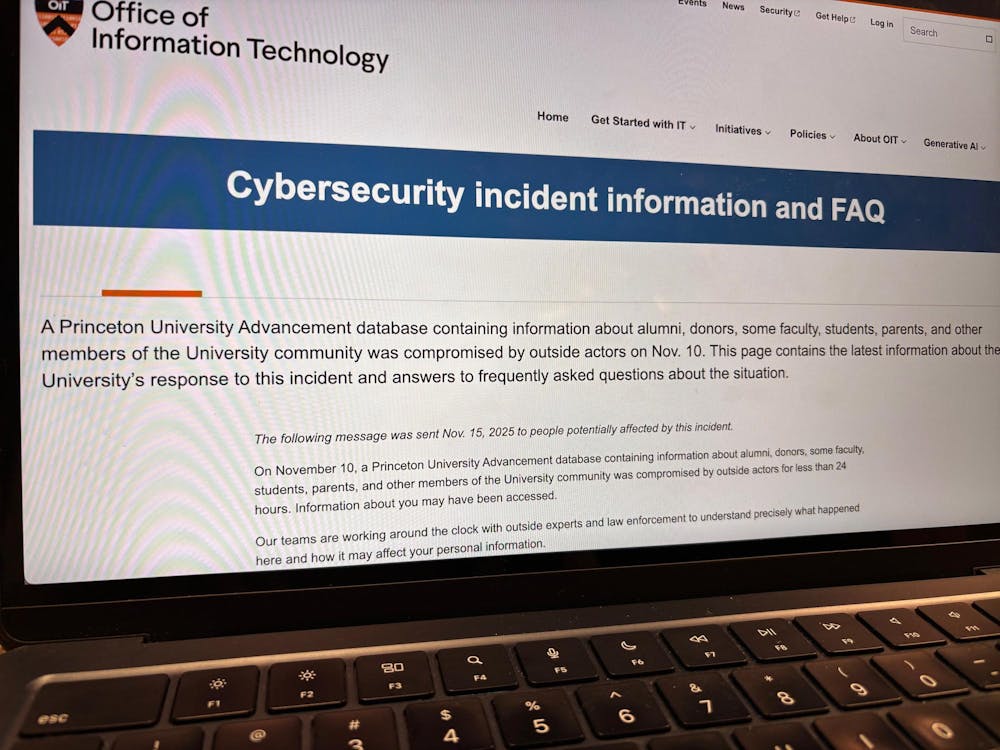
Three lawsuits have been filed against Princeton over concerns about the handling and protection of personal data after the University disclosed a cybersecurity breach in November.
On Dec. 5, the Office of Information Technology (OIT) released a follow-up update concerning the cybersecurity breach that occurred earlier last month. The breach involved an individual accessing a University Advancement database, with information about students, faculty, alumni, and donors potentially at risk. The University confirmed there was no direct evidence any sensitive information, such as social security numbers, passwords, or credit card information, was leaked. Faculty and staff received additional information on how to avoid “phishing” attacks and maintain the security of University systems.
On Nov. 18, David Ramirez '22 filed a lawsuit against the University in the U.S. District Court for the District of New Jersey, alleging that Princeton failed to implement security measures needed to keep affiliates safe.
The lawsuit claims that stolen information was a “gold mine,” claiming negligence and breach of contract. Ramirez seeks an outcome for himself and a class of about 100,000, with compensation for monetary damages, injunctive relief, and the disgorgement of profits being the goals of the suit.
On the same day, Henggao Cai filed a suit against the University, followed by a third by Gary Penna '70 on Nov. 24.
An order by Judge Robert Kirsch on Dec. 9 consolidated the three cases into a single master lawsuit. An official leadership structure has been created, with Cai and Penna’s suits falling as member cases under the lead case, Ramirez v. Princeton University.
The law firms representing the individuals did not respond to multiple requests for comment.
University spokesperson Jennifer Morrill wrote to The Daily Princetonian that the University “believes these claims are without merit, and we plan to contest them vigorously.”

The breach comes as multiple universities across the Ivy League have reported various cybersecurity incidents in the past few months.
In late November, Harvard released a report that a similar phone-based phishing attack allowed an unauthorized party to access systems used by its Alumni Affairs and Development Office. The breach was quickly contained and did not include passwords or financial information, according to Klara Jelinkova, Harvard University vice president and University chief information officer. However, it has led to one class-action suit, which has yet to be resolved.
The University of Pennsylvania experienced a breach in late October, where attackers not only accessed but also released large volumes of personally identifiable information, including bank transaction data as well as internal University documents. This incident has led to eight lawsuits filed against UPenn.
Dartmouth College also disclosed a cybersecurity incident this fall that occurred over the summer, with attackers exploiting a vulnerability in Oracle software. The breach exposed sensitive data, including Social Security numbers, financial account information, and more. While no specific lawsuits have been filed yet, Lynch Carpenter, LLP is investigating claims against Dartmouth, as of the beginning of the month.
Over the summer, Columbia University faced an IT disruption lasting multiple days that was caused by a cyberattack. The incident affected nearly 870,000 servers, including both applicants to the University and affiliated individuals, with sensitive data such as citizenship information and Social Security numbers breached. A class-action lawsuit related to this breach was settled in September, with the Columbia University Irving Medical Center awarding the plaintiffs $600,000.
The University believes that the Nov. 10 incident was unrelated to the other recent occurrences, according to OIT.

Shaun Karani is a News contributor for the ‘Prince.’ He is from New York City.
Please send any corrections to corrections [at]dailyprincetonian.com.
A previous version of this article omitted the class years of Ramirez and Penna. The 'Prince' regrets this error.
Read More
Two Princeton professors win 2027 American Chemical Society awards
Kimberly HutchinsonPrinceton chemistry professors David MacMillan and Paul Chirik were named 2027 American Chemical Society national award winners for their contributions to the field of chemistry.
Princeton chemistry professors David MacMillan and Paul Chirik were named 2027 American Chemical Society national award winners for their contributions to the field of chemistry.

Federal court blocks elimination of duration of status for international students
Luke GrippoA federal court has temporarily stopped the Department of Homeland Security from implementing its new final rule that would limit how long international students and exchange visitors can stay in the country. The next update on the case is set for Oct. 2.
A federal court has temporarily stopped the Department of Homeland Security (DHS) from implementing its new final rule that would limit how long international students and exchange visitors can stay in the country. The next update on the case is set for Oct. 2.

Preview: Football returns to action for 2026 season
Alex Beverton-SmithPrinceton football will commence their season on Sept. 19 against the Bryant Bulldogs.
Princeton football will commence their season on Sept. 19 against the Bryant Bulldogs.