Overcoming rejection
Leora EisenbergIt’s normal to feel hurt by rejection, and accepting and learning from it is far easier said than done.
It’s normal to feel hurt by rejection, and accepting and learning from it is far easier said than done.
The problem with the FBI is not related to electoral politics, so political action as generally conceived on campuses is not effective. The FBI remained racist under Obama and will probably continue to behave in the same manner after Trump. The Bureau has a long-term power structure that is resistant to outside interaction.
OIT does not have a sufficient supply of loaner computers to meet the demand of students with laptop issues. This leaves many Princetonians attempting to tackle the challenges of everyday life without the ability to do work and without the ability to do so efficiently.
The committees should work like our jury system. People should not want to serve, since it isn’t a pleasant thing to judge others. They should be picked randomly, and after a trial, they should be dismissed, never to serve again. Incorporate everyone, and let no one have too much power. It’s not a perfect system, but no system with punishments will ever be.
Over the past two years, the students involved in the divestment campaign have maintained contact with the broader campus community through petitions, referenda, and editorials. However, since newer community members might be unaware of PPPD’s work, it’s worth returning to a few basic questions: what are for-profit detention companies? Why divest from them? What does divestment entail, exactly? Where does the divestment campaign currently stand?
I am writing to acknowledge and express thanks for the petition regarding sexual misconduct published in The Daily Princetonian and forwarded to President Eisgruber and other University administrators on Nov. 20, 2017. I am responding on behalf of all the recipients. Like the signatories to the petition, the University recognizes the power imbalance inherent in the relationship between faculty and students, and is committed to providing an environment free from discrimination of any type, including sexual harassment or other violations of our sexual misconduct policy.
We, the undersigned members of the faculty of Electrical Engineering, are writing to express our anger, concern, and frustration in response to the recent incident of sexual harassment in our department. We have no tolerance for such behavior and condemn it in the strongest possible terms.
The University community was appalled when it heard that a Title IX panel found electrical engineering Professor Sergio Verdú “responsible for sexual harassment” of his graduate student Yeohee Im. The community was even more appalled that he allegedly received only an 8-hour training course for punishment, according to Im. University spokesperson Michael Hotchkiss told the "Prince" that, "penalties were imposed in addition to the required counselling" and Vice President Daniel Day said that he could not disclose the other penalties.
In the midst of a national conversation on sexual misconduct and the abuses of power by national figures like Harvey Weinstein and others, it should hardly surprise us to learn (or perhaps, remember) that academia is home to perpetrators of sexual misconduct as well. A university’s hierarchical organization enables those in authority to exploit vulnerable individuals in the hierarchy, often without consequence.
For a while, the Democratic senator from New Jersey was in deep trouble. No, not Cory Booker. I’m talking about the other senator, Robert Menendez.
This holiday season, all of us should take a moment to be humble and give thanks for Princeton. Princeton is an institution with many pros and many cons. Its perpetuation of inequalities, dark sides of history, and difficulties with change can be at times hard to swallow. But those are topics for other columns and other days. For now, let us focus on the positive; let us give thanks.
A couple of days ago, the New York Times Sunday review featured an op-ed: “Can My Children Be Friends With White People,” written by Ekow Yankah. Yankah argues in his piece that he will teach his children “suspicion,” “distrust,” and caution with respect to white people. His main argument rests upon the assertion that white people and black people cannot achieve “true” friendship because their friendship lacks the “ability” of trust.
As proud students and alumni of Princeton University, we the undersigned write to express our deep concerns regarding the University’s handling of the recent sexual harassment case against electrical engineering professor Sergio Verdu. We ask that the University elevate its disciplinary actions against Professor Verdu and firmly establish that sexual harassment will not be tolerated in our community.
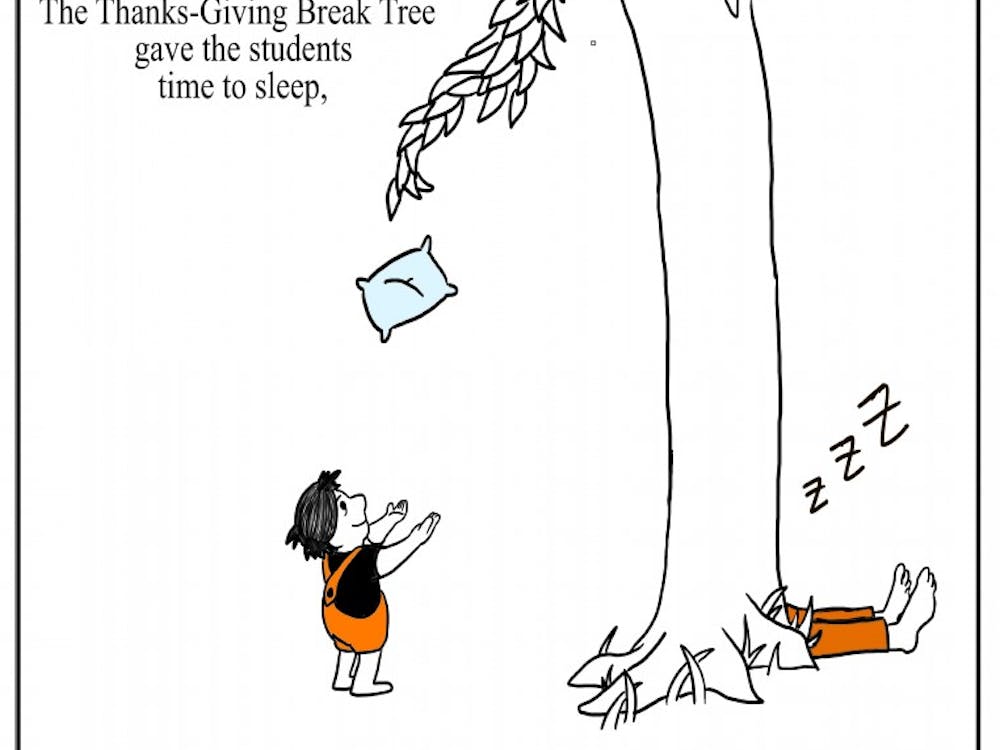
While walking to Firestone in the late hours of a recent November night, I was interrupted by a friend who remarked that I looked incredibly fatigued. My friend tried to persuade me to get a good night’s sleep and start fresh the next morning, in lieu of a late night in the bookstands. After some hesitation, I agreed, and returned to my dorm for a rarely satisfying sleep.
Like every Princeton student, I feel compunction to study almost every minute of the day. But, when I consider the millions of people who face the challenges and indignities of extreme poverty, worrying about the difference between an “A-” and “B+” seems like an unimaginable luxury.
Last semester, Princeton Students for Gender Equality (PSGE) and Princeton Students for Reproductive Justice (PSRJ) hosted the first Menstruation Celebration, a festive event in Frist Campus Center meant to both infuse joy into a discussion of a stigmatized topic and raise awareness about problems of access to menstrual products for those who need them. Additionally, sponsors of the event emphasized the acceptance of all uterus-owners and the disconnect between biological function and gender expression.
Two events have recently made the University’s endowment a subject of debate: the GOP tax plan proposal and the release of the Paradise Papers. Together, these highlight the multifaceted controversy over how universities handle their billion-dollar endowments and how the government moderates that use. On one hand, University officials expressed formal opposition to the proposed taxes on the grounds that the endowment funds academic work and financial aid, and on the other, Princeton and others have drawn criticism precisely for employing funds in offshore investment.
Joining the military is a noble way to serve the nation. While one may disagree with the political reasons behind various wars, a soldier's primary duty is — as mentioned in the oath of enlistment — to, "support and defend the Constitution of the United States." They risk their lives to protect the document that secures our freedoms and democratic government. For this reason, the University should help more of the veterans who have protected our rights.