



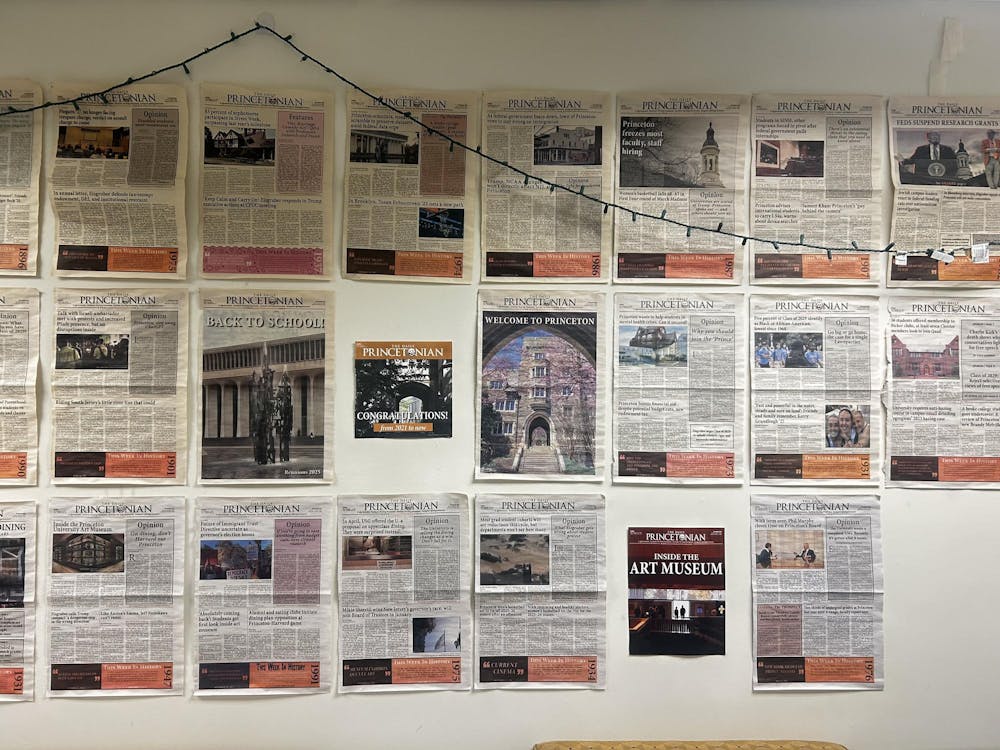
In seven semesters at The Daily Princetonian, I’ve participated in three 24-hour reporting events. In 2023, 24 hours in Wawa; in 2024, three weeks of round-the-clock coverage at Princeton’s “Gaza Solidarity Encampment”; and this year, 24 hours in the new Princeton University Art Museum.
These events are a good encapsulation of what it’s like to be in student media these days. One moment, you’re capturing the quirks of campus life. The next, you’re reporting on a national firestorm happening in your backyard.
In a truly extraordinary year for higher education, student papers have risen to the challenge. At the ‘Prince,’ we’ve detailed the faculty research impacted by funding cuts, changed the conversation around whether Princeton might pay the new endowment tax, and chronicled federal immigration raids in the municipality.
It has also been an unprecedented year for student papers. In the spring, publications across the country — including the ‘Prince’ — were inundated with requests from international students, current and graduated, asking for their names to be taken off quotes or bylines to be scrubbed from articles. They were concerned, worried, and terrified — legitimately so — that their name in the ‘Prince’ would jeopardize their visas in the wake of the arrests of students like Tufts’ Rümeysa Öztürk.
Many people framed it as an easy ask. It was not.
Why? The ‘Prince,’ like all newspapers, is committed to journalistic principles. That is not optional. We are obligated to transparency — if we make a correction to an article post-publication, we say so — and to preserve the historical record. To undermine those principles is to undermine reader trust. Without trust, we’re no better than a tabloid, blog, or another online rag.
That doesn’t mean that the challenges to international students weren’t extraordinary. In October, the ‘Prince’ took the rare step of signing an amicus brief in support of a lawsuit that challenged the Trump administration’s revocation of student visas for constitutionally protected speech. The brief, organized by the Student Press Law Center, urgently conveyed the immense difficulties faced by both international students and student papers over the spring semester.
Still, the ‘Prince’ is not an advocacy organization. We’re a newspaper. Our most important work remains our published, journalistic coverage.

In the spring, when universities across the country notified international students that the visas of their peers had been revoked, Princeton’s administrators stayed silent. But people knew this was an important story to be told, and trusted the ‘Prince’ to break the news to campus that a graduate student and a postdoc had lost their visa status.
After the tragic deaths of two undergraduates and a graduate student this year, their friends, colleagues, family, and loved ones took hours of their time to entrust us with the stories of those who had passed. While our newsroom, unfortunately, has a lot of practice writing obituaries for our peers — six undergraduates have died in my seven semesters at Princeton — this kind of work never gets easier. But it is possible because the ‘Prince’ has worked to build community trust, by approaching every story with fairness and care.
In a moment of crisis, a trusted student newspaper transforms from an everyday service to a lifeline. That goes for all student newspapers, most recently the brave staff of the Brown Daily Herald. Even when national outlets swoop in to cover a tragedy or an encampment, student reporters can provide deep sourcing and unique insight into the happenings on the ground.
Trust is slowly built by covering stories big and small. It has allowed the ‘Prince’ to dive deep into the cracks in Princeton’s mental health system, break stories on the impacts of budget cuts and changes to the campus dining landscape, scoop major departures on the men’s basketball team, and detail the impacts of AI on humanities teaching.
Of course, trust is an incomplete project. It always will be. In the past year, we have imperfectly tried to make the ‘Prince’ just a little bit better. Generations of editors-in-chief after me will continue to do the same.
Miriam Waldvogel is the 149th editor-in-chief of The Daily Princetonian. Her term ends on Dec. 31. She can be reached at miriamwaldvogel@princeton.edu.
Read More

This law school does AI policy the right way
Charlie YaleThe University needs a cohesive AI policy so students know what to expect and are not defaulting to excessive AI usage.
The University needs a cohesive AI policy so students know what to expect and are not defaulting to excessive AI usage.
Be willing to give imperfect gratitude
Samuel KligmanWith an abundance of people to whom we owe thanks, can we ever satisfactorily express our gratitude? Probably not — but we should at least try.
With an abundance of people to whom we owe thanks, can we ever satisfactorily express our gratitude? Probably not — but we should at least try.

In reversing divestment, Princeton chooses moral cowardice
Isaac BarsoumAs the world burns, Princeton will continue to be confronted with the eternal question: Which side are you on? With this decision, the University demonstrates that it remains squarely on the side of the climate deniers, the oil profiteers, the pipelines, the profits, and everyone but the people.
As the world burns, Princeton will continue to be confronted with the eternal question: Which side are you on? With this decision, the University demonstrates that it remains squarely on the side of the climate deniers, the oil profiteers, the pipelines, the profits, and everyone but the people.