



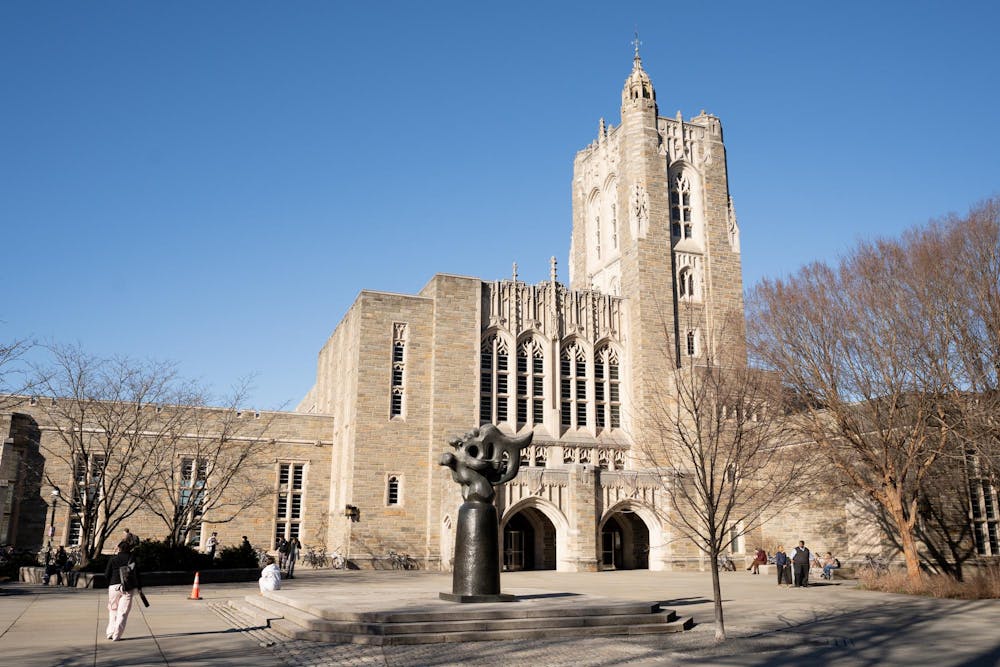
Every Princeton student knows what to do on the way out of Firestone Library. Pausing at the security desk, library visitors open their bags for inspection. After a quick glance into the backpack, the guards smile, give a thumbs-up, and visitors are free to exit.
Firestone’s security is extensive. In 2012, renovations to library systems introduced digital scanners at the desk at Firestone, which sound an alarm if a book that has not been checked out is brought through the library’s exit, and a digital card sensor, requiring users to swipe their Princeton ID to enter the library. If a visitor who is not a member of the University community wants to access Firestone’s collections, they can register for entry as the guest of a student, faculty member, or alumnus. Library borrowing cards are also available for $800 a year. Effectively, Firestone administrators have not only taken measures against book theft; they have also ensured that all library visitors are identified upon entering.
On top of these substantial measures, the bag check for books is a ridiculous redundancy — and an unnecessary inconvenience given the time it takes. And, in a University that prides itself on its vaunted Honor Code, insisting on both checks and electronic scanners suggests an unjustified lack of trust in the student body.
Stealing books from University libraries was an epidemic in the 1970s. According to one student at the time: “You just put the book in the waistband of your pants where it’s covered by your jacket and walk straight out. No one’s going to stop you.” In 1982, a police search found nearly 1,000 stolen Princeton library books in the home of a former graduate student. While some students would steal by concealing their books, others had to resort to more drastic measures. In 1974, one method of theft among students was throwing books from Firestone windows at night. The thieves would then leave the library and collect the books from outside. The window method was so prevalent in the 1970s that University administrators had Firestone’s windows locked to ensure the thefts would stop.
But this kind of rampant theft is no longer a problem.
When the electronic scanners were originally installed in 2012, it was understood that the devices could eventually make bag checks obsolete. As then-Director of Library Finance and Administration Jeff Rowlands noted, the changes to Firestone’s entrance were meant to make the library “a safer, more open environment for everyone on campus.” Rowlands went on to suggest the possibility that the library could follow the new book scanners with an eventual end to bag checks. Despite Rowlands’ suggestion, there have been no major developments in library policy over the last 13 years.
Most security guards at Firestone examine bags with the quickest of glances, likely assuming that no library visitor would dare to steal a book given Firestone’s extensive security measures. Guards typically only give the main pocket of students’ bags a cursory glance. Although guards are technically supposed to inspect students’ laptops, many don’t bother — and rightfully so. It would take an incredible lapse of judgment to attempt to sneak a book past the library’s scanning system. Instead, bag searches feel mainly symbolic, a University gesture meant to project care about propriety, rather than effectively function as a security check.
Still, as the library approaches closing time, or occasionally during busy daytime hours, lines for the bag check at Firestone can stretch across the entryway. While individual checks are not particularly time-consuming, exiting the library can come with a long, unnecessary wait.

Given that some books in Firestone’s stacks are worth over $1,000, and that not all library visitors are members of the University community, it is understandable that the University takes some security measures. But the bag check as practiced isn’t a serious attempt to find contraband. Getting rid of the checks would emphasize a new level of trust between library administration and visitors.
Students have legitimately criticized the bag check for decades. Complaints over the absurdity of library checkout policies date as far back as a 1979 satire of library policies in the ‘Prince’. In 2007, ‘Prince’ columnist Michael Medeiros noted that the bag check policy creates long lines to exit Firestone just for the sake of largely performative inspections. As Medeiros wrote, under Firestone’s policy, stealing books is easily achieved by “[keeping] your hidden library books in your backpack’s side pocket.” The University clearly didn’t get the memo — the same is true today. Princeton students left throwing books out the window in the seventies; it’s time for University policy to catch up.
Josh Stiefel ’29 is a contributing Opinion writer for the ‘Prince.’ He is from Teaneck, N.J. and can be reached at js9365@princeton.edu.
Read More

At a slight angle to the University
Jerry ZhuWhile our relationship with the University administration may not always be harmonious, our work ultimately serves to enhance the University’s core mission.
While our relationship with the University administration may not always be harmonious, our work ultimately serves to enhance the University’s core mission.

AI-resilient pedagogy must transcend the classroom
Nick ManetasAI-resilient pedagogy must address an educational environment in which merely teaching information has become less important than providing students avenues for self-directed inquiry.
AI-resilient pedagogy must address an educational environment in which merely teaching information has become less important than providing students avenues for self-directed inquiry.

Can honor survive the 21st century?
Frank StrasburgerThe issue here isn’t principally where or how students take exams. It’s what kind of community you are willing to live in.
The issue here isn’t principally where or how students take exams. It’s what kind of community you are willing to live in.