



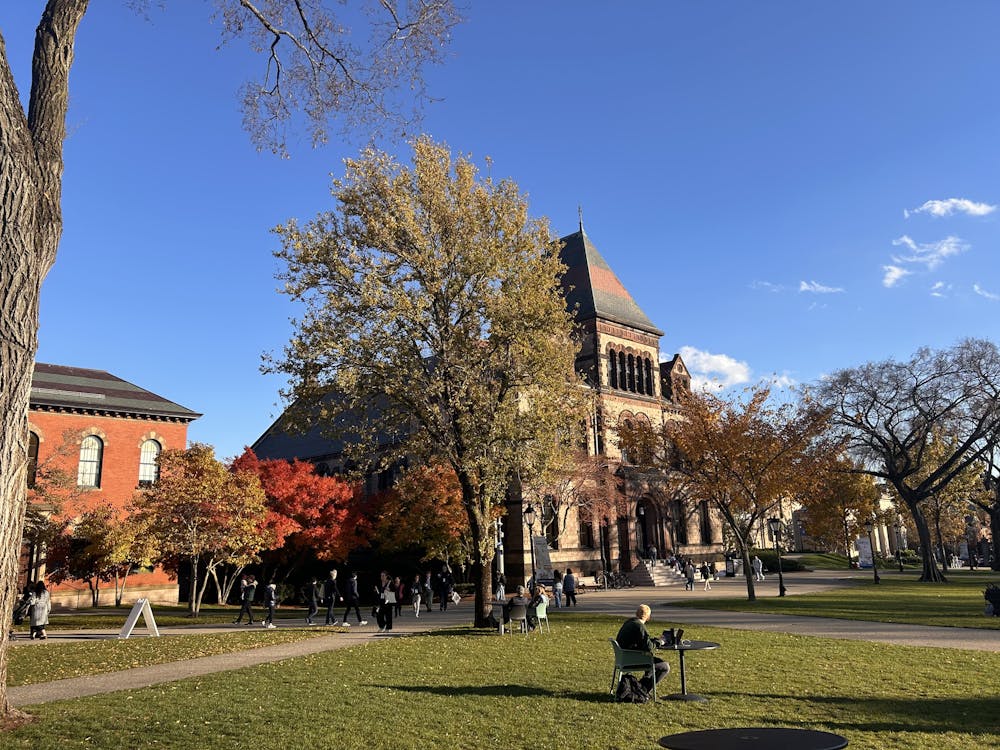
On Saturday afternoon, two students were shot and killed while attending an exam review session at Brown University. Ella Cook, 19, was a sophomore from Mountain Brook, Ala., who played piano and served as the vice president of Brown’s Republican Club. Mukhammad Aziz Umurzokov, 18, was a first-year student from Chesterfield County, Va., who aspired to become a neurosurgeon. Nine other students were injured.
The shooting at Brown is deeply tragic. But it is not the time for mere thoughts and prayers. It hasn’t been for decades. As another Ivy League university, this moment calls for Princeton to stand in solidarity with the victims of the Brown shooting by pushing for significant reform to fight violence. University President Christopher Eisgruber ’83 is uniquely equipped as the past chair and active board member of the Association of American Universities (AAU) — an organization with a precedent of condemning gun violence — to lobby for gun reform policies on the national and state level.
In the aftermath of the Sandy Hook shooting thirteen years ago, the AAU issued a statement that took a strong stance on gun violence. In it, they called for Congress to implement “meaningful, consequential actions,” while also criticizing the commerce of “high-powered weapons” and “high-volume magazines” with no benign purposes. In the past, the AAU has not been afraid of taking a stance on gun reform, or of treating it as a university problem.
The AAU has also advocated for reforms to gun violence research. The 1996 Dickey Amendment, which states that “none of the funds made available for injury prevention and control at the Centers for Disease Control and Prevention (CDC) may be used to advocate or promote gun control,” had discouraged the CDC from researching the causes and consequences of gun violence for decades. In 2017, the president of the AAU vocally opposed this measure, and in 2018, Congress clarified the amendment’s scope, leading to the first allocation of federal funds to gun-violence research in over twenty years.
Notably, this reclarification of the Dickey Amendment happened under the first Trump administration, despite Trump’s history of opposition to gun safety laws. Even in an unfriendly political environment, there are avenues to push for gun reform. Given the AAU’s history, lobbying for policies that tackle gun violence is fully within the scope of the organization. Combatting gun violence is fundamentally tied to the mission of protecting higher education.
Beyond his role in the AAU, however, Eisgruber has the potential to be a strong advocate for gun reform. He has taken to the media to defend higher education and academic freedom, giving over twenty on-the-record interviews in the first two months of this school year alone. Prior to becoming the University’s president, he demonstrated some sympathies towards gun reform. As an established leader in the fight for higher education, he can substantially shape the discourse around gun reform as a university-relevant issue.
Even if gun reform remains stagnant on the federal level, significant reforms can be achieved on the state level to protect Princeton from gun violence. New Jersey has the second-strongest state gun laws in the nation, according to the Giffords Law Center. But it still has room for further evidence-based reform, such as requiring everyone prohibited from purchasing guns to relinquish their firearms, and mandating, rather than merely incentivizing, microstamping on new handguns. Here, Eisgruber and Princeton have the power to work with the newly-elected Governor-elect Mikie Sherrill, who has been a strong supporter of gun reform during her time in Congress.
On political issues, Princeton has adopted a policy of institutional restraint, which allows for the University to comment in rare cases that relate to the University’s core values. This is different from institutional neutrality, in which universities do not express any political positions. Princeton’s mission is to “advance learning through scholarship, research, and teaching of an unsurpassed quality.”

Eisgruber himself has said that “we have to stand up for our values.” In order for productive learning to occur, students must feel safe — which is impossible in a world where students at peer institutions are senselessly slaughtered by gun violence, while the federal government implements rollbacks instead of reform in response. If we value learning, we implicitly value learning that is safe from the threat of violence. Pushing for gun reform falls under defending the University’s mission, and is therefore justified under institutional restraint.
These efforts could serve as a blueprint for other universities, too. By advocating for reform on the state and federal level, Princeton could set the precedent for other schools to make gun reform policy a central institutional priority.
Raf Basas ’28 (he/him/his) is an Opinion columnist from Elk Grove, Calif. You can reach him at raf.basas[at]princeton.edu or @raf.basas on Instagram. All of his columns can be read here.
Read More

The real crisis on campus isn’t cheating, it’s thinking
Jack GoodmanFurther, a growing body of research confirms that use of generative AI undermines the cognitive effort that is essential to the development of the human brain. As AI use increases, learning, recalling, and critical thinking skills decline.
Further, a growing body of research confirms that use of generative AI undermines the cognitive effort that is essential to the development of the human brain. As AI use increases, learning, recalling, and critical thinking skills decline.

Trust in academia is at a low. Can Writing Seminar help?
Ian RosenzweigAcademia has a PR problem, and no amount of insular critical inquiry is going to solve it. Writing Seminars should live up to their name and teach us not just to solve thorny research problems but also to effectively communicate our solutions through clear and — perhaps more importantly — stylistically compelling prose.
Academia has a PR problem, and no amount of insular critical inquiry is going to solve it. Writing Seminars should live up to their name and teach us not just to solve thorny research problems but also to effectively communicate our solutions through clear and — perhaps more importantly — stylistically compelling prose.

Why is the recording policy being kept secret?
Isaac BarsoumIn denying new students — and faculty and staff, for that matter — the right to know what regulations they are subject to, Princeton makes violations likely and will end up unfairly investigating or disciplining community members who were unaware of the policy’s existence in the first place.
In denying new students — and faculty and staff, for that matter — the right to know what regulations they are subject to, Princeton makes violations likely and will end up unfairly investigating or disciplining community members who were unaware of the policy’s existence in the first place.