The cult of exclusivity
Katherine ZhaoWhen that orange tiger popped up on our screens back in March, it meant acceptance. It meant we beat out 93 percent of the applicant pool and made it to Princeton.
When that orange tiger popped up on our screens back in March, it meant acceptance. It meant we beat out 93 percent of the applicant pool and made it to Princeton.
In a college setting as rigorous as Princeton’s, to what extent is it socially acceptable for students to talk about the concept of “struggle”? We often hear our friends grieve over tricky problem sets and ridiculous amounts of reading, and it’s certainly not uncommon to hear someone in the dining hall talk about how his or her recent experience with grade deflation was a slap in the face.
One of the things I was most uncertain about as an incoming freshman was the Street. I never drank in high school, and my friend group didn’t party much, so I didn’t really know what to expect when I arrived on campus.
Entering my sophomore year, I began discussing with my friends the inevitable decision of which eating clubs to consider.
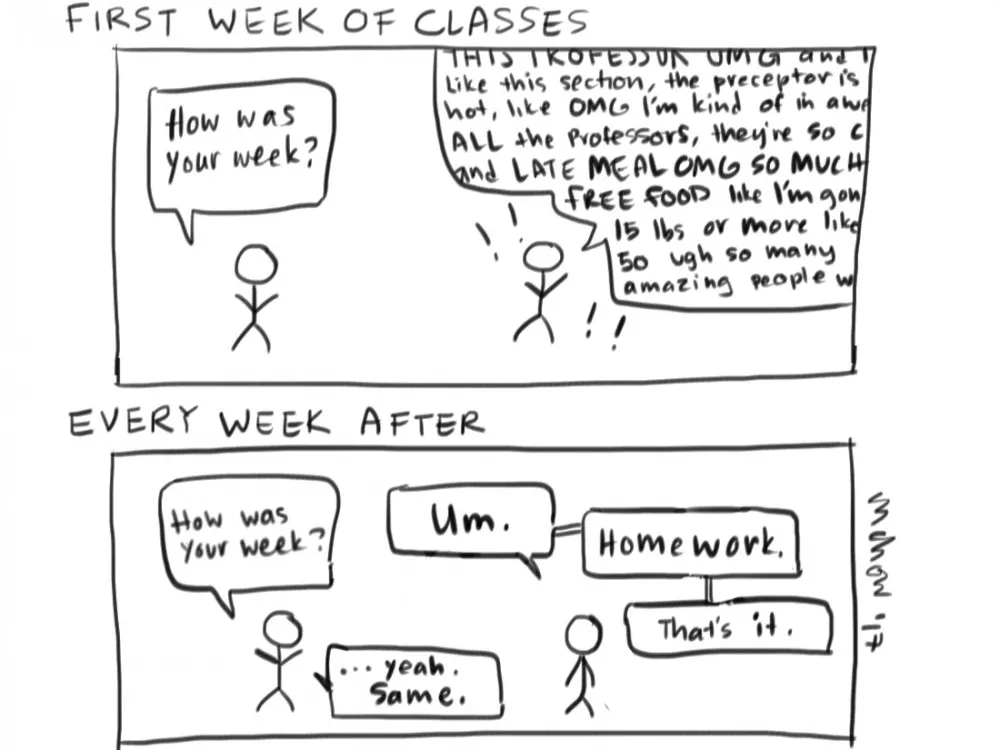
In the middle of my first week of classes here at Princeton, I could finally take a breath.
In the multipurpose room of Dillon Gymnasium, I found my hips turning slowly to Enya’s “Wild Child.” It was something I wouldn’t have wanted my grandfather to see.
Princeton has long been a leader in liberal arts education, and in today’s increasingly pre-professional world, the University stands strongly behind its goal of providing all students with a broad base of knowledge.
By Ellen Chances Once upon a time, there was a canopy that stood tall and happy at the Princeton train station.
For the entire day, he was all I could think of. Nervous thoughts rushed through my mind just as I rushed through my day.
Finishing at 21 hours and 19 minutes, Sen. Ted Cruz ’92 may have broken the record for longest campaign announcement speech in history.
I had just gotten back from the Street, clothes crusted in heaven-knows-what, when my mother calls me from Korea at 4 a.m.
The successful (or unsuccessful) conclusion of fall bicker reminds us that the central element of Princeton’s social experience is defined by our communal eating options.
This month, while everyone was returning to the quintessentially Princeton setting of ivy-covered castles (or, in the case of Wilson, ivy-covered bomb shelters), I was also returning, along with a number of others, to a setting that holds little in common with everything ivy: the Wilcox/Wu dish room. Three-and-a-half hours a night, two nights a week, I join my fellow student workers in a deceptively simple task— cleaning the dishes that hundreds of our classmates have used, so that they can be returned to the servery to be used by hundreds more.
By David Hammer We do not pretend to understand the occult forces that drive student group advertisement.
During my internship program this summer, my fellow interns and I gathered in The Huffington Post offices, talking to former Princeton Dean of Religious Life (and current HuffPo Religion editor) Paul Raushenbush.