



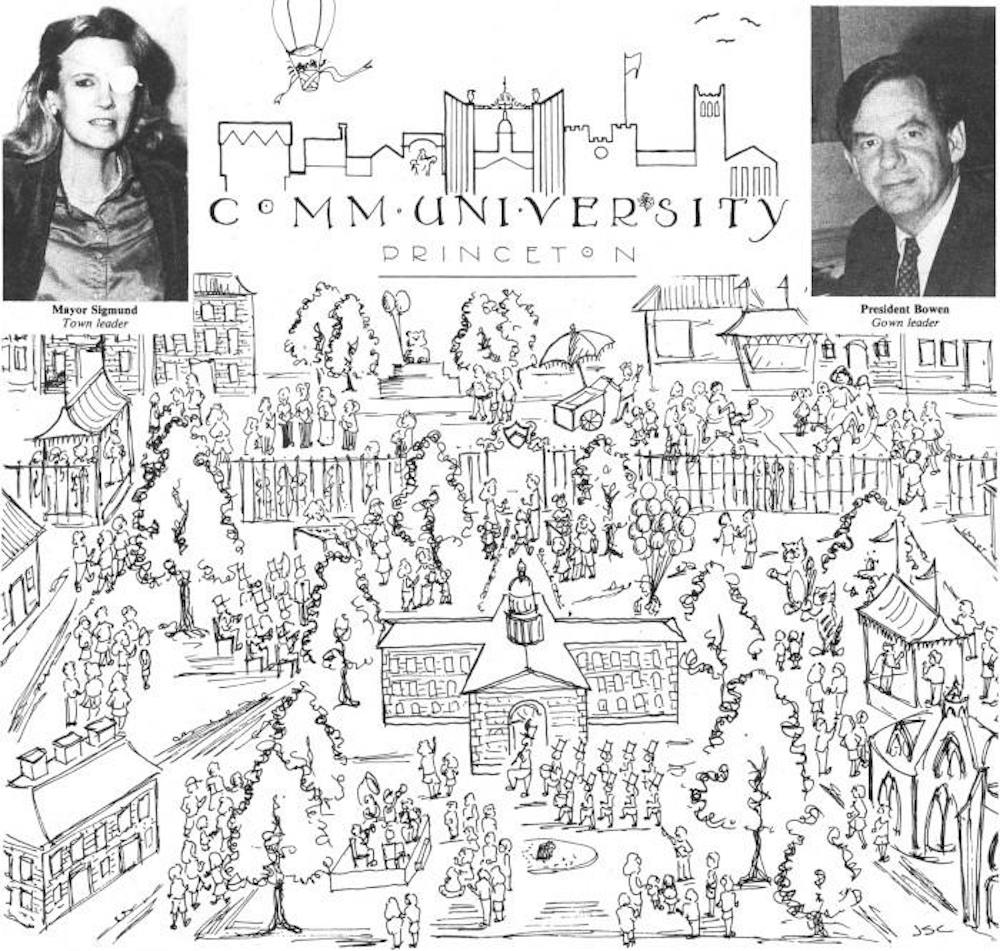
In 1985, Doug Platt ’86 had an idea: “a huge spring carnival” that would bring together the town of Princeton and the University for a day of celebration and community. He called it Communiversity, and with a starting budget of $8,000 — worth over $25,000 today — and 30 student volunteers, he pulled it off.
The Daily Princetonian reported that more than 7,000 attendees “wandered along Nassau Street and onto the campus to sample the food and entertainment in the first spring festival of its kind at Princeton.” The executive director of the Princeton-based Coalition for Nuclear Disarmament called it “a special and well-spent occasion.” And Communiversity, a roaring success that represented an effective synthesis of University and town, became an annual event. Thirty-six years after Platt’s efforts, Communiversity’s attendance regularly measured above 40,000 and was “Central Jersey’s largest and longest running cultural event.”
And then the COVID-19 pandemic hit, and in July 2020, Communiversity took its final breaths.
Since the pandemic, the town-gown relationship has withered. Certain new initiatives, like Porchfest, inaugurated in 2022, have made inroads in repairing it. But now, six years after the pandemic, it’s time to rethink our approach to the relationship between Princeton and the University — and, finally, bring back Communiversity.
Communiversity was a whole-of-University affair. In 1985, the ‘Prince’ described the planning as a monthslong endeavor that culminated in a four-hour event including local food vendors, singing, dance, and music group performances, a life-size chess game, a giant game of “Simon Says,” and construction of the world’s largest ice cream sundae. Campus tours took guests through outdoor sculptures and the Art Museum. A kung fu demonstration and game of ultimate frisbee took place at the same time on Cannon Green. Cars were banned from the section of Nassau Street where the event took place, and a chalk street mural was created there alongside parachute games, sneaker painting, and a community sculpture. A hot air balloon lifted off in Witherspoon Courtyard to cap it all off.
In sum, on the Communiversity docket was: “dancing, singing, juggling, marching, frolicking,” said the advertisement in the ‘Prince.’
The schedule, published as a full page, also included extensive lists of “town participants” and “gown participants.” At least five hundred students were “actively involved.”
Communiversity was envisioned as part of a solution to a long-standing problem: “Princeton has the potential to be an excellent university town. Right now it isn’t,” said Platt. “Townspeople only come on campus for Alexander Hall, the U-Store and the Art Museum; the students go only as far as Nassau Street for the stores. That’s not communication.” Platt was right. And it wasn’t a community, either.

Interactions between the town and the University have long been elusive for Princeton. The ‘Prince’ hailed that 1985 inauguration as “a rare blending of town and gown.”
But by 2017, Communiversity was attracting tens of thousands of visitors each year, only a small fraction of whom were students. By then, the philosophy underpinning the event had crystallized: The event represented “a chance to expand the Orange Bubble, if only slightly, by appreciating the town that thrives right on the other side of the FitzRandolph Gate.”
“I’ve loved Communiversity because as a Princeton student, it’s easy to forget that there’s a whole world outside the university with a culture all of its own,” Jaqueline Berardo ’19 told the ‘Prince’ at the time. “Every spring Communiversity reminds me of that, in the best way possible.”
But then Communiversity died in the long winter of the COVID-19 pandemic. In 2022, Adam Welch, the executive director of the Arts Council of Princeton, the group that organized Communiversity — and now co-organizes Porchfest and other arts-centered events in town — wrote that the pandemic prompted the Council to reenvision Communiversity, and ultimately to abandon it.
“What is Communiversity and does it further our mission of Building Community Through the Arts?” Welch questioned. “The goal of becoming the largest arts festival in the state lost its raison d’etre along the way.”
Welch might be right that Communiversity was not, perhaps ever, truly an arts festival. From its inception in 1985, when it subsumed the Arts People Party — the Arts Council’s pre-existing festival — Communiversity always aimed to be more than just an arts festival. It was both a physical and symbolic coming-together of the University and the town in a celebration of all that we have in common and all that makes us different.

For decades, Communiversity was more for the community than for the arts. After its cancellation, Welch wrote, it was replaced by an “array” of “decentralized events,” culminating in Princeton Porchfest. But while Porchfest is a wonderful celebration of local music and a welcome addition to the Princeton cultural scene, in 2025, it attracted just over 3,500 attendees — a fraction of Communiversity’s draw.
And while Welch touts the decentralization of arts programming as providing “more safety and flexibility,” it ignores a key fact: For Communiversity, the centralization was the point.
The Arts Council of Princeton may have decided that Communiversity is outside its mission. That’s fine. But the University — perhaps spearheaded by students focused on the town-gown relationship — should work with community organizations to bring it back, with or without the Arts Council’s support.
The event was once a vibrant celebration of community and university, town and gown. It could be that once more, giving us a chance to dance, sing, juggle, march, and frolic together again.
Isaac Barsoum is a junior in the politics department from Charlotte, N.C. who likes whimsy and doesn’t think the pandemic should still be taking it from us. He is an associate Opinion editor for the ‘Prince.’ He can be reached at isaac[at]dailyprincetonian.com.
Read More

Who rights our rules?
Charlie YaleWith fairness for students in mind, the University must require that all changes to RRR go through the Committee on Rights and Rules.
With fairness for students in mind, the University must require that all changes to RRR go through the Committee on Rights and Rules.
Freedom of speech is a right, not an excuse
Lily Halbert-AlexanderFreedom of speech should function to hold us to a high standard of honesty and transparency, not to excuse abuses of power and influence in the country’s most influential institutions.
Freedom of speech should function to hold us to a high standard of honesty and transparency, not to excuse abuses of power and influence in the country’s most influential institutions.

We know what has changed. How will future classes?
Thomas BuckleyI am by no means the first student to complain about replacing the charm of meandering into Labyrinth on the first day of classes with navigating an e-commerce website, but I might be among the last. When the Class of 2027 graduates, so will the last class of students who remember Princeton before eCampus.
I am by no means the first student to complain about replacing the charm of meandering into Labyrinth on the first day of classes with navigating an e-commerce website, but I might be among the last. When the Class of 2027 graduates, so will the last class of students who remember Princeton before eCampus.