



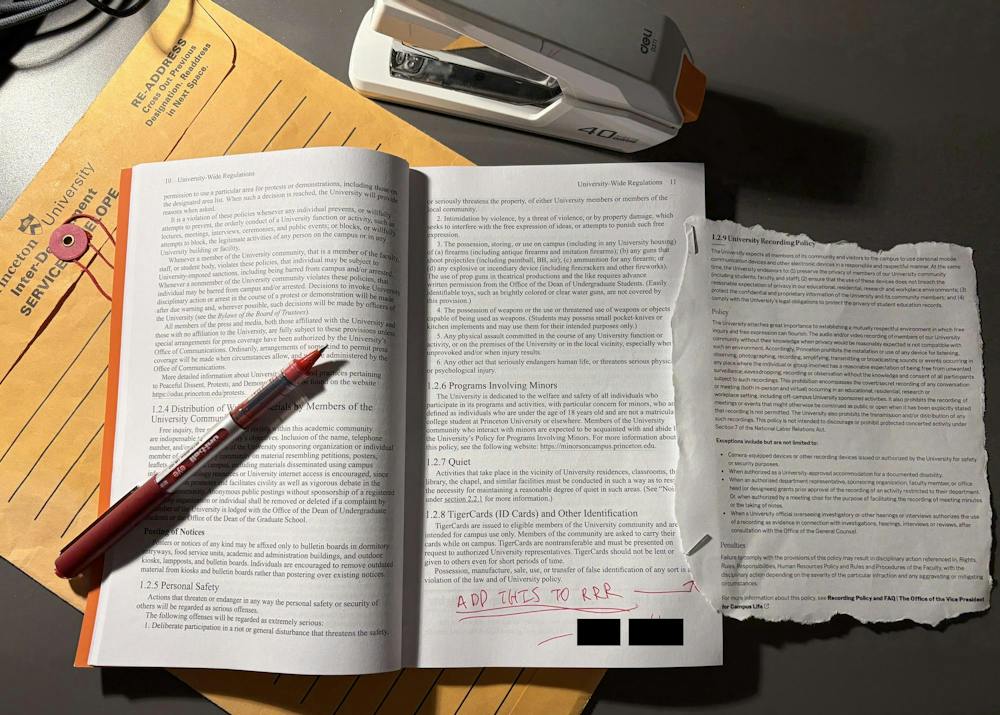
Earlier this month, my colleague Isaac Barsoum penned a column questioning why Princeton’s recording policy was not in Rights, Rules, Responsibilities — which Princeton calls “a concise reference and guide” for all University policy. After the column was published, the policy was added to RRR. This response — if belated, and certainly appearing a bit sheepish — would seem to resemble a win for advocates of University transparency.
But we’re left to wonder how that policy got there: According to the Council of the Princeton University Community Charter, potential changes to RRR are considered by the Committee on Rights and Rules — a committee of the CPUC charged with investigating “the adequacy of the procedures for making and applying” rules to the student body. According to a person with knowledge of the Committee on Rights and Rules, that body didn’t meet to consider adding the recording policy to RRR after the publication of Barsoum’s column.
So how did the recording policy make its way into RRR? And if the Committee on Rights and Rules isn’t the sole arbiter of what ends up in RRR, how will students know who is making the decisions on what is included and how those decisions are made? With fairness for students in mind, the University must require that all changes to RRR go through the Committee on Rights and Rules.
As a broader critic of the CPUC, I bemoan its general powerlessness when it comes to many of the big issues affecting the University — like questions of fossil fuel divestment — which are typically addressed instead by the Board of Trustees and the University president. But, on issues of discipline in particular, the CPUC’s committees hold considerable leverage — the Committee on Rights and Rules, for example, has the power to investigate “all rules regarding the conduct of resident members of the University community,” giving it significant authority over the procedures that regulate our day-to-day life.
This is particularly important because the Committee on Rights and Rules is supposed to have a say on what goes in RRR. Importantly, the group also includes student members who can represent the interests of undergraduates and graduates alike. If the Committee is able to be circumvented, as seems to have occurred in the addition of the recording policy, it demonstrates that student input may be overridden in the name of a larger administrative goal, whatever that may be. When the Committee on Rights and Rules is bypassed, students are entirely precluded from the approval process of the rules that impact them.
The earliest reference to the Committee on Rights and Rules dates back to 1969 when the CPUC was established. According to reporting from The Daily Princetonian at the time, the committee had the power to create “binding” rules for all members of the University community. The University library’s earliest copy of RRR comes from 1974, which included excerpts from documents published in the late 1960s. The document has seemingly been engrained in University culture for more than 50 years, but the process of how to change it has become less clear since.
It is true that students don’t have a say in many of the regulations that affect us. For example, when there was a vote to reinstate mandatory proctors in exams last spring, it was the faculty who were polled, not the students. The policies that pass through the CPUC are one of the few places where students — supposedly — have the opportunity to speak for themselves: it’s crucial that our representatives continue to get their say on how those policies make or don’t make their way into the rules framework.
As it stands, we don’t know how RRR got changed: a mystery entity, be it a dean or some other person or group, added the policy seemingly without consulting the Committee.

The process for amending other documents regarding University governance is fairly clear: the Office of the Dean of Undergraduate Students, for example, “has a long-standing charge to develop, articulate, and enforce policies related to student organization activity” and governs the standards for student organizations. As outlined by RRR, the Office of the Dean of the Graduate School has wide purview to create and enforce policy as it pertains to graduate students. The faculty, too, are able to vote on the Rules and Procedures of the Faculty, their primary governing document. The underlying feature of each of these documents is that the answer to the question of who has authority to make changes to them is fairly clear and easy to answer, which means that people know who’s making the decisions that impact them and where exactly in the University that authority lies. The same is not true for RRR.
It’s concerning enough that, as Barsoum reported, not all policies that apply to members of the University community are included in RRR even though, according to University spokesperson Michael Hotchkiss, it is the expectation that all students “familiarize themselves with all University policies.” While it is understandable to want to avoid the “rigid codification and relentless administration of rules and regulations” that RRR swears off in its introduction, if students are always expected to be following all the rules, they should, at the very least, be centralized and easy to find. But not only is RRR incomplete — intentionally so, apparently — it is ostensibly liable to evolve at any moment with little transparency about how such policy changes are made and who holds the authority to make them.
The question of how the recording policy ended up in RRR may go unanswered. But we can only hope that the mystery RRR editors make it clear in due time how the document gets changed.
Charlie Yale is a junior in the history department from Omaha, Neb., and one of the head Opinion editors of The Daily Princetonian. He encourages you to submit a response to this piece or write an op-ed for the ‘Prince.’ You can reach him at yale[at]dailyprincetonian.com.
Read More
Freedom of speech is a right, not an excuse
Lily Halbert-AlexanderFreedom of speech should function to hold us to a high standard of honesty and transparency, not to excuse abuses of power and influence in the country’s most influential institutions.
Freedom of speech should function to hold us to a high standard of honesty and transparency, not to excuse abuses of power and influence in the country’s most influential institutions.

We know what has changed. How will future classes?
Thomas BuckleyI am by no means the first student to complain about replacing the charm of meandering into Labyrinth on the first day of classes with navigating an e-commerce website, but I might be among the last. When the Class of 2027 graduates, so will the last class of students who remember Princeton before eCampus.
I am by no means the first student to complain about replacing the charm of meandering into Labyrinth on the first day of classes with navigating an e-commerce website, but I might be among the last. When the Class of 2027 graduates, so will the last class of students who remember Princeton before eCampus.

It’s time to end the alumni interview
Cate YoungThough it’s tough to diverge from tradition, the interview process presents far more possible risks than it does positive returns. Interviews’ ultimate and admirable goal is to get to know Princeton applicants better—and to let them get to know the University—but there are better and more equitable ways to achieve this.