



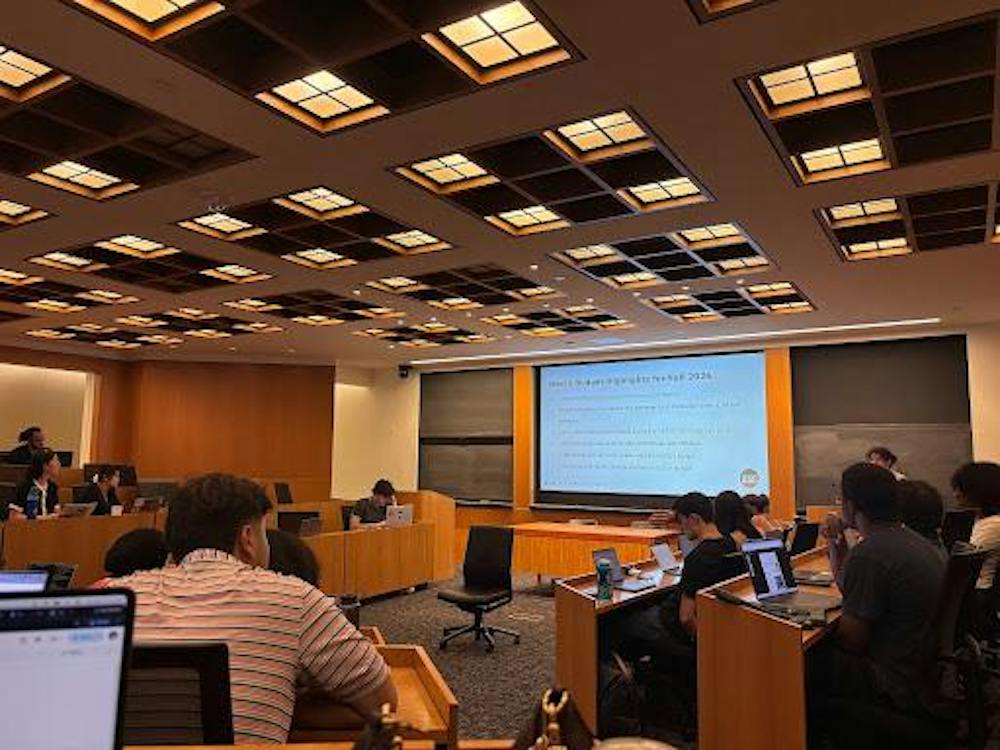
On Sunday, the Undergraduate Student Government senate kicked off its first meeting of the 2026–27 school year with discussions about changes to the winter election cycle, its plans for a record-high semesterly budget, and several new academic and campus initiatives.
Among the proposed election changes are moving the winter election cycle earlier in the semester to avoid the holiday period and revising the slate system for candidates seeking USG’s top executive positions. Under the current calendar, the winter election cycle falls around Thanksgiving week, when many students and candidates are off campus.
The calendar change is intended in part to make it easier for students without previous USG experience to run for office. During the meeting, USG Vice President Anuj Krishnan ’27 said that the modification would likely occur through an amendment to the USG elections handbook, rather than its constitution.
USG President Quentin Colón Roosevelt ’27 also discussed changing the way slates operate for candidates. He argued that the current slate system creates an unnecessarily combative atmosphere between competing teams and that it creates barriers to candidates running for the first time.
“We’re very open to talking about all this,” Colón Roosevelt said. “We really want to make sure that USG seems open to everyone. First, that means we increase voter participation when we do elections, and second, we make it easier to run as a first-time candidate by getting rid of these things that sometimes exclude people.”
As the first meeting progressed, USG Treasurer Marvel Jem Roth ’28 shared that USG has the largest spendable semester balance in University history. The new budget is approximately $767,747.92, and student activities fees were also raised to $109 per student, up from $604,149.45 and $104, respectively. While the student activities fee was increased by approximately 4.5 percent, the same rate as tuition, room, and board, the new budget was significantly increased from the previous semester.
“We have a lot of money,” Roth said. “I want to distribute it to students, and I would like to do that creatively in ways that are going to maximize community building. We want to maximize our budget utilization.”
In a statement to The Daily Princetonian following the meeting, Roth wrote that USG allocated its entire known operating budget for Spring 2026 after introducing new financial accountability measures, including financial contingencies and publicly itemized ledger-detail budgets.

Roth suggested that event postponements and students’ demanding academic schedules and other technical reasons contributed to less spending, leading to an unanticipated budget surplus.
She added that this fall’s budget is also being driven by what she said was the highest student activities fee — which almost doubled in Fall 2023 — in USG history.
USG’s Projects Board, which provides funding for undergraduate projects and on-campus programming, now has a $200,000 programming budget. Projects Board funding is available to undergraduates seeking support for initiatives taking place on campus.
Tiger Ties, an annual celebration of its cultural and international communities, is also returning this semester with a $21,000 budget.
Roth said USG hopes to put its increased resources toward student programming at a time where the University is implementing broader budget reductions.
Following Roth’s presentation on financial matters, the senate also heard updates on applications for new student organizations from Student Group Recognition Committee Chair Akash Bhowmick ’27. Seven groups were approved for recognition: Princeton Pilots Club, Orange Wall, Princeton Students in the Nation’s Service, Ping Pong Pals, Baltic Society, Passionfruit Magazine, and Princeton Exploration of Anomalous Reality.

Academic Committee Chair Isaac Bernstein ’28 also presented updates on several initiatives planned for the semester.
Bernstein said 86 academic units participated in this year’s Academic Expo, marking the event’s highest attendance in at least the last four years. The expo moved this year to the Lewis Center for the Arts, and the committee also altered its communication strategy surrounding the event.
“The idea is that we continue to grow and improve this event every year, and so this was very exciting to see in that aspect,” Bernstein said. “The two biggest things we want to continue working on are noise levels. It’s just a really hard problem to fix because you have 1,500 undergraduates, plus all the departments, and then heat because there are all the people in space.”
Bernstein is a former staff News writer for the ‘Prince.’
The Academics Committee is also continuing its Minor Program Initiative in collaboration with the Office of the Dean of Undergraduate Students and the Office of Institutional Research. A Minor Program Fair is planned for later in the semester, with the goal of increasing awareness of Princeton’s minor programs and the resources available through them. Bernstein also highlighted the new design minor, managed by the Keller Center for Innovation in Engineering Education.
The committee is also pursuing several additional academic initiatives, including a Proctoring Guidelines Advisory Group established over the summer after a historic vote took place last semester on proctoring and Honor Code standards. The committee is also collaborating with the McGraw Center for Teaching and Learning on a DEI and Academics survey focused on students’ previous academic experiences and inequities.
After Bernstein, Campus and Community Affairs (CCA) chair Anaya Willabus ’28 previewed upcoming programming for the semester, including Porchfest on Sept. 26, as well as future student trips. She introduced a new rewards card program, through a USG initiative called Tigers in Town, to incentivize students to explore and support local businesses. This program will provide students with a one-time voucher and a bingo sheet of businesses. Once students complete the bingo sheet, they can turn it in for a larger voucher for any business that CCA partners with.
Willabus is a staff Copy editor for the ‘Prince.’
Willabus said that she and her partnership council coordinator Sophie Foreman hope to launch the rewards program at the start of the spring semester.
Willabus also shared an update about the Religious Transit Pilot Program, which was launched last academic year to help students attend religious commitments off-campus. According to Willabus, $2,000 was spent last semester providing students with transportation by utilizing USG’s partnership with Lyft.
“What we realized is that it’s sort of difficult for students to organize the carpooling either in larger scales for the church groups where you need different people to use their $70 to work together,” Willabus said. “And then for the people who are going to be in remote areas, they’re having a really hard time getting noticed to take them there.”
As the semester progresses, USG is expected to further consider its proposed election handbook changes while committees begin implementing a slate of new programs backed by the organization’s historically large budget.
The USG senate typically meets every Sunday at 5 p.m. in Robertson 016.
Joann Kim is a News contributor for the ‘Prince’ and a member of the Class of 2030.
Please send any corrections to corrections[at]dailyprincetonian.com.
Read More
Princeton confirms employee benefit cuts amid far-reaching budget cuts
Meghana VeldhuisDue to a broader financial squeeze that has already cut faculty raises and staffing, University employees will face higher health care costs and reduced retirement contributions starting in 2027.
Due to a broader financial squeeze that has already cut faculty raises and staffing, University employees will face higher health care costs and reduced retirement contributions starting in 2027.

U. to limit number of student representatives at faculty meetings following press restrictions
Gray CollinsPrinceton will limit student government and CPUC representatives to two observers each at faculty meetings beginning Sept. 14.
Princeton will limit student government and CPUC representatives to two observers each at faculty meetings beginning Sept. 14.

Thieves steal $250,000 in designer bags from Princeton luxury boutique in overnight break-in
Elizabeth HuFour masked people broke into a luxury boutique store in Princeton on Sept. 1, stealing over $250,000 worth of handbags.
Four masked people broke into a luxury boutique store in Princeton on Sept. 1, stealing over $250,000 worth of handbags.