



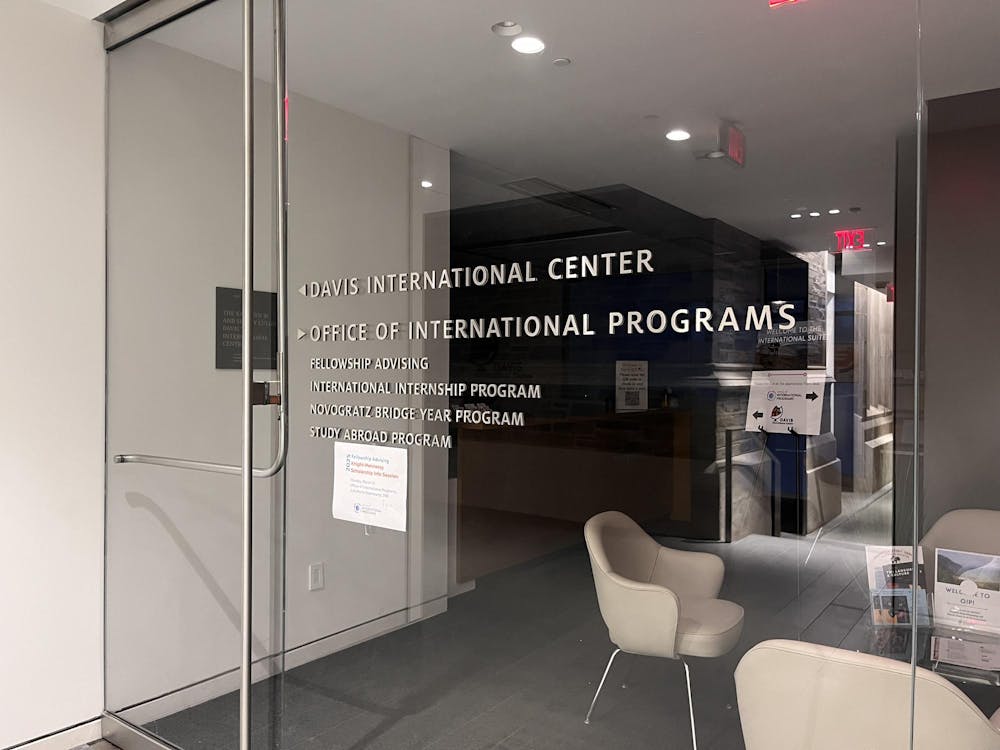
International students’ internship opportunities may soon be significantly limited. Following new guidance from the U.S. Immigration and Customs Enforcement, the University indicated in a Sept. 1 email that Curricular Practical Training will likely no longer be approved for all undergraduate and most graduate students. CPT is a temporary work authorization that allows international students on F-1 visas to pursue off-campus internships.
The new guidelines issued by the Department of Homeland Security do not change the underlying regulation, but instead represent a stricter interpretation of the existing policy compared to previous years. Other universities are working to comply with federal requirements around CPT approval, opting to review current programs and halting work authorizations for students on F-1 visas except in cases where the work is a degree requirement.
Approval for CPT is intended to be limited to internship opportunities that represent “an integral part of an established curriculum.” Previously, many universities, including Princeton, approved CPT when an internship was not required for graduation. The only Princeton degree programs that require an internship for graduation are the Masters in Public Affairs in the School of Public and International Affairs and the Masters in Finance in the Bendheim Center for Finance. The new DHS guidelines specify that CPT approvals for students completing programs without required internships could lead to “an institution losing certification to enroll foreign students.”
The new restrictions will not affect programs in which the University provides a grant for students to intern for an outside organization, such as Princeton Internships in Civic Service, also known as PICS, and the Recognizing Inequities and Standing for Equality internship program, known as RISE, both housed under the auspices of the Pace Center for Civic Engagement.
In Aug. 12 and Aug. 24 memos, ICE issued new guidance that universities should only approve CPT if an internship or practical training experience is a mandatory requirement for a student’s degree program.
The University declined to comment specifically on CPT. Albert Rivera, Director of the Davis International Center, also did not respond to a request for comment by The Daily Princetonian.
The Davis International Center’s webpage on CPT was recently purged and is currently “under construction.”
Following the new ICE guidance, several universities paused or restricted certain forms of their CPT programs. New York University, which has one of the largest populations of international students of any American university, recently paused all pending and upcoming CPT requests, as did UC Berkeley and the University of Washington. While refraining from a full suspension, Columbia University opted to increase restrictions on CPT, allowing only programs that are essential to degree requirements.

International students pursuing off-campus internships will now have to resort to Optional Practical Training (OPT), an alternative to CPT that has also come under threat by the Trump administration. Under OPT, students can work in the United States for up to a total of 12 months before or after graduation, while CPT authorization is limited to a student’s time in a degree program. Students in programs designated as STEM by DHS are eligible to apply for a 24-month OPT extension.
Typically, international students use CPT for work experience prior to completion of their degree to maximize their OPT time after graduating. CPT is also easier to obtain, as students can apply via the Davis International Center. For OPT, students must apply directly to U.S. Customs and Immigration Services, a unit of the Department of Homeland Security..
Elizabeth Chen ’28, an international student from Canada, said that given the enhanced restrictions associated with CPT and OPT, she’d be more inclined to seek on-campus employment.
“I’d only think about using Princeton [to find a job] as opposed to using OPT,” Chen said.
The restrictions that are likely ahead mean changes for international students’ plans after graduation. Chen said, “It’s made me consider whether or not I want to pursue work or schooling in the U.S. post grad.”
Multiple other international students that the ‘Prince’ contacted did not respond to requests for comment.

Meiya Xiong is a News contributor for the ‘Prince’ and a member of the Class of 2030.
Jonah Vimont is a News contributor for the ‘Prince’ and a member of the Class of 2030.
Please send any corrections to corrections[at]dailyprincetonian.com.
Read More

N.J. Lt. Gov. Dale Caldwell ’82 reportedly being investigated for inappropriate behavior
Oliver Wu and Giselle MorenoNew Jersey Governor Mikie Sherrill has opened an internal investigation into Dale Caldwell ’82, New Jersey’s lieutenant governor and secretary of state, for alleged inappropriate behavior with women and possible ethics violations, the New Jersey Globe reported on Friday.
New Jersey Governor Mikie Sherrill has opened an internal investigation into Dale Caldwell ’82, New Jersey’s lieutenant governor and secretary of state, for alleged inappropriate behavior with women and possible ethics violations, the New Jersey Globe reported on Friday.
A B1G match-up: Women’s soccer falls to Ohio State
Siena SydenhamNo. 8 Ohio State proved to be a worthy opponent for the Tigers. Two goals in the first 10 minutes gave the Buckeyes momentum, and a second half surge in Princeton’s performance came too late and was not enough to combat the wide OSU lead.
No. 8 Ohio State proved to be a worthy opponent for the Tigers. Two goals in the first 10 minutes gave the Buckeyes momentum, and a second half surge in Princeton’s performance came too late and was not enough to combat the wide OSU lead.

Independent Major Program paused for further review
Mia Chen and Katharine GloverAs of this semester, the Independent Major Program has been paused and will not accept applications from the Class of 2030 or subsequent classes until further notice.
As of this semester, the Independent Major Program has been paused and will not accept applications from the Class of 2030 or subsequent classes until further notice.