



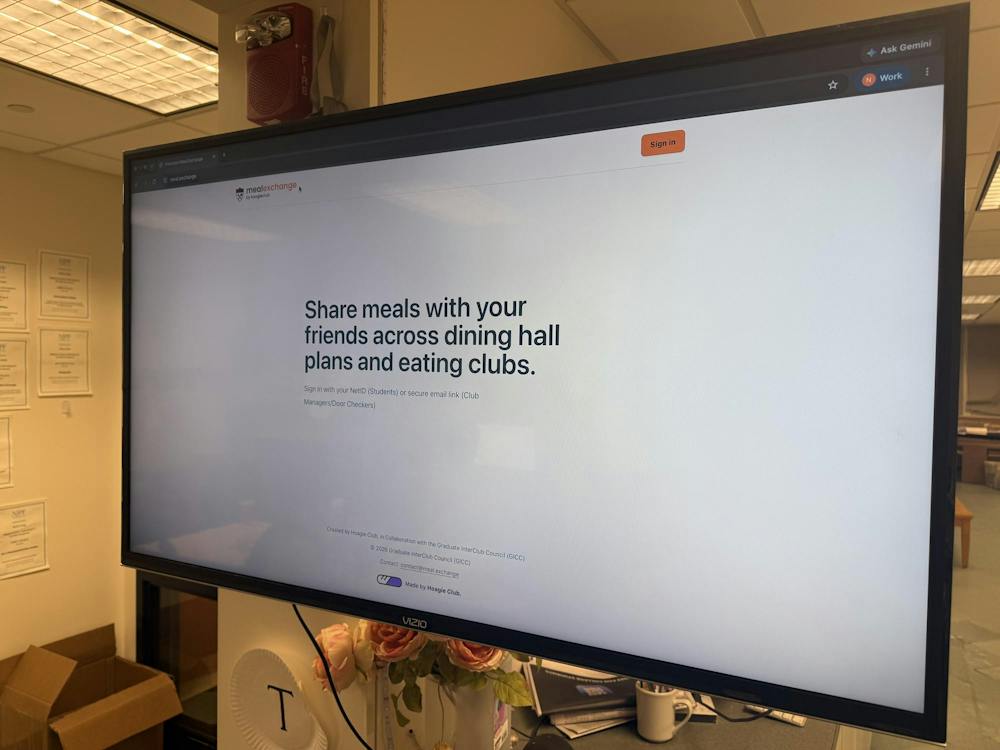
Princeton’s new meal exchange platform is launching this week, weeks after the Fall semester began, restoring meal exchanges between students in eating clubs and those on University dining plans, as well as club-to-club exchanges.
Meal exchanges between eating clubs can begin as early as Thursday, while exchanges involving University dining halls will begin Monday, according to an announcement sent to students Wednesday by Interclub Council President Allison Lee ’27. Individual eating clubs will determine when their exchanges begin, how many exchanges they permit, and which days they are available.
While Block 32 meal swipes — which give all juniors and seniors 32 University dining swipes throughout a semester for free — will not be eligible for exchange, juniors and seniors will be able to purchase an additional 10 meals — named Block 10 — that can be used for meal exchanges.
The new platform, meal.exchange, was developed by the student-run Hoagie Club, and largely preserves the process students used under the previous MealX system. Students can log in, search for another student, and send or accept an invitation for a meal swap. Once an invitation is accepted, the platform emails a barcode that can be scanned at meal check-in to initiate or complete the exchange.
The system allows meal exchanges between students on different dining plans, whether they are two students in different eating clubs, or whether one is in an eating club and one is on a University dining plan.
“For those familiar with the previous system, the process will remain largely the same,” Lee wrote in the announcement.
The launch follows months of work to replace MealX. In February, it was announced that the University planned to decommission the old software after officials told eating club representatives that the platform was antiquated and that the University would not fund an upgrade amid ongoing cost reduction.
The ICC and Graduate Interclub Council then worked with student developers on a replacement platform. The ‘Prince’ reported in August that the system had been finalized and was expected to roll out at the beginning of the fall semester, a launch that has since been delayed.

Undergraduate Student Life Committee Chair Oscar Barrios ’27 was involved in discussions beginning the first week of September with University administrators over the number of swipes the new meal exchange system would cost an undergraduate student.
“I’d like to commend the work of the student developers as well, who, over the summer, were able to bring something to life. We are very excited to see how this develops as an entirely student-led initiative,” Barrios said in an interview with the ‘Prince.’
The new platform also gives students greater flexibility in completing exchanges. Students will now have the entire semester to complete an exchange, rather than the previous 30-day window. Lunches can also be exchanged for dinners, and vice versa. No fall semester exchanges will be permitted after Dec. 22, the last day of fall final assessment period.
Furthermore, a change addressing how exchanges are charged to block meal plans was finalized this week.
For the 2026–27 academic year, students on Block 128 and Block 10 plans will use one swipe when participating in an exchange. Beginning in the 2027–28 academic year, two swipes — accounting for the two meals provided through the exchange, one for each student, will instead be deducted from the plans of each of the students involved.
“We believed [this] change would erode the spirit of meal exchange at a moment when upperclass students are already navigating a period of significant transition, shaped by the removal of independent status and growing selectivity across the eating clubs,” USG wrote in an email accompanying Lee’s statement.

Barrios said the two-swipe system was initially going to be implemented this fall.
“We were definitely opposed to the University’s decision to move from the one-to-one system to the two-to-two system given that students were not given enough anticipation or enough notice, and given that this is the first semester that we are implementing this new meal exchange system,” Barrios said.
Barrios said he and USG Vice President Anuj Krishnan ’27 met this week with Chris Lentz of Campus Dining and Chris Burkmar ’00 in the Office of the Vice President for Campus Life to discuss the planned two-swipe system.
“After talking through some things with them, we agreed that it is definitely beneficial for us to keep this one-to-one system — not because it makes financial sense [for the University], we agree it doesn’t, but because students weren’t told about this,” Barrios said. He added that students had already selected their meal plans and could not switch plans in response to the change.
According to Barrios, the University agreed to preserve the one-swipe policy for this academic year before beginning the two-swipe system next fall.
The University declined to comment. ICC and GICC representatives did not immediately respond to requests for comment.
Barrios said USG plans to continue discussing ways to encourage students to participate in meal exchange after the two-swipe structure begins.
Razvan Verde is a staff News writer for the ‘Prince.’ He is from Newport News, Va.
Please send any corrections to corrections[at]dailyprincetonian.com.
Read More

This Week in History: Murray-Dodge Café opens its doors
Miriam DubeLast week, Murray Dodge Café celebrated 50 years of serving as a relaxed, alcohol-free social space for students. Commemorating decades of free cookies and tea, the ‘Prince’ looks back on how the café overcame various hurdles to open its doors, and the café’s first few months serving students on campus.

‘We still have pride’: Students and faculty react to U.S. News ranking that placed Princeton second
Claire Ding and Albert TanStudents and faculty reacted to Princeton dropping its No. 1 position on U.S. News’s annual university rankings for the first time in 15 years.
Students and faculty reacted to Princeton dropping its No. 1 position on U.S. News’s annual university rankings for the first time in 15 years.

Laptop smashed and TVs damaged in Bowen Hall, investigation ongoing
Sena ChangA laptop and multiple monitors were found damaged in Bowen Hall on Sunday morning. This incident is still under investigation as of Monday.
A laptop and multiple monitors were found damaged in Bowen Hall on Sunday morning. This incident is still under investigation as of Monday.