




The following is a guest contribution and reflects the author’s views alone. For information on how to submit a piece to the Opinion section, click here.
I am a Princeton student and a volunteer for Sam Wang’s congressional campaign. Earlier this week, two other students associated with Sue Altman’s campaign, a rival to Wang’s, wrote an Opinion piece in The Daily Princetonian criticizing Wang for contesting Altman’s ballot petition. What I read in that piece, and the accusatory statements the Altman campaign issued in response to being challenged, strike me as farcical and demand a response. Wang’s challenge was not a bid to silence students, as claimed in the earlier Opinion piece, but a good-faith effort to defend democratic institutions.
The piece’s instigating event was New Jersey’s petition deadline. In order to appear on the ballot for congressional primaries, candidates must submit petitions with 500 signatures from voters with the relevant party affiliation. Per New Jersey law, members of the public, including staffers for other campaigns, are allowed to challenge signatures on the basis of, for instance, the signer being a fictional person or because they’re not registered in the district. These challenges are mediated by an administrative law judge (ALJ).
The students who authored the critique of Wang are concerned with 83 signatures that were disqualified by the ALJ because they were collected by people not registered to vote in New Jersey. This was stipulated by a state law that remains on the books, and the ALJ thus followed, despite the law having been invalidated in a 2021 lawsuit.
Their assertion was that Wang was deliberately trying to “silence” them by challenging the signatures they gathered, and they claim that the eventual re-validation of the signatures by Secretary of State Dale Caldwell ’82 proves Wang’s conniving intent. But in the end, even after the students’ collected signatures were restored, 310 out of the 1,022 signatures Altman submitted were invalidated, orders of magnitude more than any other candidate. Wang, who submitted more signatures than Altman, had only several disqualified.
There were myriad reasons for the disqualifications of Altman’s signatures. For instance, hundreds of signatures were found to be from people not registered in the correct district or to have been falsified, including from “Jesus Christ” and “Louie Lunchmeat.” The Altman campaign blamed these issues on the firm they had hired to collect signatures for them.
Many of the challenges to Altman’s signatures came from other campaigns, especially Wang’s, as he had done due diligence to identify irregularities in his own petition and those of other candidates, and from Plainfield mayor Adrian Mapp, who was understandably upset that Altman’s petition included hundreds of fake voters that were listed as being his constituents. The students’ claim of being silenced diverts attention from these more fundamental issues with Altman’s petitions.
Articles about this incident from The Daily Princetonian and New Jersey Globe, as well as the statements issued by various campaigns, show the primary concern was about the overall integrity and honesty of this election, and of the people running in it. The petitioning process should reflect the genuine preferences of the electorate and is thus polluted by erroneous and fabricated signatures.

By focusing on just these 83 signatures and claiming vindication, the students gloss over the hundreds that remain disqualified, and which are of a greater concern. It is because of this greater number of fabricated signatures that even people not running in this race, like the chair of the Montgomery Democratic Organization, have called for Altman to suspend her campaign. Narrowly focusing on just the 83 signatures is a form of nitpicking, causing us to miss the broader problems with a campaign involved with falsified signatures.
To me, however, the greatest issue isn’t that the Altman petitions exhibited what the New Jersey Globe called “systemic issues.” Rather, it’s how the Altman campaign has comported itself. Since the issues with their petitions came to light, Altman and her staff have leveled vitriol at other candidates, accusing them of ganging up against her as part of a political “machine,” and of stooping to “Trumpy” tactics. Altman’s attacks are malicious, unwarranted, and deeply disappointing. Not in the least because they ring hollow when being leveled at first-time candidates by a long-time politician who has been backed by large and influential political action committees.
It’s worth reiterating that, despite all this, Altman managed to exceed the 500 signature limit and has qualified for the ballot in June. Lashing out against those who raised legitimate concerns about her petitions is entirely unnecessary and a bid to undermine an effort to make the petition process more accurately reflect democratic opinion. If Altman had owned up to the broader issues in her petitions and committed to improvements, rather than blaming paid contractors for any errors, she would have gained substantial respect for being transparent and taking responsibility in the way a leader should.
Moreover, Wang isn’t trying to silence students. Challenging potentially invalid signatures is not an attack on students’ — or anyone’s — voices, but rather a good-faith attempt to defend democracy against potentially fraudulent practices. Suggesting that Wang is silencing students creates a misleading picture and potentially undermines a necessary check on undemocratic behavior.
Setting all else aside, congressional representatives should, at a minimum, be honest, have integrity, and be willing to own up to their mistakes. I’ve known Sam Wang for a few years, and his campaign is the first I’ve volunteered for because I know he has these qualities and that he’s a public servant at heart. In the course of getting involved with this election, I’ve been heartened to see that several other candidates are similarly invested in protecting the integrity of our democracy and in their commitment to the public good. While I still think Wang is the best choice, I don’t think he’s the only good choice. I suspect he would agree with me.
The integrity of our democracy is predicated on people making good-faith efforts to follow the rules and on checks to catch mistakes. Wang has been a democracy reformer for over a decade. Protecting democracy is a pillar of his platform. This is why he filed challenges to the issues in Altman’s petitions, and why the vast majority of these challenges were found to be valid through the proper legal processes.

American democracy is not self-enforcing; it must be consciously maintained. The efforts of Wang and Mapp to challenge invalid signatures represent nothing more, and nothing less, than that. The antipathy and name-calling that followed, however, distract from bigger and more pressing issues and are in no one’s interest.
Benjamin Midler is a Ph.D. candidate in the Princeton Neuroscience Institute. He is from California, and can be contacted at bm9751[at]princeton.edu. He is a volunteer for Sam Wang’s congressional campaign.
Please send any corrections to corrections[at]dailyprincetonian.com.
Read More
Bring back Communiversity
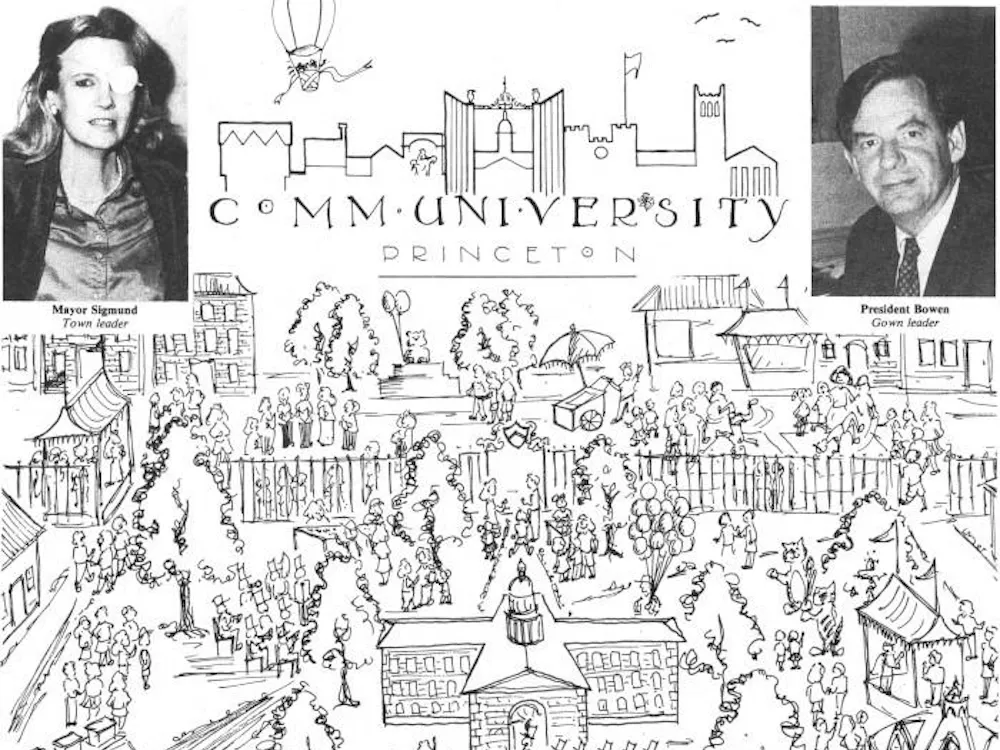
Isaac BarsoumFrom its inception in 1985, when it subsumed the Arts People Party — the Arts Council’s pre-existing festival — Communiversity always aimed to be more than just an arts festival. It was both a physical and symbolic coming-together of the University and the town in a celebration of all that we have in common and all that makes us different.
From its inception in 1985, when it subsumed the Arts People Party — the Arts Council’s pre-existing festival — Communiversity always aimed to be more than just an arts festival. It was both a physical and symbolic coming-together of the University and the town in a celebration of all that we have in common and all that makes us different.

Who rights our rules?
Charlie YaleWith fairness for students in mind, the University must require that all changes to RRR go through the Committee on Rights and Rules.
With fairness for students in mind, the University must require that all changes to RRR go through the Committee on Rights and Rules.
Freedom of speech is a right, not an excuse
Lily Halbert-AlexanderFreedom of speech should function to hold us to a high standard of honesty and transparency, not to excuse abuses of power and influence in the country’s most influential institutions.
Freedom of speech should function to hold us to a high standard of honesty and transparency, not to excuse abuses of power and influence in the country’s most influential institutions.